
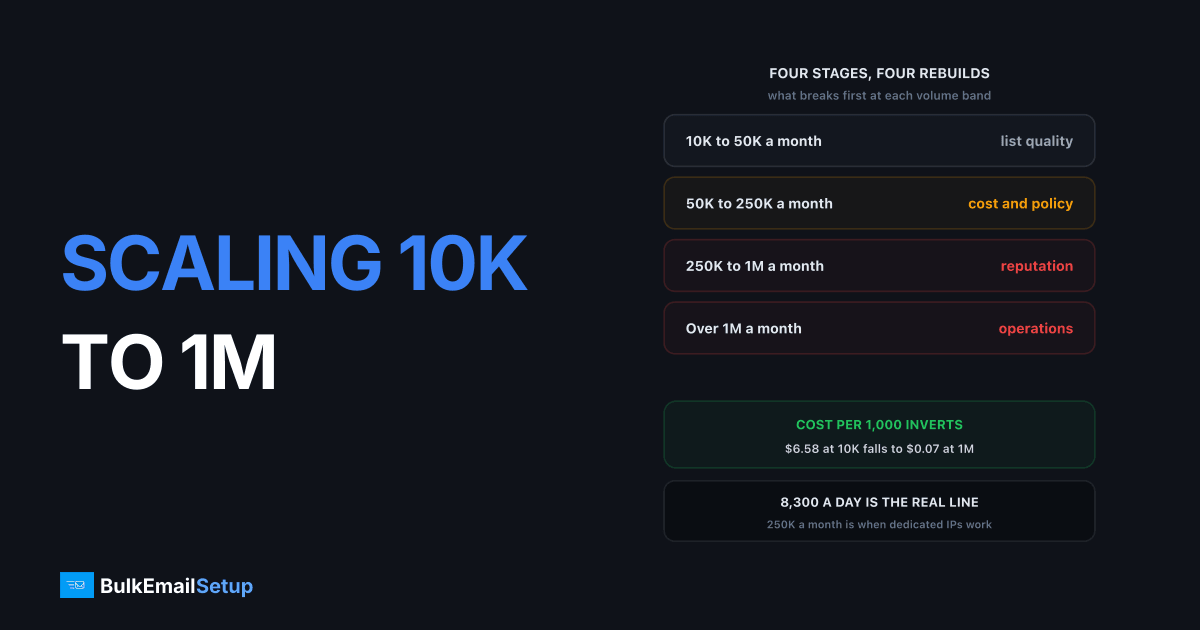
Scaling email volume from 10,000 to 1,000,000 a month is four stages, and each breaks something different. From 10K to 50K any relay works and list quality is your only constraint. From 50K to 250K the bill hurts and shared-pool policy risk appears. From 250K to 1M you need dedicated IPs, a 4 to 6 week warm-up, and bounce automation. Above 1M you need multiple IPs, separated streams, and a named deliverability owner. Most teams fail by treating this as one climb instead of four rebuilds.
The four stages of scaling email volume
Every row below is a different setup, not a bigger version of the last one.
| Stage | Monthly volume | Daily volume | Setup that fits | What breaks first |
|---|---|---|---|---|
| 1 | 10K to 50K | 350 to 1,700 | Any shared relay | List quality |
| 2 | 50K to 250K | 1,700 to 8,300 | Shared relay, watch the bill | Cost and provider policy |
| 3 | 250K to 1M | 8,300 to 33,000 | 1 to 3 dedicated IPs | Reputation and bounce handling |
| 4 | Over 1M | 33,000+ | 3 to 5 IPs, split streams | Operations and people |
The daily column decides your infrastructure, because Gmail, Yahoo and Microsoft judge you per IP per day, not per month. A sender doing 250,000 a month across four days is a stage 4 problem wearing a stage 3 label, since those days are 62,000 each.
Stage 1, 10K to 50K a month
The infrastructure question here is boring: use a shared relay and stop thinking about it. Brevo, SendGrid, Mailgun and Amazon SES all deliver fine at 30,000 a month. SES costs $3 to $5 at this volume, Brevo $25 to $45. A rounding error either way.
List quality is your constraint and stays your constraint the whole climb. At 10K a month a 2% bounce rate is 200 bad addresses nobody notices. The same hygiene at 500K is 10,000 hard bounces, which gets you throttled at Gmail and auto-paused on SES.
Three things pay off three stages later. Set up SPF, DKIM and DMARC now, an afternoon at 10K and a migration project at 500K. Validate addresses at the signup form, which beats any cleaning tool later. Register in Postmaster Tools and log your complaint rate monthly, since it needs history before it shows anything.
The mistake that kills stage 1 is buying dedicated infrastructure. At 30,000 a month a dedicated IP sends about 1,000 a day, too thin for Gmail to form a confident opinion, so you get throttled like a stranger indefinitely. Full argument in how many emails before you need dedicated infrastructure.
Stage 2, 50K to 250K a month
This is where the invoice starts to matter. At 100,000 a month SendGrid and Mailgun are around $90, Mailchimp $300 and Klaviyo $400, because the latter two bill on contacts rather than sends. Two new problems land here.
Policy risk. Your complaints now move the needle on a shared IP other customers use. SendGrid and Mailgun act at roughly 0.1%, well under Google's published 0.3% limit in the Gmail sender guidelines. A suspension at 200,000 a month pauses revenue for one to six weeks.
Bill shape. Per-email pricing was invisible at 30K and is a line item at 250K. The flat-rate crossover appears here, worked out in at what volume does a dedicated SMTP pay for itself.
The mistake that kills stage 2 is moving to dedicated too early. At 80,000 a month you send 2,600 a day. Split across two IPs, each does 1,300 a day, which starves both. If you move here, move to exactly one IP.
The quieter stage 2 mistake is hitting a volume target with frequency instead of list growth. Mailing 40,000 contacts weekly instead of monthly turns 40K into 160K a month with zero new consent. Volume looks great, complaints climb, and the list is smaller in six months.
Stage 3, 250K to 1M a month
At 250,000 a month you send roughly 8,300 a day, finally enough for a dedicated IP to hold its own reputation. This is the real transition, the only stage where the infrastructure genuinely changes. Three things become non-optional.
Dedicated IPs. One IP carries you to about 500K a month. Past that you want two or three so no single IP hits the throttle ceilings that produce 421 4.7.28 deferrals at Gmail. Sizing: how many IPs do I need for my volume.
A real warm-up. You cannot move 250,000 emails onto a fresh IP in week one. The schedule runs 4 to 6 weeks from a few hundred a day to full volume, and every boundary above this adds another cycle. Day by day in the IP warm-up schedule explained.
Bounce automation. At 30,000 a month you can eyeball the bounce report. At 500,000 a 1.5% bounce rate is 7,500 addresses. Unless those are suppressed automatically within the send cycle, you re-mail them next campaign and the rate compounds.
Skipping that automation because manual worked last quarter is the mistake that kills stage 3. It worked because the numbers were small. Manual suppression is the most common reason a well-warmed IP goes bad in month three.
Stage 4, over 1M a month
One million a month is 33,000 a day. At that point you stop having an email setup and start having email operations: three to five IPs, separated streams, and someone whose job description mentions deliverability.
Stream separation is the big one. Transactional mail (password resets, receipts, order confirmations) belongs on a different IP from marketing. A campaign that draws complaints should never delay a password reset. Keeping them together is the highest-consequence shortcut at this volume.
Even per-IP load and real monitoring. Splitting 33,000 a day across three IPs gives 11,000 each, inside what a warmed IP handles at Gmail. Letting the mailer pick an IP at random per message produces jagged patterns that reputation systems read as instability. Watch Postmaster Tools daily and check blocklists on every IP, because one blocklisting at 1M a month costs more per day than a year of tooling.
What changes at each stage across five dimensions
| Dimension | Stage 1 (10K-50K) | Stage 2 (50K-250K) | Stage 3 (250K-1M) | Stage 4 (1M+) |
|---|---|---|---|---|
| Infrastructure | Any shared relay | Shared relay, one provider | 1 to 3 dedicated IPs | 3 to 5 IPs, split streams |
| Cost model | Per email, trivial | Per email, noticeable | Flat rate wins | Flat rate wins by a lot |
| Deliverability | Auth records correct | Complaints under 0.1% | 4 to 6 week warm-up, per-IP reputation | Per-IP monitoring, seed testing |
| Tooling | Relay dashboard | Dashboard plus suppression list | Automated bounce and FBL processing | Delivery dashboard, blocklist alerts |
| People | Whoever runs marketing | Same person, 2 hrs/month | Named owner, 4 to 8 hrs/month | Deliverability owner, 8 to 15 hrs/month |
The row that surprises people is cost model. It doesn't get worse as you scale, it inverts.
How cost per 1,000 inverts as you climb
Flat-rate infrastructure is terrible at low volume and unbeatable at high volume. Per-email pricing is the mirror image. Below: a $549 one-time server plus $20 a month hosting, amortised over 12 months, against typical relay bills.
| Monthly volume | Dedicated server, per 1,000 | SendGrid, per 1,000 | Klaviyo, per 1,000 |
|---|---|---|---|
| 10,000 | $6.58 | ~$2.00 | ~$15.00 |
| 50,000 | $1.32 | ~$0.40 | ~$3.00 |
| 250,000 | $0.26 | ~$1.00 | ~$2.80 |
| 500,000 | $0.13 | ~$0.80 | ~$2.40 |
| 1,000,000 | $0.07 | ~$0.90 | ~$2.40 |
Read the first column top to bottom. It falls by a factor of 94 while the relay columns barely move, which is why the same server that's a bad buy at 10K is obvious at 500K. Amazon SES is the exception that stays cheap all the way up, at $0.10 per 1,000 on the SES pricing page, plus $24.95 a month per dedicated IP. SES wins on cash at every volume and loses on hours, because you own warm-up, bounce parsing and blocklist response.
The warm-up timeline at each boundary
Every boundary above 250K costs a warm-up cycle. Budget for it before the campaign calendar is set. You cannot compress it.
| Boundary you cross | Warm-up needed | What you're warming | Elapsed time |
|---|---|---|---|
| 250K, moving to dedicated | 4 to 6 weeks | First IP, 200/day to full volume | 6 weeks |
| 500K, adding a second IP | 3 to 4 weeks | New IP only, existing IP unaffected | 4 weeks |
| 1M, adding IPs three to five | 3 to 4 weeks, in parallel | All new IPs together | 5 weeks |
| Splitting transactional onto its own IP | 2 to 3 weeks | Low-volume, high-engagement stream | 3 weeks |
Transactional warms faster because receipts see 60% to 80% open rates against 15% to 25% for campaigns. Engagement is what warm-up measures.
The 12-month plan from 10K to 1M
For a team starting at 10,000 a month with a list growing 25% a month.
- Months 1 to 2 (10K to 20K). Stay on the relay. Fix SPF, DKIM, DMARC. Turn on signup validation and register in Postmaster Tools.
- Months 3 to 4 (20K to 60K). Still shared. Automate hard-bounce suppression while volume is small enough to test safely.
- Months 5 to 6 (60K to 150K). Cost review. Separate transactional from marketing in your sending code, even though both still go through the relay, so the IP split is trivial later.
- Month 7 (150K to 220K). Provision the dedicated server and first IP. Start warm-up while production mail still flows through the relay.
- Months 8 to 9 (220K to 400K). Warm-up completes. Cut marketing over in 25% increments across three weeks, relay kept as fallback.
- Months 10 to 11 (400K to 700K). Add IPs two and three, warmed in parallel. Move transactional onto its own IP. Wire up blocklist alerting.
- Month 12 (700K to 1M). Add remaining IPs for headroom. Name the deliverability owner. Move to weekly monitoring and quarterly seed testing.
The infrastructure work is about 12 weeks of that year. The rest is list growth, the real bottleneck and the part no vendor can sell you.
The stage-check quiz
Four questions place you. Answer yes to three or more and you're at stage 3 or above.
- Is your busiest day over 8,000 emails, not your average day?
- Do you send on 15 or more days a month?
- Does automation suppress hard bounces every cycle, rather than a person sometimes?
- Does a named person own deliverability?
If your busiest day is over 8,000 and nobody owns deliverability, close that gap before buying anything: infrastructure without an owner degrades faster than a shared pool you ignore. The other failure is staying too long. A team at 600,000 a month on Klaviyo pays about $1,400 a month for sends that cost $60 on SES, which is $16,800 a year of billing model, not deliverability.
How BulkEmailSetup helps
We build the stage 3 and stage 4 setup: your own server, your own IPs, SPF, DKIM, DMARC and PTR configured, MTA tuned, bounce handling automated, and the 4 to 6 week warm-up run properly so the IPs earn their ceilings. No per-email meter, so cost per 1,000 keeps falling as volume climbs.
Basic is $549 one-time and covers 1 SMTP server, 3 dedicated IPs, 25,000 emails/day and unlimited contacts, which carries you to about 750,000 a month. Higher tiers scale to 15 IPs and 200,000 emails/day for anyone past 1M. See pricing and pick the tier matching the stage you'll be in twelve months from now, not today.
Frequently asked questions
How long does it take to scale from 10,000 to 1,000,000 emails a month?
Twelve to eighteen months if your list grows honestly. The infrastructure work is only about 12 weeks of it: 4 to 6 weeks of IP warm-up crossing into 250K, and another 4 to 6 weeks adding IPs above 750K. The rest is spent growing the list, because sending volume can only grow as fast as the number of people who asked to hear from you.
At what volume do I need to stop using a shared relay?
Around 250,000 emails a month. Below that a warm shared pool at SendGrid, Mailgun or Brevo delivers better than a dedicated IP because it borrows established reputation. Above 250K you send enough daily volume (roughly 8,000 a day) for a dedicated IP to hold its own reputation, and the per-email bill starts beating the flat cost of a server.
What is the biggest mistake when scaling email volume?
Scaling send volume faster than the list grows. Teams hit a revenue target by mailing the same 40,000 contacts four times a week instead of once, which quadruples volume with zero new consent. Complaint rates climb past Gmail's 0.3% limit within two or three campaigns and the whole program stalls, no matter what infrastructure sits underneath.
How many IPs do I need to send 1 million emails a month?
Three to five. One million a month is roughly 33,000 a day, and a warmed dedicated IP comfortably carries 10,000 to 20,000 a day at Gmail without hitting 421 4.7.28 throttling. Three IPs cover the base load and the extra one or two give you headroom for peak days and let you keep transactional mail on its own IP.
Does cost per 1,000 emails go up or down as I scale?
It falls sharply on flat-rate infrastructure and stays roughly flat on a per-email relay. At 10,000 a month a $549 server works out around $6.58 per 1,000 in year one, which is terrible. At 1,000,000 a month the same server is about $0.07 per 1,000, cheaper than Amazon SES at $0.10 per 1,000.
Do I need to hire someone to send a million emails a month?
Not a full-time hire, but you need one named owner. Below 250,000 a month deliverability is a 2 hour a month task for whoever runs marketing. Above 750,000 it becomes 8 to 15 hours a month of bounce triage, blocklist checks and Postmaster Tools reading, which is a real slice of one person's job rather than a side task.


