
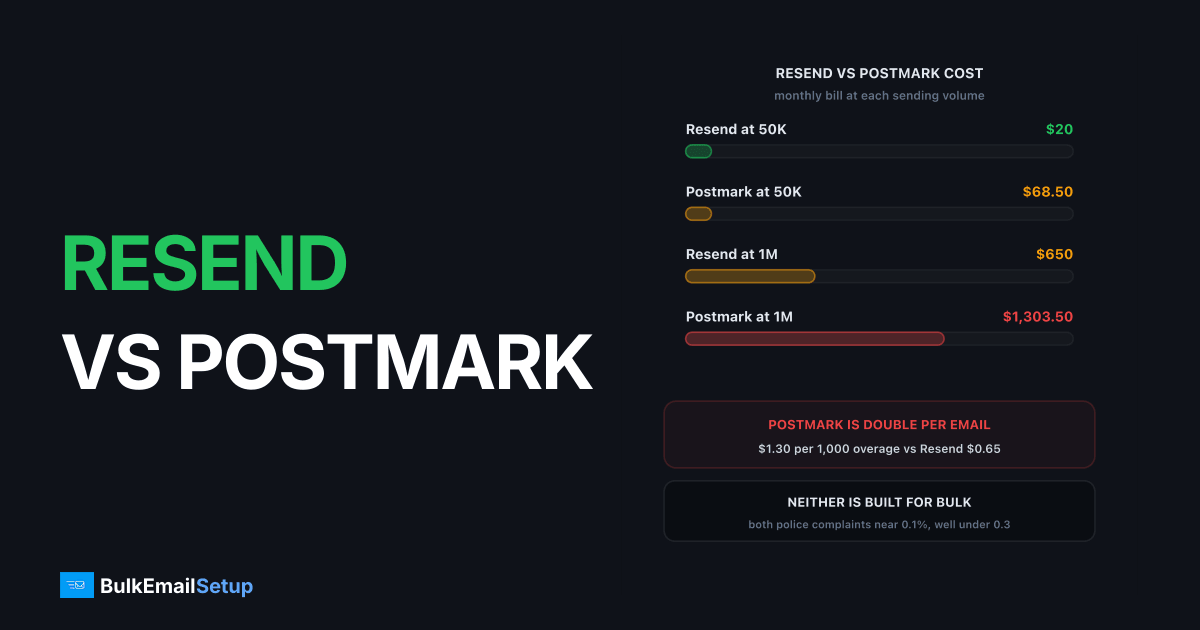
Neither Resend nor Postmark is built for bulk. Postmark is a premium transactional service that runs about $1,303 a month at 1,000,000 emails and requires 300,000 a month before it will sell you a dedicated IP. Resend is roughly half the price at $650 for the same volume and cheaper still per email, but it is younger and its marketing product prices by contacts, not sends. If the question is which one to push a million marketing emails through, the honest answer is neither, and the reason is the same at both: shared transactional pools police complaint rates far tighter than Gmail does.
I have run production mail through both. They are good tools. They are just tools built for a different job than the one people ask them to do.
What each one actually is
Both are developer-first, API-first, and openly transactional in their positioning. The difference is age and philosophy.
| Factor | Resend | Postmark |
|---|---|---|
| Launched | 2023, young | 2010, mature |
| Core pitch | Developer experience, React Email | Fast transactional delivery, strict policing |
| Free tier | 3,000/mo, 100/day cap | 100/mo, no overage allowed |
| Marketing product | Separate, priced by contacts | Broadcast message stream |
| Stream separation | Product-level split | Enforced at the stream level |
| Dedicated IP | $30/mo, needs 3,000/day | From $50/mo, needs 300,000/mo |
| Log retention | 30 days on free, longer on paid | 45 days default, up to 365 on Pro |
Postmark's whole reputation rests on being unfashionably strict. It has spent fifteen years refusing mail that would dent its pools. Resend is the newer, friendlier version of the same idea, with better ergonomics and a shorter enforcement history.
What do they cost at 50K, 500K and 1M?
Resend wins on price at every volume, and the gap widens as you scale.
Both vendors publish their numbers, so this is arithmetic, not estimation. Postmark's plans include 10,000 emails and then charge overage per 1,000. Resend sells bundled volume tiers.
| Monthly volume | Resend | Postmark (Pro) | Difference |
|---|---|---|---|
| 50,000 | $20 (Pro plan) | $16.50 + $52 overage = $68.50 | Resend saves $48.50 |
| 500,000 | $350 (Scale) | $16.50 + $637 = $653.50 | Resend saves $303.50 |
| 1,000,000 | $650 (Scale) | $16.50 + $1,287 = $1,303.50 | Resend saves $653.50 |
Postmark's Platform tier drops overage to $1.20 per 1,000, which brings 1M to about $1,206. Still nearly double Resend. Check both directly, since tiers move: Resend pricing and Postmark pricing.
Per-email, Resend's Scale tier at 1M works out to $0.65 per 1,000. Postmark Pro sits at $1.30 per 1,000 in overage, exactly double. That premium is real money at volume, and Postmark is not shy about what it buys: human support that answers fast, message streams that cannot contaminate each other, and a pool policed hard enough that your receipts land.
For a wider price picture across the market, we keep a running table in cost per 1000 emails, every provider.
The policy difference on bulk and marketing mail
This is where the two genuinely diverge, and it matters more than price.
Postmark splits your account into Message Streams. Transactional mail goes on one, broadcast on another, and they run on separate infrastructure so a marketing campaign that draws complaints cannot drag down the IP carrying your password resets. Postmark enforces the split. Send marketing on your transactional stream and you get a message asking you to move it.
Resend runs a separate marketing product priced by contact count rather than by send: $40 a month at 5,000 contacts, scaling to $650 at 150,000 contacts, with the transactional side billed by volume. Same intent, softer edges.
| Policy area | Resend | Postmark |
|---|---|---|
| Marketing mail | Allowed on the marketing product | Allowed on Broadcast streams only |
| Stream enforcement | Product-level, lighter touch | Active, they will contact you |
| Cold outreach | Banned | Banned |
| Purchased lists | Banned | Banned |
| Affiliate offers | Case by case | Effectively no |
| Enforcement track record | Short, since 2023 | Fifteen years, consistent |
Neither will take cold email. Neither will take a purchased list. That is not a gap in their products, it is the deal on shared infrastructure: your complaint rate lands on IPs their other customers depend on, so their tolerance has to sit below the receiving networks'.
Google's published bulk sender rules put the hard complaint ceiling at 0.3% and the target at 0.1%, per the Gmail sender guidelines. Both Resend and Postmark act well before 0.3%, because by the time Gmail reacts, the damage is already on a pool.
Features head to head
Roughly comparable on the fundamentals, different in flavour.
| Feature | Resend | Postmark |
|---|---|---|
| Templating | React Email, first-class | Handlebars-style templates + API |
| Webhooks | Delivery, bounce, complaint, open, click | Same set, plus stream-tagged |
| Inbound parsing | Yes | Yes, long-established |
| SMTP endpoint | Yes, alongside the API | Yes, alongside the API |
| Suppression handling | Automatic | Automatic, per stream |
| Message search window | 30 days free, longer paid | 45 days, extendable to 365 |
| Support speed | Good, async | Fast human replies, its selling point |
Resend's React Email integration is the genuine differentiator for a React shop. Writing templates as components, previewing them in the same tooling as your app, is a real workflow gain rather than a marketing bullet. Postmark's answer is fifteen years of templates that work and a support team that replies in minutes.
The retention difference bites in support work. When a customer says "I never got the invoice" six months ago, Postmark Pro can still show you the event. Resend's shorter default window cannot.
What happens when you push marketing volume through either
The failure runs in a predictable order, and I have watched it three times.
- Week one. Volume triples. Delivery still looks fine, opens look fine.
- Week two. Complaint rate crosses roughly 0.1%. Nothing visible yet.
- Week three. An automated review lands. Sending throttled or paused pending a reply.
- Week four. Transactional mail on the same reputation starts deferring. Support tickets about missing password resets.
Step four is the whole reason both vendors separate streams. On a transactional-first provider, the marketing mail is not the thing that breaks. The receipts are.
If your list is clean, opt-in, and engaged, you can run marketing through either for a long time without trouble. The trouble arrives with the segment you have not mailed in eighteen months, the re-engagement blast, or the list you inherited from an acquisition. That is the send that trips the review.
Send this here, not there
Match the mail type to the right home rather than forcing everything down one pipe.
| Mail type | Best home | Why |
|---|---|---|
| Password resets, receipts, alerts | Postmark | Speed and strict pool policing |
| App notifications at volume | Resend | Half the per-email cost, same job |
| Opt-in newsletter under 50K contacts | Resend marketing or Postmark Broadcast | Contact-priced or stream-isolated |
| Product digests, 500K+/month | Own server or Resend Scale | Overage is the dominant line item |
| Marketing at 1M+/month | Dedicated SMTP server | Flat cost, your own IPs |
| Cold outreach, purchased lists | Neither, and not any shared pool | Policy and law both apply |
That last row is not a technical limitation you can route around. Cold outreach needs consent rules met under CAN-SPAM or GDPR wherever your recipients are, and no infrastructure changes that.
Where a dedicated server takes over
The crossover sits between 300,000 and 500,000 emails a month, and it is the same threshold at which both providers will finally sell you a dedicated IP.
The signal is simple. Postmark wants 300,000 a month before it hands over a dedicated IP at $50. Resend wants 3,000 a day, about 90,000 a month, at $30. Both of those floors exist because a dedicated IP below that volume never accumulates enough sending history to build reputation, so it sits cold and delivers worse than the shared pool would have.
Once you are past those floors, you are paying a per-email rate for infrastructure you have proved you can support. At 1M a month, Postmark Pro's $1,303 buys you a shared abstraction plus one dedicated IP add-on. A dedicated server at that volume is a flat cost, gives you multiple IPs to split streams across, root MTA access, your own PTR record, and raw logs when something defers.
The trade is real work. You own warm-up, blocklist monitoring, and authentication. If you want that comparison in detail from each side, we wrote Resend vs a dedicated SMTP server and Postmark vs a dedicated SMTP server. If Postmark's price is the specific thing pushing you, Postmark alternatives covers the like-for-like swaps first.
The honest verdict
Pick Postmark if transactional mail is business-critical, volume sits under about 200,000 a month, and you want someone to answer the phone. The premium is defensible at that scale, because $68.50 at 50,000 emails is not a budget line anyone argues about, and the stream isolation is the best in the category.
Pick Resend if you are a React shop, if per-email cost matters, or if you are sending high-volume product email that is technically transactional. At half Postmark's rate it is the better economic choice at every tier above 50,000.
Pick neither for actual bulk marketing. Both will take opt-in newsletter traffic on the right stream, and both will eventually review you if the list quality slips. At 500,000-plus a month of marketing mail, you are paying transactional prices for infrastructure you do not control, on a pool whose rules were written for other people's receipts.
How BulkEmailSetup helps
We build dedicated SMTP infrastructure you own: your own server, your own IPs, full SPF, DKIM, DMARC and PTR configuration, MTA tuning, bounce handling and a warm-up plan. Because the IPs are yours alone, there is no shared pool to protect, no stream policy to satisfy, and no per-email meter running as volume grows.
Basic starts at $549 one-time, covering 1 SMTP server, 3 dedicated IPs, 25,000 emails/day and unlimited contacts. Higher tiers scale to 15 IPs and 200,000 emails/day. See pricing for the full range.
Frequently asked questions
Is Resend or Postmark cheaper for bulk email?
Resend, by a wide margin. At 1,000,000 emails a month Resend's Scale plan is $650 flat, while Postmark's Pro plan works out to roughly $1,303 after 990,000 emails of overage at $1.30 per 1,000. At 500,000 the gap is $350 versus about $653. Postmark's price buys support and stream isolation, not volume.
Can I send marketing email through Postmark?
Yes, but only on a Broadcast message stream, kept separate from your transactional stream. Postmark polices the split and will ask you to move mail that lands on the wrong stream. It is not a bulk marketing platform and it does not want cold outreach or purchased lists at any volume.
Does Resend allow bulk marketing sends?
Resend has a separate marketing product priced by contacts rather than emails, from $40 a month for 5,000 contacts up to $650 for 150,000. It permits opt-in marketing but bans cold outreach and purchased lists like every shared pool does. It is younger than Postmark, so its enforcement history is shorter.
Do Resend and Postmark offer dedicated IPs?
Both do, with different gates. Resend charges $30 a month per IP on Scale plans and asks for at least 3,000 emails a day. Postmark charges from $50 a month per IP and requires roughly 300,000 emails a month. Below those floors a dedicated IP hurts you, because low volume never builds reputation.
How long do Resend and Postmark keep my email logs?
Postmark keeps 45 days by default on Basic, and Pro and Platform let you extend retention up to 365 days. Resend's free tier keeps 30 days of data, with longer windows on paid plans. If you need a year of message history for support or compliance, Postmark's paid tiers handle it natively.
What happens if I push marketing volume through a transactional provider?
Three things, in order. Your complaint rate rises above the roughly 0.1% these providers police for, a review lands on the account, and the transactional mail sharing that reputation starts deferring. Password resets arriving late is the actual cost, and it is why both vendors separate the streams.
At what volume should I stop using either and run my own server?
Around 300,000 to 500,000 emails a month of steady sending. That is where Postmark's overage passes $400 a month, where Resend's Scale tiers stop being trivial, and where you would already qualify for a dedicated IP add-on at both. At that point a flat-cost dedicated server with your own IPs is usually cheaper and gives you the MTA access neither provider offers.


