
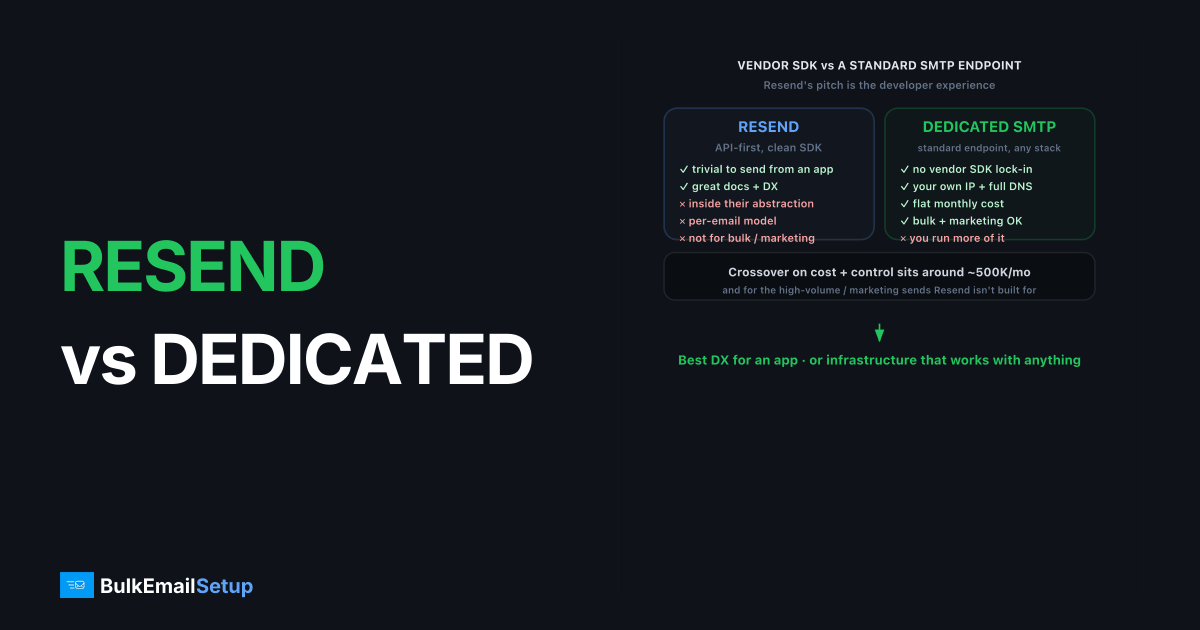
Resend is the better choice for developers who want a clean API and fast transactional sending at low to moderate volume; a dedicated SMTP server wins on cost-per-email, IP control, and high-volume or marketing sends Resend isn't built for. Resend abstracts infrastructure behind a developer-friendly API and bills per email. A dedicated SMTP server gives you a standard SMTP endpoint, your own IP, full DNS access, and a flat monthly cost that works with any stack, no vendor SDK required.
What is Resend and why do developers like it?
Resend is an API-first email service for developers, focused on transactional and product email with a clean SDK and good docs. It bills by monthly email volume with a free tier for testing. As of early 2026, dedicated IPs are available on higher-volume plans.
The developer experience is the whole pitch. Resend makes sending email from an app feel trivial. The trade-off is that you're inside their abstraction and per-email model, not running your own infrastructure.
How do Resend and a dedicated SMTP server compare?
| Factor | Resend | Dedicated SMTP server |
|---|---|---|
| Price model | Per-email tiers | Flat monthly |
| Interface | API / SDK first | Standard SMTP (any stack) |
| Best for | Transactional, dev teams | High volume, full control |
| Marketing / cold email | Discouraged | Allowed, you control policy |
| Dedicated IP | Higher tiers | Included, you control it |
| Setup effort | Minutes | Hours to days (or managed) |
| Deliverability control | Provider-managed | Full: IP, warm-up, DNS, MTA |
Figures are directional as of early 2026. Confirm current tiers on the Resend pricing page.
Does a standard SMTP endpoint still matter for developers?
Yes, more than vendor SDKs suggest. A standard SMTP endpoint works with any language, framework, or off-the-shelf app, no library lock-in. Django, Laravel, Rails, WordPress, or a legacy system all speak SMTP on ports 587 or 465. We cover framework setup in SMTP for Django, Laravel, and Rails apps.
That portability matters when you switch providers or run mixed workloads. An API ties you to one vendor's shape; SMTP doesn't. A dedicated server gives you both the endpoint and the IP behind it.
When does a dedicated server win for a dev team?
It wins on cost and control at volume. Per-email pricing is cheap at 100K/month and expensive at 1M+/month, because the bill scales with each send while a dedicated server stays flat. We compare options in cheapest SMTP for transactional email.
Control is the other half. On a dedicated server you set SPF, DKIM, and DMARC, the PTR record, isolate transactional from marketing streams, and run your own warm-up. Deliverability still depends on clean sending, not the API.
What does the cost look like at volume?
Resend's per-email model is cheap and developer-friendly at the volumes most apps actually send. But per-email scales with each message while a flat dedicated plan holds, so the crossover arrives as your app grows. Here's a directional comparison as of early 2026.
| Monthly volume | Resend (per-email) | Dedicated SMTP server (flat) |
|---|---|---|
| 100K | Cheap, great DX | Flat plan, likely more per email |
| 500K | Competitive | Roughly break-even territory |
| 1M | Notable line item | Flat plan usually cheaper per email |
| 5M+ | Largest cost driver | Flat plan, clearly cheaper per email |
For a product that sends mostly transactional email, Resend often stays the better deal because most apps never reach the crossover. The math flips when you add high-volume marketing, product digests, or notifications that push monthly sends into the millions. We compare options in cheapest SMTP for transactional email.
Where is Resend the better choice?
Resend wins on developer experience for transactional and product email. The clean SDK, good docs, and modern API make sending from an app trivial, and for a team that values shipping speed over infrastructure ownership, that's worth real money. At low to moderate transactional volume, it's an easy yes.
It's also a strong pick when you want sending handled and don't want to think about IPs or warm-up. Resend manages reputation behind the abstraction, so a small team without an email engineer gets reliable delivery without operating anything. For a startup focused on the product, not the mail stack, that hands-off model fits well until volume or marketing needs change.
Where does a dedicated SMTP server win?
A dedicated SMTP server wins on cost at volume, on IP control, and on sends Resend isn't built for. Cold outreach and large marketing campaigns sit outside Resend's transactional focus, and a standard SMTP endpoint works with any language or off-the-shelf app without a vendor SDK. Django, Laravel, Rails, and legacy systems all speak SMTP natively. We cover that in SMTP for Django, Laravel, and Rails apps.
Control is the other win. You own the IP, isolate transactional from marketing streams, run your own warm-up, and read raw SMTP responses when something defers. An API ties you to one vendor's shape and policy; SMTP keeps you portable. For a team that wants to own deliverability as engineering, the dedicated server gives both the endpoint and the IP behind it.
How do you migrate from Resend to a dedicated server?
Migration is DNS plus warm-up, and for many apps it's simpler than a Resend integration because SMTP needs no SDK. Point your mailer at the new host, port 587 or 465, and credentials. The careful part is reputation: a fresh dedicated IP starts cold and warms over four to six weeks.
Stage the move. Stand up the server with SPF, DKIM, DMARC, and PTR verified. Keep time-critical transactional mail on Resend while you ramp marketing and bulk on the new IP using a warm-up schedule. Shift the rest once placement holds. Many teams keep Resend for critical transactional sends and run their own server for everything high-volume, which is a sensible split.
Who should pick which?
| Your situation | Better pick |
|---|---|
| Transactional, dev-team app | Resend |
| Value SDK and developer experience | Resend |
| Low to moderate volume | Resend |
| Cold email or bulk marketing | Dedicated SMTP server |
| High volume past 1M/month | Dedicated SMTP server |
| Need framework-agnostic SMTP | Dedicated SMTP server |
| Need multiple isolated IPs | Dedicated SMTP server |
What deliverability rules carry over no matter which you pick?
Leaving Resend doesn't change what receivers demand. Gmail and Yahoo's bulk sender rules (5,000+ recipients a day) require SPF, DKIM, and DMARC all passing, one-click unsubscribe per RFC 8058, TLS, valid PTR or reverse DNS, and a spam complaint rate under 0.3%, ideally under 0.1%. Resend manages much of this behind its API; on a dedicated server you own each record. Neither path lets you skip the thresholds.
The records carry technical floors worth knowing. Your DKIM key should be 2048-bit, with 1024 the weak minimum. Your SPF must resolve in 10 DNS lookups or fewer, or receivers return a PermError and fail the check. DMARC steps through none, quarantine, then reject as your authentication proves stable. These gate inbox placement whether you send over an API or raw SMTP.
What goes wrong when developers switch badly?
The classic mistake is cutting all traffic to a cold IP at once. A new dedicated IP that suddenly pushes high volume looks like a spam cannon to Gmail, which replies with a 421 4.7.28 rate limit or a soft block to the spam folder. The fix is patience: ramp from roughly 50 to 100 a day and double every few days while watching placement.
The second mistake is assuming SMTP is harder than the API and over-engineering the move. It isn't. Most mailers, in any language, take a host, port (587 or 465), username, and password, and you're sending. The real work is reputation, not integration. Clean the list, suppress hard bounces, isolate transactional from marketing streams, and let your most engaged contacts lead the warm-up. A switch is the worst moment to skip list hygiene.
In practice, the dev teams we onboard spend about an hour swapping their mailer config and then weeks watching the warm-up. The pattern we see most often is a team that ports the Resend integration cleanly, then sends day one at 20K because the app was already doing that volume, and the cold IP draws a wall of 421 4.7.28 deferrals from Gmail by mid-morning. The code was never the risk, the ramp curve was.
How much volume justifies leaving Resend?
For mostly transactional sending, the honest answer is often not yet. Resend's developer experience is worth its per-email rate, and many apps never reach a cost crossover on transactional mail alone. The trigger is usually adding sends Resend isn't built for, like bulk marketing or cold outreach, or watching per-email cost climb as monthly volume passes a million.
When that happens, consistency rules the move. A dedicated IP needs steady volume to stay warm, with a rough floor near 50K a month. There's a staffing factor too: a dedicated server's controls only help if someone will read logs, tune warm-up, and manage DNS, though for a dev team that's usually a comfortable fit. Many teams reach a sensible split, keeping Resend for critical transactional sends while running their own server for high-volume traffic. If you're weighing the line, how many emails before you need dedicated infrastructure covers the signals.
How BulkEmailSetup helps
If Resend's per-email model or transactional focus no longer fits your sending, a dedicated SMTP server gives you a standard endpoint, your own IP, and a flat rate. We provision clean dedicated IPs, configure authentication, and run the warm-up so your app sends at scale on infrastructure you control. See plans on our pricing page.
Frequently asked questions
Is Resend cheaper than a dedicated SMTP server?
For low to moderate transactional volume, Resend's free tier and per-email pricing are cheap and developer-friendly. At consistent high volume, a flat-rate dedicated SMTP server usually costs less per email because the bill no longer scales with each message.
Does Resend offer a dedicated IP?
Resend offers dedicated IPs on higher-volume plans. A dedicated SMTP server includes the IP plus full SMTP and DNS control, so you own warm-up, PTR, and reputation directly instead of through an API abstraction.
Can I use Resend for bulk marketing or cold email?
Resend is built for transactional and product email with a clean developer API, and it polices abuse to protect deliverability. For high-volume marketing or cold outreach, a dedicated SMTP server you control is a better fit than an API-first transactional service.
When should developers choose a dedicated SMTP server over Resend?
Choose a dedicated server when per-email cost dominates, when you need multiple isolated IPs, or when you want full MTA and authentication control. A standard SMTP endpoint also works with any language or framework without a vendor SDK.


