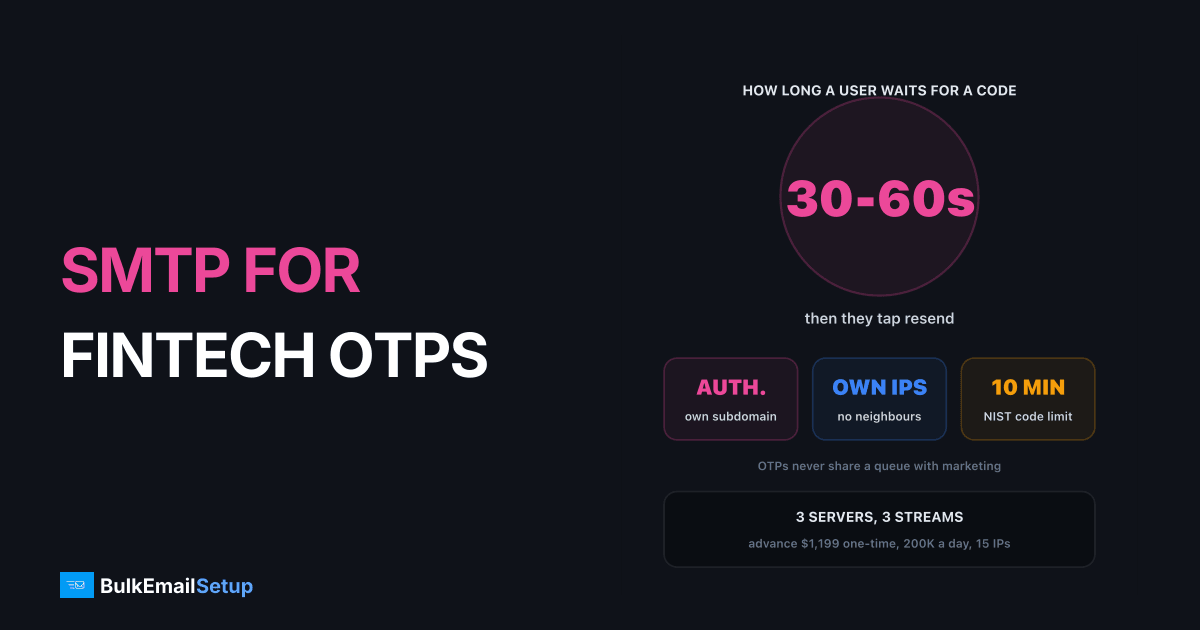
An OTP email service for fintech has seconds, not minutes, to land a code: users start tapping resend after about 30 to 60 seconds, so codes need their own fast lane. That means a separate subdomain and queue for OTPs and security alerts, dedicated IPs once volume is steady, and DMARC at p=reject. The rules that matter are PCI DSS (no full card numbers in email), NIST SP 800-63B (email is not an accepted out-of-band authenticator) and Gmail's sender requirements. Marketing mail never shares the OTP stream.
How fast an OTP has to land
Targets, not law: past 30 to 60 seconds users hit resend
| Moment | Target | What breaks it |
|---|---|---|
| App hands the code to SMTP | under 1 second | OTP stuck behind a campaign in the same queue |
| Inbox provider accepts it | a few seconds | 421 deferrals from a cold or shared IP |
| User sees it | under 30 seconds | spam folder, Promotions tab |
| Code expires | 5 to 10 minutes | too short: users fail; too long: weaker security |
NIST treats an out-of-band authentication as invalid if not completed within 10 minutes, which is why so many fintechs pick that as the upper bound. Every resend doubles the mail volume for that login and makes the next one more likely to be throttled, so speed is a cost issue as well as a user issue.
How an OTP email service for fintech splits the streams
The most important design choice is that login codes never share a queue, an IP or a sending subdomain with marketing.
One bad campaign should never delay a login code
| Stream | Example subdomain | IPs | Priority |
|---|---|---|---|
| OTPs and security alerts | auth.yourdomain.com | dedicated, smallest pool | highest, never queued behind others |
| Account alerts and statements | notify.yourdomain.com | dedicated | high |
| Marketing and product news | news.yourdomain.com | separate pool | normal, paced for warm-up |
Each subdomain gets its own DKIM key and aligned SPF. Gmail and Microsoft score them separately enough that a complaint spike on news.yourdomain.com does not drag down auth.yourdomain.com. Our post on SMTP for SaaS transactional email covers the same split for non-financial apps.
Dedicated IP or shared pool?
| Monthly OTP and alert volume | Better choice | Why |
|---|---|---|
| Under about 30,000 a month | reputable transactional provider, shared pool | too little traffic to keep an IP warm |
| Steady, 1,000+ a day to each big inbox provider | dedicated IPs | no neighbours, predictable speed |
| Spiky (launches, salary days) | dedicated IPs warmed above the peak | spikes on a cold IP get deferred |
The rule of thumb comes from AWS: once warm, a dedicated IP should keep sending around 1,000 emails a day to each provider you care about, or its reputation fades. Most fintech apps with a real user base clear that easily on OTPs alone.
The rules that apply
Five checks before an OTP email goes live
- PCI DSS. Card numbers sent by end-user messaging must be protected with strong cryptography. The simple rule: never put a full card number in an email. Show the last four digits at most.
- NIST SP 800-63B. Email does not prove possession of a device, so the NIST guidance says it shall not be used for out-of-band authentication. Use email codes for low-risk checks, account recovery and alerts, and an app or hardware key for the main second factor.
- Gmail and Yahoo sender rules. SPF, DKIM and DMARC for every sender, with stricter rules at 5,000 or more a day. See Google's sender guidelines.
- DMARC at p=reject. Financial brands are the most spoofed senders. Reject stops look-alike phishing using your exact domain. Our DMARC policy guide explains how to get there safely.
- Local privacy law. GDPR, UK GDPR or US financial privacy rules govern the data inside the alert, even when no marketing consent is needed.
What a fintech sending setup costs
Example: 200,000 active users, each getting about 6 OTPs and alerts a month, so 1.2 million emails a month, or about 40,000 a day.
| Option | Monthly cost | Notes |
|---|---|---|
| Amazon SES | about $120 + $24.95 per dedicated IP | 3 IPs adds about $75 |
| Transactional ESP with dedicated IP | several hundred dollars and up | priced by volume tier |
| Own dedicated server, Advance | about $49 hosting | $1,199 one-time, 200,000 a day |
The own-server route has the most headroom: 200,000 a day covers salary-day spikes of five times the average. Whatever you pick, budget for monitoring. A missed OTP shows up as failed logins and support tickets long before anyone checks a delivery dashboard. Compare more options in cheapest SMTP for transactional email.
How BulkEmailSetup helps
We set up dedicated SMTP infrastructure you own, built to split streams: separate sending subdomains and IP pools for OTPs, alerts and marketing, with SPF, DKIM, DMARC and PTR on each, bounce handling, and automatic IP warm-up on Advance and Custom.
| Plan | One-time fee | Emails per day | SMTP servers | IPs | Hosting you pay your host |
|---|---|---|---|---|---|
| Advance | $1,199 | 200,000 | 3 | 15 | about $49 a month |
| Custom | $2,997 | 1,000,000 | 12 | 60 | about $170 a month |
Three servers on Advance map neatly to three streams. No monthly fee to us and no per-email bill. See the Advance plan or compare all pricing.
Frequently asked questions
How fast must OTP emails arrive?
No law sets a delivery time, but users start tapping resend after about 30 to 60 seconds, so aim for the inbox provider to accept the message within a few seconds. NIST's guidance for out-of-band codes treats an authentication as invalid if not completed within 10 minutes, and many fintechs expire email codes between 5 and 10 minutes.
Should fintech OTP email use a dedicated IP?
Yes, once volume is steady. A dedicated IP means no other sender's campaign can slow your codes. The catch is that an IP needs regular traffic to keep its reputation. Amazon SES suggests around 1,000 emails a day to each major inbox provider per dedicated IP. Below that, a reputable transactional provider's shared pool is often safer.
What compliance rules apply to fintech email?
Never put a full card number in an email: PCI DSS requires card numbers sent by end-user messaging to be protected with strong cryptography. NIST SP 800-63B does not accept email as an out-of-band authenticator, so email codes suit low-risk checks and recovery, not your main second factor. Add DMARC at p=reject, TLS on every hop, and any local financial privacy law.
What email setup do fintech apps use?
Separate streams. OTPs and security alerts go from their own subdomain, such as auth.yourdomain.com, through a high-priority queue and dedicated IPs. Account statements and alerts use a second stream, and marketing a third. Each stream has its own SPF, DKIM and DMARC alignment, so a marketing complaint spike never touches login codes. BulkEmailSetup's Advance plan sets up 3 servers and 15 dedicated IPs for $1,199 one-time, enough to split the streams.
Can I send OTPs and marketing email from the same domain?
You can, but you should not. If a campaign draws complaints, Gmail and Microsoft lower the reputation of that domain and its IPs, and your next login codes arrive late or in spam. Use subdomains for each stream and keep marketing on separate IPs. It costs almost nothing and removes the risk.
Do OTP emails need an unsubscribe link?
No. OTPs, security alerts and account notices are transactional, so marketing consent and unsubscribe rules do not apply to them, and Gmail's one-click unsubscribe rule targets marketing mail. Keep them strictly transactional though. Adding a promotion to an OTP email turns it into marketing in the eyes of both regulators and spam filters.