
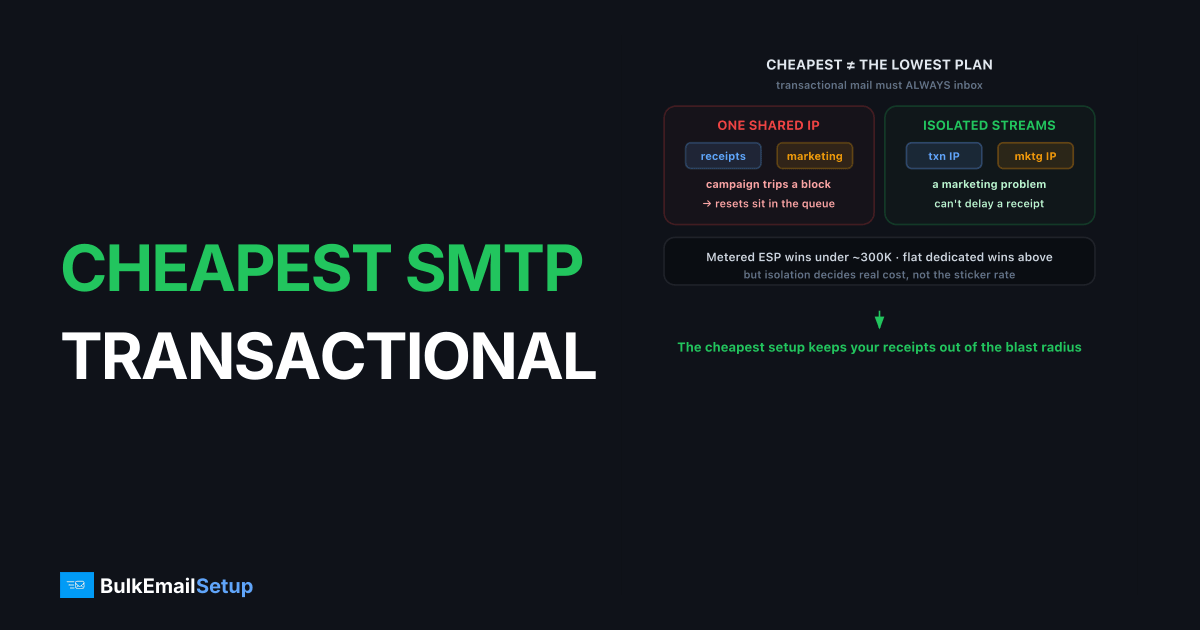
The cheapest SMTP for transactional email depends almost entirely on volume. Below a few hundred thousand sends a month, metered ESPs with free or pay-as-you-go tiers win, often under $0.001 per email. Above roughly 300K to 500K transactional emails monthly, a flat-rate dedicated SMTP server becomes cheaper, because its cost stops scaling with every send. But transactional mail has a second rule: it must always inbox, so the cheapest option that also isolates it from marketing usually wins on real cost.
What makes transactional email pricing different?
Transactional email pricing differs because the cost of failure is high. A delayed password reset or a missing receipt isn't a soft metric, it's a support ticket and a churned user. So the "cheapest" transactional SMTP isn't simply the lowest per-email rate, it's the lowest rate that still keeps critical mail reliably in the inbox.
That changes the math. For marketing, a 2% deferral barely registers. For transactional, every deferred message is a user staring at a login screen. This is why transactional streams justify a dedicated IP earlier than marketing volume alone would suggest, you're buying reliability, not just throughput.
The cheapest transactional setup at scale isn't the cheapest plan, it's the one that prevents your marketing blast from throttling your receipts. Co-mingling the two on one shared pool is a hidden cost that only shows up the day a campaign mistake delays your sign-up emails.
What does transactional SMTP cost at different volumes?
Transactional SMTP costs roughly $0 to $50/month at small volume on metered tiers, rising to $600 to $1,200+ per month at a million emails on per-email ESP pricing (typical rates, early 2026). A flat dedicated SMTP plan holds steady across that range, so its per-email cost falls as you grow.
| Monthly transactional volume | Metered ESP (typical) | Flat dedicated SMTP |
|---|---|---|
| 10K - 50K | free to ~$30 | flat plan (may be overkill) |
| 100K | $50 - $120 | flat plan, competitive |
| 500K | $300 - $600 | flat plan, usually cheaper |
| 1M+ | $600 - $1,200+ | flat plan, clearly cheaper |
The crossover sits where your linear ESP bill passes the flat plan price, commonly between 300K and 500K transactional sends a month. We break the per-email side down further in cost per email - dedicated SMTP vs ESP.
Why isolate transactional email at volume?
Isolate transactional email because it has different deliverability needs than marketing, and mixing them on one IP means a marketing problem becomes a transactional outage. A dedicated IP for transactional mail keeps password resets and receipts flowing even when a campaign trips a complaint spike or a temporary block.
We've seen a marketing send spike complaints and trigger a Yahoo 421 4.7.0 [TSS04] Messages temporarily deferred block, and because transactional shared the same IP, sign-up confirmations sat in the queue behind the throttled marketing batch for about 40 minutes. Splitting the streams onto separate dedicated IPs made that failure mode impossible: the marketing IP can get deferred without the receipts IP ever noticing.
Practical isolation for transactional senders:
- Separate IP for transactional vs marketing, so reputation doesn't cross-contaminate.
- Separate subdomain, covered in subdomain vs root domain for sending, so domain reputation is clean too.
- Correct authentication, since transactional mail still needs SPF, DKIM, and DMARC to pass. See SPF vs DKIM vs DMARC.
For transactional email at volume, the cheapest reliable setup isolates critical mail on a dedicated IP separate from marketing, so a campaign complaint spike can't delay password resets (M3AAWG sending best practices). Co-mingling streams on one shared pool is a hidden cost that surfaces the first time a marketing send triggers a temporary block.
When is the cheapest SMTP not the cheapest choice?
The cheapest SMTP stops being the cheapest choice when downtime costs more than the savings. A dirty shared pool that saves you $50/month but delays receipts during a blocklist hit is expensive in support load and lost trust. For transactional mail, reliability is part of the price.
The honest framing: cheap is fine when your volume is low and your provider polices its pool. As you scale past a few hundred thousand transactional sends a month, a flat dedicated plan is usually both cheaper and more reliable, which is a rare combination. It only delivers if you keep your lists clean and your complaint rate under control, since no infrastructure fixes bad sending practices.
What deliverability rules apply specifically to transactional mail?
Transactional mail must still meet the same bulk-sender rules as marketing once you cross 5,000 messages a day to Gmail or Yahoo: SPF, DKIM, and DMARC all passing, a valid PTR record, TLS, and a complaint rate under 0.3%. Both Gmail's bulk sender guidelines and Yahoo's sender best practices spell out the same bar. The "it's just a receipt" excuse doesn't exempt you. Receivers apply the same authentication checks to every stream.
The rules that bite transactional senders hardest:
- Authentication must pass, or you risk 550 5.7.26 (unauthenticated) at Gmail. See SPF vs DKIM vs DMARC.
- Valid PTR / rDNS on the sending IP, non-negotiable at scale.
- Complaint rate under 0.3%, ideally under 0.1%, even for transactional.
- TLS in transit, expected by major receivers.
A pattern we see often: a team assumes transactional mail is exempt from bulk-sender rules because users "asked for it," then watches receipts start failing authentication after a DNS change nobody caught. In one onboarding, a customer's password-reset stream had been bouncing with 550 5.7.26 Unauthenticated email at Gmail for two days before anyone noticed, because a DKIM record got truncated during a registrar migration. Transactional volume is exactly the kind of high-frequency sending these rules target, and it's held to the same bar as a marketing blast.
What does the crossover look like as a worked example?
The crossover is easiest to see with a single growing app. Picture a SaaS product whose transactional volume climbs from 100K to 1M emails a month over a year. On metered pricing, the bill tracks volume almost perfectly. On a flat plan, the number barely moves, so the effective cost per email keeps falling.
| Monthly transactional volume | Metered ESP bill (typical) | Flat dedicated SMTP | Effective flat cost per 1K |
|---|---|---|---|
| 100K | ~$50 - $120 | flat plan | mid |
| 300K | ~$180 - $350 | same flat plan | lower |
| 500K | ~$300 - $600 | same flat plan | lower still |
| 1M | ~$600 - $1,200+ | same flat plan | clearly lowest |
The flat column is one number across every row. That's the whole point. Around 300K to 500K sends a month, the metered bill catches up to and then passes the flat plan, and from there the gap only widens. A growing transactional sender crosses that line once and never comes back.
Transactional volume is the kind that grows quietly. You don't decide to triple it; your user base does it for you. That makes the crossover sneak up on teams who budgeted at last year's volume. The flat plan's advantage is partly that it removes the budgeting surprise entirely, the bill is the bill whether signups doubled or not. For the broader per-thousand view, see SMTP pricing per 1,000 emails compared.
How do you cut cost without hurting reliability?
Cut cost without hurting reliability by sizing your plan to real volume, isolating transactional onto its own dedicated IP, and keeping lists clean so you don't pay to send to addresses that bounce. The cheapest reliable transactional setup is a lean, well-authenticated stream, not the lowest sticker price on a dirty pool.
Practical cost-cutting that doesn't sacrifice the inbox:
- Right-size capacity to your real peak, not a vanity tier.
- Isolate transactional on a dedicated IP so marketing can't throttle it.
- Clean your list so you're not paying to send to dead addresses. See email list cleaning guide.
- Authenticate correctly so mail isn't wasted on bounces and rejections.
The honest part: there's no version of cheap-and-reliable that skips the fundamentals. A flat dedicated plan gives you a predictable floor on cost, but list hygiene and authentication are still your job. Get those right and the cheapest infrastructure also becomes the most reliable.
One more cost most teams forget: engineering time. Every hour spent chasing a deferral, re-warming an IP, or untangling a bounce loop is money the per-email price tag never shows. A flat plan with the authentication and warm-up handled for you keeps that hidden cost off the invoice and out of your sprint.
How BulkEmailSetup helps
For transactional email at volume, we provision a dedicated IP you control, isolated from your marketing streams, with full SMTP access and SPF, DKIM, DMARC, and PTR configured correctly. We warm the IP and monitor reputation so your receipts and password resets keep landing, on a flat monthly plan instead of a per-send meter. See options on our pricing page.
Frequently asked questions
What is the cheapest SMTP for transactional email?
At low volume, metered ESPs with a free or pay-as-you-go tier are cheapest, often under $0.001 per email. Above roughly 300K to 500K transactional emails per month, a flat-rate dedicated SMTP server usually beats them on effective cost per email.
Should transactional email use a dedicated IP?
At volume, yes. Transactional mail (password resets, receipts, confirmations) must always inbox, so isolating it on a dedicated IP separate from marketing protects it from campaign mistakes that could otherwise delay critical messages.
Is cheap SMTP bad for transactional deliverability?
Cheap shared pools can be, if the provider doesn't police abusers. For transactional email, where a delayed password reset is a real problem, paying for a clean dedicated IP or a well-policed pool is usually worth more than the lowest sticker price.
How much does transactional SMTP cost at 1 million emails?
On a metered ESP, roughly $600 to $1,200+ per month at typical per-email rates as of early 2026. On a flat-rate dedicated SMTP server, the same volume often costs less and stops scaling linearly with your send count.


