
Mailjet is the better fit if you want a campaign builder plus an SMTP relay at low to moderate volume; a dedicated SMTP server wins on cost-per-email and control once you send consistently past roughly 500K/month. Mailjet (part of the Sinch group) bundles email design and contact tools with tiered, daily-capped sending. A dedicated SMTP server is pure infrastructure: a flat monthly cost, your own IP, full SMTP and DNS access, and throughput limited only by what your IP can carry.
What is Mailjet and who uses it?
Mailjet is an email platform with a drag-and-drop campaign builder, transactional API, and SMTP relay, now part of Sinch. It targets teams that want collaborative email design alongside sending. As of early 2026, Mailjet prices by monthly volume with daily send caps on lower tiers.
The bundle is the selling point. If your team designs campaigns and needs sending in one place, Mailjet fits. If you only need high-volume SMTP throughput, the daily caps and per-email tiers become friction.
How do Mailjet and a dedicated SMTP server compare?
| Factor | Mailjet | Dedicated SMTP server |
|---|---|---|
| Price model | Per-email tiers + daily caps | Flat monthly |
| Bundled tools | Campaign builder, contacts | None, pure SMTP |
| Volume limits | Daily/monthly by plan | Bound by IP capacity |
| Dedicated IP | Paid add-on, higher plans | Included, you control it |
| Setup effort | Minutes | Hours to days (or managed) |
| Deliverability control | Provider-managed | Full: IP, warm-up, DNS, MTA |
| Support | Plan-dependent | Provider or self-managed |
Figures are directional as of early 2026. Confirm current tiers on the Mailjet pricing page.
How do the sending limits actually bite?
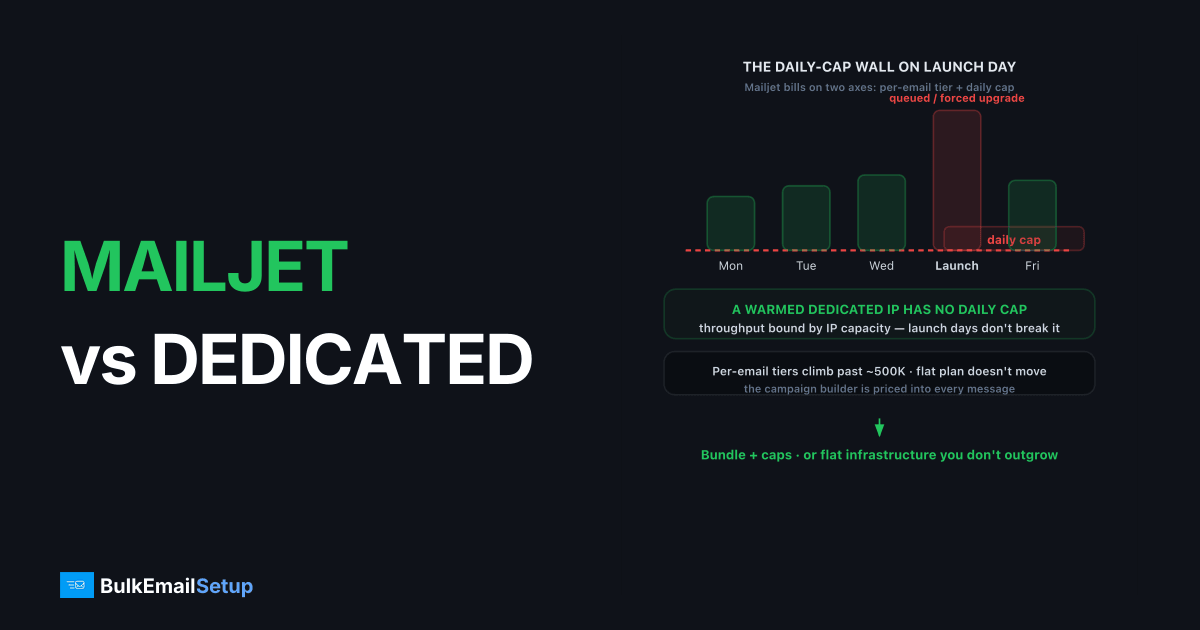
Daily caps catch growing senders off guard. A plan that allows, say, a fixed daily volume looks fine until a launch day pushes you over and mail queues or you forced-upgrade mid-campaign. Per-email tiers then climb as monthly volume grows, because the cost scales with every send.
A dedicated server has no per-message tier. Throughput is bound by IP capacity and warm-up state, so a well-warmed IP can carry far more without a plan change. We cover throughput math in how many emails per day per IP.
The daily cap bites hardest on the days you least want it to. The teams that move to us off Mailjet usually hit it on a launch or a Black Friday send: the monthly allowance has room left, but the daily ceiling stops the queue mid-campaign and forces a same-day tier upgrade to keep mail flowing. A flat dedicated plan has no such ceiling, so a 200K launch night runs at whatever pace a warmed IP safely carries, not whatever the plan tier permits that calendar day.
When does a dedicated SMTP server get cheaper?
The crossover is consistent high volume. Per-email tiers feel cheap at 50K/month and add up at 1M/month, while a dedicated server's bill stays flat. We run the comparison in Mailjet alternatives and cost per email: SMTP vs ESP.
Control is the other trigger. On a dedicated server you configure SPF, DKIM, and DMARC, set the PTR record, and warm the IP yourself. Deliverability still depends on list quality and complaint rate, not the platform.
What does the cost look like at volume?
Mailjet's bill moves on two axes: the per-email tier and the daily cap you've paid to raise. A flat dedicated plan moves on neither. Mapping real volume against both makes the crossover visible. Here's a directional view as of early 2026, now under the Sinch group.
| Monthly volume | Mailjet (tiers + caps) | Dedicated SMTP server (flat) |
|---|---|---|
| 50K | Cheap, builder included | Flat plan, likely more per email |
| 100K | Competitive | Roughly break-even territory |
| 500K | Higher tier, caps lifted | Flat plan usually cheaper per email |
| 1M+ | Largest line item | Flat plan, clearly cheaper per email |
The campaign builder and contact tools are priced into every tier. If you use them, that's fair value; if you only need throughput, it's overhead on each message. We compare options in Mailjet alternatives and the broader curve in cost per email: SMTP vs ESP.
Where is Mailjet the better choice?
Mailjet wins when collaborative campaign design and sending belong in one tool. Teams that build emails together, manage contacts, and send from the same dashboard get real value from the bundle. The drag-and-drop builder and shared templates remove genuine friction for marketing teams.
It's also a reasonable pick at low and moderate volume where the daily caps never matter. If you send under 100K a month and lean on the design and collaboration features, paying per email is fine. You're buying a product with sending attached, not raw infrastructure. The friction only shows up when volume outgrows the tier the bundle was priced for.
Where does a dedicated SMTP server win?
A dedicated SMTP server wins when daily caps constrain you, when cost shouldn't scale per message, or when you need IPs you control. A well-warmed dedicated IP carries far more per day than a capped tier, so launch days don't force a mid-campaign upgrade. We cover that ceiling in how many emails per day per IP.
Control is the other win. You run your own warm-up, configure authentication yourself, and isolate streams across separate IPs. When deliverability dips, you read raw SMTP responses instead of a dashboard summary. For a high-volume operation where email is the core channel, owning the infrastructure beats renting it through a design suite you've outgrown.
How do you migrate from Mailjet to a dedicated server?
Migration is DNS plus warm-up, not a rebuild. Both speak standard SMTP on ports 587 or 465, so the app change is host, port, and credentials. The careful part is reputation: a fresh dedicated IP starts cold and warms over four to six weeks.
Stage the move. Stand up the server with SPF, DKIM, DMARC, and PTR verified. Route a small slice through the new IP while Mailjet carries the bulk, ramping on a warm-up schedule. Shift the rest once placement holds. If you still want Mailjet's builder, you can design there and send through your own relay, though most teams move the whole send once volume justifies it.
Who should pick which?
| Your situation | Better pick |
|---|---|
| Want builder plus contacts plus sending | Mailjet |
| Under 100K/month, lean on tooling | Mailjet |
| Collaborative campaign design | Mailjet |
| 500K+/month, steady | Dedicated SMTP server |
| Daily caps block your launches | Dedicated SMTP server |
| Need multiple isolated IPs | Dedicated SMTP server |
| Email is your core channel at scale | Dedicated SMTP server |
What deliverability rules carry over no matter which you pick?
Leaving Mailjet doesn't change what receivers demand. Gmail and Yahoo's bulk sender rules (5,000+ recipients a day) require SPF, DKIM, and DMARC all passing, one-click unsubscribe per RFC 8058, TLS, valid PTR or reverse DNS, and a spam complaint rate under 0.3%, ideally under 0.1%. Mailjet handles much of this in its dashboard; on a dedicated server you own each record. Neither path lets you skip the thresholds.
The records carry technical floors worth knowing. Your DKIM key should be 2048-bit, with 1024 the weak minimum. Your SPF must resolve in 10 DNS lookups or fewer, or receivers return a PermError and fail the check. DMARC steps through none, quarantine, then reject as your authentication proves stable. Getting these correct matters more than which platform sends your mail.
What goes wrong when senders switch badly?
The classic mistake is cutting all volume to a cold IP at once. A new dedicated IP that suddenly pushes 200K in a day looks like a spam cannon to Gmail, which replies with a 421 4.7.28 rate limit or a soft block to the spam folder. The fix is patience: ramp from roughly 50 to 100 a day and double every few days while watching placement.
The second mistake is moving a dirty list to fresh infrastructure, then blaming the server. A new IP with a 5% bounce rate and rising complaints burns reputation faster than a managed pool would, because all the damage lands on an IP that's entirely yours. Clean the list, suppress hard bounces, and let your most engaged contacts lead the warm-up. A switch is the worst moment to skip list hygiene.
How much volume justifies leaving the bundle?
The threshold is consistency, not just a number. A dedicated IP needs steady volume to stay warm, with a rough floor near 50K sends a month sent regularly. Below that, Mailjet's managed sending usually delivers better because your mail rides a warm pool. Above it, a dedicated IP starts to pay off, and the case strengthens as volume climbs.
Cost points the same way. Mailjet's per-email tiers and daily caps stay cheap at low volume and become your largest line item past several hundred thousand a month, especially since the campaign builder is priced into every tier. Once that bill rivals a flat dedicated plan, and once daily caps start blocking launch days, the bundle is a premium you're paying on every message. For most senders the crossover lands somewhere past 500K consistent monthly emails. There's a staffing factor too: a dedicated server's controls only help if someone will read logs, tune warm-up, and manage DNS. How many emails before you need dedicated infrastructure covers the signals.
How BulkEmailSetup helps
If Mailjet's daily caps and per-email tiers no longer suit a high-volume operation, a dedicated SMTP server gives you flat-rate throughput and full IP control. We provision clean dedicated IPs, configure authentication, and run the warm-up so launch days don't trigger forced upgrades. See plans on our pricing page.
Frequently asked questions
Is Mailjet cheaper than a dedicated SMTP server?
At low volume, Mailjet's free and starter tiers are cheaper and include marketing tools. At consistent high volume, a flat-rate dedicated SMTP server usually costs less per email because you stop paying per-message tiers and daily-limit upgrades.
What are Mailjet's sending limits?
Mailjet's free tier caps daily and monthly sends, and you lift those caps by upgrading. A dedicated SMTP server has no per-message tier; throughput is bound by your IP capacity and how well the IP is warmed, not by a plan ceiling.
Does Mailjet offer a dedicated IP?
Yes, Mailjet offers dedicated IPs on higher-volume plans, typically as a paid add-on. A dedicated SMTP server includes the IP plus full DNS and MTA control, so you own warm-up, PTR, and reputation directly.
When should I move from Mailjet to a dedicated server?
Move when per-email tiers and daily caps drive your cost, when you need multiple isolated IPs you control, or when you want MTA-level control. That usually happens once you send consistently above roughly 500K emails per month.


