
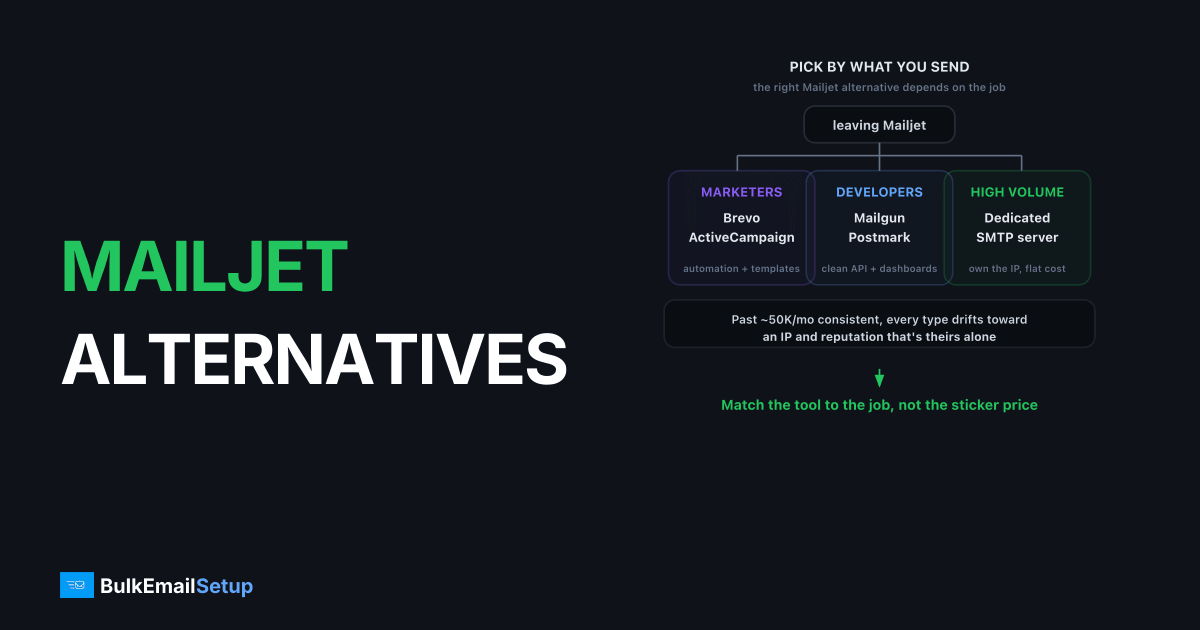
The best Mailjet alternative depends on whether you send for marketing or for apps, and on how much volume you push. Marketers who want built-in automation usually look at Brevo or ActiveCampaign. Developers who want a clean API lean toward Mailgun or Postmark. But if you send more than roughly 50,000 emails a month consistently, the better Mailjet alternative is often a dedicated SMTP server, because per-email ESP pricing stops making sense and shared IP pools stop protecting your inbox rate. This guide compares the real options with honest pricing as of early 2026.
Why look for a Mailjet alternative?
Mailjet is a solid all-in-one for low to mid volume, but two limits push senders to look elsewhere: deliverability on shared pools and cost at scale. On lower tiers your mail leaves from IP pools shared with other customers, so a noisy neighbor can drag your inbox placement. Dedicated IPs exist only on higher plans, and per-email pricing compounds once you cross a few hundred thousand sends.
The other friction is control. Mailjet abstracts away SMTP details, which is fine until you need to tune warm-up, isolate streams, or debug a 550 5.7.1 block yourself. At that point an environment where you own the IP and the records starts to look better.
The shared-pool problem isn't theoretical. The senders who come to us from Mailjet's lower tiers almost always describe the same symptom: Gmail placement is fine, but Outlook and Hotmail quietly slide to junk, and nothing they change on their own list moves it. That pattern is the signature of inherited IP reputation, because Microsoft weights the sending IP harder than Gmail does, so a poolmate's bad week shows up at Outlook first. Moving to an IP they own is usually what fixes it, not another content tweak.
Mailjet alternatives compared
Here's how the main options stack up. Prices are approximate as of early 2026 and shift with promotions, so treat them as ranges.
| Option | Rough price | Dedicated IP | Best for | SMTP control |
|---|---|---|---|---|
| Mailjet | Free to ~$25+/mo, scales per volume | Higher tiers only | Mixed marketing + transactional | Limited |
| Brevo | Free to ~$65+/mo | Add-on (~$45-60/mo) | Marketers wanting automation | Limited |
| Mailgun | ~$15-90+/mo + overage | Add-on (~$59/mo) | Developers, API-first | Moderate |
| Postmark | ~$15+ per 10K, usage-based | Add-on | Fast transactional | Moderate |
| Amazon SES | ~$0.10 per 1,000 + infra | Add-on (~$25/mo) | Devs comfortable with AWS | High (you build it) |
| Dedicated SMTP server | Flat monthly | Included, you own it | Consistent high volume | Full |
Which Mailjet alternative fits which sender?
For marketers who live in templates and automation, Brevo or ActiveCampaign replace Mailjet's marketing side cleanly. For developers sending transactional mail from an app, Mailgun and Postmark offer better APIs and deliverability dashboards. Amazon SES is the cheapest per email if you're comfortable wiring up bounce handling, suppression, and DNS yourself.
The split matters because each tool optimizes for a different job. A marketer doesn't want to manage Postfix. A developer doesn't want a drag-and-drop campaign builder. And a high-volume sender of either type eventually wants the IP and the reputation to be theirs alone. That's the gap a dedicated SMTP server fills. For the broader trade-off, see Mailjet vs a dedicated SMTP server.
What to look for in a Mailjet alternative
The features worth checking in a Mailjet alternative are the ones its shared pools and per-email tiers constrain at scale: reputation control, pricing that fits your pattern, and real SMTP access. Score each option against these rather than chasing the lowest sticker price.
- Reputation isolation. Mailjet's lower tiers put you on shared pools, where a noisy neighbor drags your inbox rate. A dedicated IP you own removes that risk entirely.
- Pricing that does not punish bursts. Per-email tiers spike when a big campaign pushes you into overage. Flat plans hold steady through busy months.
- SMTP and stream control. Can you tune warm-up, isolate transactional from marketing, and debug a
550 5.7.1block yourself? Mailjet abstracts these away; owned infrastructure exposes them. - Authentication done right. SPF under the 10-DNS-lookup limit, DKIM at 2048-bit, DMARC at
quarantineorreject. Get these wrong and you trip550 5.7.23SPF-fail rejections. - Warm-up support. Any new dedicated IP needs a 4-6 week ramp. A managed provider runs it on schedule instead of leaving you to guess.
Weight these by what pushed you to look. A sender hit by a shared-pool blocklisting cares most about a dedicated IP. A sender stung by overage cares most about flat pricing.
How the alternatives differ in practice
Each Mailjet alternative optimizes for a different job, so the right one depends on what you send and how much. Marketing-led teams and developer-led teams pull in opposite directions, and high-volume senders of either type eventually want infrastructure they own.
- Brevo and ActiveCampaign replace Mailjet's marketing side. Templates, automation, and send-based pricing that keeps big lists affordable. Best when campaigns and workflows are the job.
- Mailgun and Postmark replace Mailjet's transactional side. Clean APIs, deliverability dashboards, and fast event visibility. Best when an app sends receipts, resets, and notifications.
- Amazon SES is the cheapest per email at roughly $0.10 per 1,000, if you are comfortable wiring up bounce handling, suppression, and DNS yourself. Best when engineering time is cheap and volume is high.
- A dedicated SMTP server gives you a dedicated IP you own, flat pricing, and full SMTP access. Best when volume is high and steady and the reputation needs to be yours alone.
The split matters because a marketer does not want to manage Postfix, and a developer does not want a drag-and-drop campaign builder. Pick for your dominant use case, not the longest feature list.
When a dedicated SMTP server beats every ESP
Above roughly 50,000 emails a month sent consistently, dedicated infrastructure changes the math. A dedicated IP gives you a reputation nobody else can wreck, full SMTP access lets you isolate transactional from marketing streams, and flat monthly pricing removes the overage surprises that hit per-email plans during a big campaign.
The catch is honest: a dedicated IP needs a 4-6 week warm-up, and deliverability still depends on your list hygiene and complaint rate. Get SPF, DKIM, and DMARC right and keep complaints under 0.3%, and a dedicated setup outperforms a shared pool. Skip the discipline and no platform saves you. The volume threshold is covered in when do you need a dedicated SMTP server.
The cost case sharpens as volume climbs. Mailjet and the other ESPs meter per email, so the bill grows with every send and spikes when a campaign runs hot. A flat dedicated plan holds the same number whether you send 200K or 800K in a month. At 100K/month the difference is small and an ESP's convenience may win. By 500K and beyond, per-email metering plus add-on IPs usually cost more than a flat plan that bundles the volume and the dedicated IP into one predictable figure. Predictability is half the value, since you can forecast a flat plan to the dollar and an overage-prone tier you cannot.
Migrating off Mailjet without a deliverability dip
You move off Mailjet without a deliverability dip by carrying your authentication intact and warming any new IP before full volume. Domain reputation is portable: your SPF, DKIM, DMARC records and sending history travel with the domain. IP reputation does not, which is the single most common cause of a post-migration spam folder drop.
Confirm your records before cutover: SPF under the 10-DNS-lookup limit (or Gmail returns PermError), DKIM signing at 2048-bit, and DMARC at quarantine or reject with passing alignment. Then ramp the new platform or dedicated IP from roughly 50-100 emails/day over 4-6 weeks, watching for 421 4.7.28 rate-limit deferrals as a sign you are pushing too fast. Keep your complaint rate under the 0.3% Gmail and Yahoo threshold throughout. For a large list, send your most engaged subscribers through the new IP first, since their opens and low complaints build positive reputation fastest, then layer in the rest as it warms. Our Gmail bulk sender requirements for 2026 covers the full checklist.
The common mistake here is treating the switch as the moment to also clean house on a stale list. Do one or the other, not both at once. A new IP has zero reputation, so if you point it at addresses that have not opened in a year, the bounces and spam-folder placements list you within days, and you cannot tell whether the IP warm-up or the dead list caused it. Clean the list on Mailjet first, where you still have an established reputation to absorb the bounces, then migrate the surviving engaged segment to the new IP. Sequencing the two jobs keeps each one debuggable.
How BulkEmailSetup helps
If your Mailjet bill is climbing or your inbox rate keeps slipping on a shared pool, a dedicated SMTP server gives you a dedicated IP you control, full SMTP access, and authentication set up correctly from day one. We provision the server, handle the warm-up, and monitor reputation so you skip the babysitting. See plans on our pricing page.
Frequently asked questions
Why do senders leave Mailjet?
The two common reasons are deliverability and price scaling. Mailjet runs shared IP pools on lower tiers, so your inbox rate can depend on poolmates. Dedicated IPs sit on higher plans, and per-email costs climb fast once you pass a few hundred thousand sends a month.
What is the best Mailjet alternative for high volume?
For consistent volume above roughly 50K-100K emails a month, a dedicated SMTP server usually beats per-email ESP pricing on both cost and control. You get a dedicated IP you own, full SMTP access, and flat monthly billing instead of overage fees.
Does Mailjet give you a dedicated IP?
Yes, but only on its higher-priced plans, and you still ramp and manage reputation within Mailjet's environment. A standalone dedicated SMTP server gives you the same dedicated IP with full control over warm-up, routing, and authentication records.
Is Brevo or Mailgun a better Mailjet replacement?
Brevo suits marketers who want templates and automation in one place. Mailgun suits developers who want a clean API and deliverability tooling. Neither fixes shared-pool reputation at scale, which is why high-volume senders move to dedicated infrastructure.


