
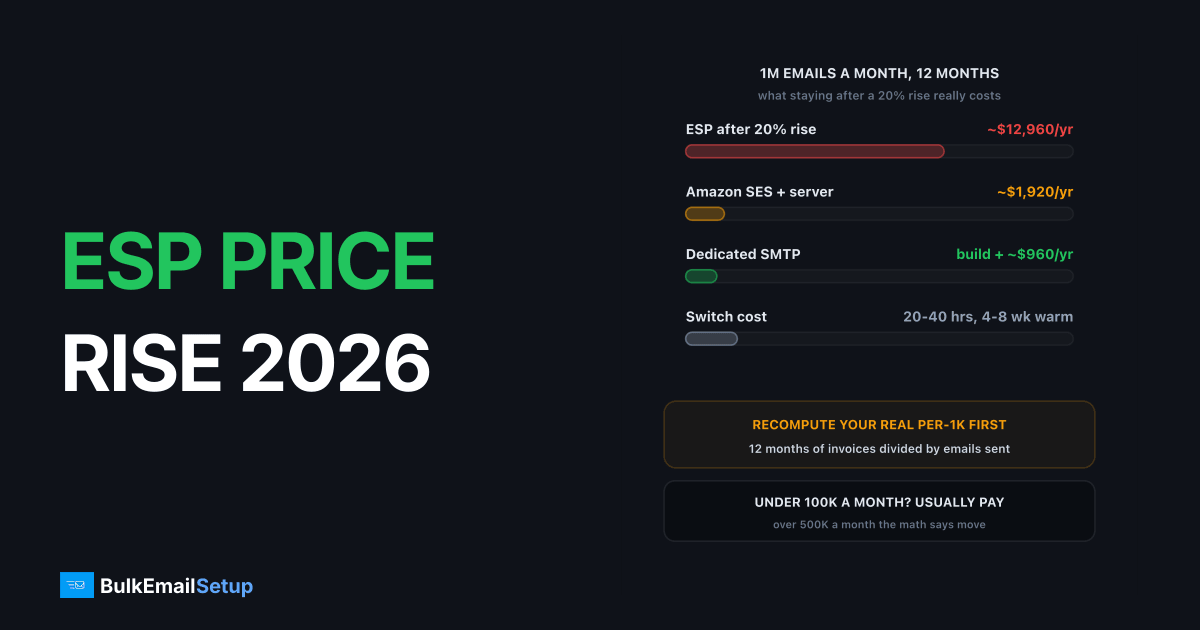
Most ESP price increases in 2026 will not arrive as a bigger number on the pricing page. They arrive as a changed billing metric, a lost free tier, an add-on that used to be included, or a higher overage rate. Mailchimp's shift to contact-based billing, Klaviyo's active-profile model, SendGrid retiring its permanent free plan and Mailgun cutting its free tier to 100 emails a day all raised real bills without touching the headline rate. The right response depends on your volume: under 100,000 a month you usually pay or downgrade, between 100,000 and 500,000 you negotiate or split the stack, and past 500,000 the math says move.
I've been through four of these on production accounts. The pattern is always the same: the email announcing the change is polite, the invoice two months later is not. Here is how to read the change, measure it, and decide.
The six ways a price rise arrives
A price increase is any change that makes the same sending cost more. Only one of the six forms looks like a price increase.
| Form | What changes | How you notice | Example seen in the wild |
|---|---|---|---|
| Tier reprice | Same plan, higher number | The announcement email | Mailchimp raised plan prices in 2023 and again since |
| Metric change | You are billed on contacts or profiles, not sends | Bill jumps with zero volume change | Mailchimp to contacts (2019), Klaviyo to active profiles |
| Free tier removal | Free plan becomes a trial or shrinks | Small accounts get a first invoice | SendGrid ended its permanent free plan, Mailgun free is 100 a day |
| Add-on unbundling | Dedicated IP, validation or SSO leaves the plan | New line items appear | Dedicated IPs at roughly $30 a month each on SendGrid |
| Overage rate rise | Per-email cost above quota increases | Launch months hurt more | Mailgun overage runs $1.10 to $1.80 per 1,000 by tier |
| Annual-only | Monthly billing disappears or costs more | Renewal forces a 12-month commit | Common in mid-market plans, watch for it at renewal |
The metric change is the expensive one. When Mailchimp moved to charging on audience size, it also counted unsubscribed and non-subscribed contacts toward the tier for a period, so a list of 60,000 with 15,000 unsubscribes was billed as 60,000. Klaviyo's active-profile model is fairer in principle, but a re-engagement send that touches 200,000 dormant profiles makes them all active for the billing month.
The free-tier removal matters more than it looks. Mailgun's pricing page now lists free at 100 emails a day, Basic at $15 for 10,000 a month, Foundation at $35 for 50,000 and Scale at $90 for 100,000. That $15 floor did not exist for many small senders three years ago.
What has already happened, and what to watch for
I'm careful here because a lot of "2026 price increase" articles invent announcements. This is what I'm confident has happened, and what I'd expect based on the pattern.
| Provider | Happened | Watch for |
|---|---|---|
| Mailchimp | Contact-based tiers, unsubscribed contacts counted for a period, plan prices raised, sends capped at 10x to 12x contacts per month with overage | Further tightening of send multipliers, more features moved to Standard and Premium |
| SendGrid | Permanent free plan retired in favor of a trial, older plans closed to new signups, dedicated IPs as paid add-ons | Legacy plan holders migrated to current tiers at renewal |
| Klaviyo | Active-profile billing, SMS and email billed on separate meters | Profile-count thresholds moving down |
| Mailgun | Free tier reduced to 100 a day, tiered overage from $1.10 per 1,000 | Validation and log retention priced separately by tier |
| SparkPost | Post-acquisition plan restructuring and repositioning under Bird | Legacy self-serve accounts pushed to enterprise contracts |
None of these was framed as a price increase. Mailchimp's own marketing pricing page states that overages apply if the contact or send limit is exceeded, which is the mechanism doing the work. The bill rises through the multiplier and the overage, not the plan price. I covered the general shape of that trap in hidden costs of ESP overage fees.
Compute your real per-1K before and after
The only number that matters is total spend divided by emails sent. The headline rate is marketing.
Pull 12 months of invoices and build this table for your own account. Here is a real-shaped example at 500,000 emails a month on a mid-market plan.
| Line item | Before | After a 20% tier rise | After a metric change |
|---|---|---|---|
| Base plan | $450 | $540 | $450 |
| Dedicated IPs (3 at $30) | $90 | $90 | $90 |
| Overage, average month | $60 | $72 | $180 |
| Validation | $25 | $25 | $25 |
| Monthly total | $625 | $727 | $745 |
| Real cost per 1,000 | $1.25 | $1.45 | $1.49 |
Two things stand out. A 20% tier rise became a 16% real rise here because the add-ons did not move. And the metric change, which came with no announced increase at all, cost more than the tier rise. That is why you recompute rather than read the email.
The recompute takes 20 minutes:
- Sum every invoice line for 12 months: base, IPs, overage, validation, support.
- Divide by total emails sent, in thousands. That is your real per-1K today.
- Re-price each line under the new terms, using your actual peak months for overage.
- Divide again. The gap between the two per-1K figures is the real increase.
If step 4 gives you under 10%, skip to the section on when to pay. If it gives you over 25%, the rest of this article is for you.
The decision by volume
Your options are negotiate, downgrade, split the stack, or move. Which ones are open to you depends almost entirely on monthly volume, because that is what decides whether anyone at the ESP will talk to you.
| Monthly volume | Negotiate | Downgrade | Split stack | Move |
|---|---|---|---|---|
| Under 100K | No account manager, rarely works | Yes, right-size the tier and drop unused add-ons | Rarely worth the complexity | Only if the rise is over 30% |
| 100K to 500K | Sometimes, ask for a 12-month rate hold | Yes, clean the list first | Yes, marketing to SES or a dedicated server, transactional stays | Yes if per-1K is over $1.00 |
| 500K to 1M | Yes, you have an account manager now | Limited, you are already on a volume tier | Yes, the usual answer | Yes, payback is under 3 months |
| Over 1M | Yes, and threaten credibly | No | Yes | Yes, and the math is not close |
Negotiate works when you can name the alternative and its price. "Amazon SES is $0.10 per 1,000 and we've tested it" gets a rate hold. "We're unhappy" does not. Ask for one of three things: the old rate held for 12 months, the metric change waived for your account, or the add-on bundled back in. Account managers can usually grant one of the three.
Downgrade is the cheapest fix and the one people skip. A list with 25% dead addresses is 25% of your contact-tier bill wasted on a contact-based plan. Cleaning the list, dropping a dedicated IP you cannot keep warm, and moving off a tier you only need two months a year commonly cuts a bill by a third. I walked through this for SendGrid in your SendGrid bill is too high and for Mailchimp in your Mailchimp bill is too high.
Split the stack is the option most senders do not know they have. Keep transactional mail, which is low volume and needs the ESP's logs and API, on the ESP. Move marketing and newsletter volume, which is 80 to 90% of most bills, to cheap infrastructure. The ESP bill drops to its lowest tier and you keep the tooling where it earns its price.
Move everything when volume is high enough that the platform layer costs more than the platform is worth to you. The break-even sits around 250,000 a month for most teams. The full working is in the break-even point for dedicated SMTP.
What staying costs against the alternatives
Here is the comparison at three volumes. "Stay" assumes a mid-market ESP at a typical blended rate after a 20% rise, including one dedicated IP add-on. SES is send fees plus a small server for the sending app. The dedicated server figures use our Basic and higher tiers plus hosting.
| Monthly volume | Stay after 20% rise | Amazon SES | Dedicated SMTP server |
|---|---|---|---|
| 100,000 | ~$150/mo | ~$10 sends + ~$30 hosting | $549 one-time + ~$40/mo hosting |
| 500,000 | ~$625/mo | ~$50 sends + ~$40 hosting | $549 one-time + ~$60/mo hosting |
| 1,000,000 | ~$1,080/mo | ~$100 sends + ~$60 hosting | higher tier one-time + ~$80/mo hosting |
| 12-month total at 1M | ~$12,960 | ~$1,920 | build cost + ~$960 |
At 100,000 a month the dedicated server pays back in about 5 months and SES pays back immediately, but both hand you warm-up, bounce handling and monitoring that the ESP was doing for you. At 1 million a month the ESP costs roughly $11,000 a year more than either alternative, and that gap buys a lot of engineering time.
SES is the cheapest number on the table and I'd be lying if I said otherwise. What it does not include is a campaign builder, list management, or a bounce dashboard, and Amazon can freeze the account for review with the same reputation sensitivity as any shared pool. The SES vs dedicated server comparison goes into where each one breaks.
The switching cost nobody prices
Moving is not free, and the cost is mostly time, not money.
| Switching cost | Typical scale | Notes |
|---|---|---|
| Template and API migration | 10 to 20 hours | more if you have deep automation logic |
| Suppression list export and import | 2 to 4 hours | do not skip, or you re-mail every unsubscribe |
| DNS: SPF, DKIM, DMARC, PTR | 2 to 4 hours | plus 48 hours for records to reach every resolver |
| IP warm-up | 4 to 8 weeks | full volume is not available on day one |
| Parallel running | 1 to 2 months of double billing | old ESP stays live while new IPs warm |
| Deliverability dip | 1 to 3% for the first weeks | new IPs, no history at Gmail or Microsoft |
The warm-up is the expensive line. New IPs start cold whatever your history elsewhere, and Google's sender guidelines mean you are held to the same 0.3% spam-rate ceiling from the first day, with none of the reputation cushion your old IPs had built. Ramp roughly 30% every two days per IP and expect 4 to 8 weeks to full volume.
The trick that makes moving safe is the split-stack route from the previous section: warm the new infrastructure with your most engaged segment while the ESP carries the rest, then shift volume over as reputation builds. The step-by-step is in how to switch ESP without losing deliverability.
When to just pay
Sometimes the honest answer is to grumble and pay. Pay when all three of these are true.
- The real per-1K increase from your recompute is under about 15%.
- You send under 100,000 emails a month.
- You use the platform, meaning automations, segmentation, A/B testing and reporting that your team actually opens.
At 50,000 emails a month a 15% rise on a $150 bill is $270 a year. Twenty hours of migration plus a warm-up period costs more than that. Pay it, set a calendar reminder for the next renewal, and revisit when volume doubles.
Also pay if the increase is a free-tier removal and you were on the free tier. A $15 Mailgun Basic plan or the first paid Mailchimp tier is a fair price for 10,000 emails and a working dashboard. The moment to act is when the paid tiers move, not when free ends.
Do not pay, or at least do not pay quietly, when the increase is a metric change on a list you have not cleaned. That is the one case where the bill is inflated by addresses that earn you nothing, and a list cleanup before renewal is worth more than any negotiation.
How BulkEmailSetup helps
We build dedicated SMTP infrastructure you own: your own server, your own IPs, full SPF/DKIM/DMARC/PTR configuration, MTA tuning, bounce handling and a warm-up plan. There is no per-email meter, no contact tier, no add-on that used to be included, so the next ESP pricing email is somebody else's problem. Most customers use it as the marketing half of a split stack first and move the rest over once the IPs are warm.
Basic starts at $549 one-time, covering 1 SMTP server, 3 dedicated IPs, 25,000 emails/day and unlimited contacts. Higher tiers scale to 15 IPs and 200,000 emails/day. See pricing, or run your own numbers against the break-even point for dedicated SMTP.
Frequently asked questions
How do ESPs raise prices without announcing a price increase?
The common route is changing the billing metric rather than the number. Mailchimp moved from send-based to contact-based pricing, Klaviyo bills on active profiles, and several providers cut free tiers instead of raising paid ones. Mailgun's free plan is now 100 emails a day and SendGrid replaced its permanent free plan with a trial. Your invoice grows while the price page looks unchanged.
How do I calculate my real cost per 1,000 emails after an ESP price increase?
Add up 12 months of invoices including base plan, dedicated IP add-ons, overage and validation, then divide by emails actually sent in thousands. A $600 monthly bill at 500,000 emails is $1.20 per 1,000. Re-run the same sum under the new pricing before you decide anything, because a 20% tier rise often becomes a 30% real rise once overage rates move too.
Should I negotiate with my ESP or just switch?
Negotiate first if you send over about 250,000 emails a month, because that volume gets you an account manager who can hold your old rate for 12 months or waive a metric change. Below 100,000 a month there is usually nobody to negotiate with, and the cheaper fix is right-sizing the tier or moving marketing volume to Amazon SES at roughly $0.10 per 1,000.
What does switching ESPs actually cost?
Budget 20 to 40 engineering hours for template, API and suppression list migration, plus 4 to 8 weeks of IP warm-up during which you cannot send full volume from the new setup. At 1 million emails a month the send-fee saving is often $800 or more per month, so the switch pays back inside a quarter. At 50,000 a month it may never pay back.
When is it better to just pay the ESP price increase?
When the rise is under about 15%, you send fewer than 100,000 emails a month, and you actively use the platform features you are paying for such as automations, segmentation and the campaign builder. In that case the switching cost, roughly 20 to 40 hours plus a warm-up period, exceeds a year of the increase.
Is a dedicated SMTP server cheaper than staying on an ESP after a price rise?
At volume, yes. A one-time build of $549 covers 25,000 emails a day with no per-email fee, against an ESP bill of roughly $1,080 a month at 1 million emails after a 20% rise. Payback is under a month at that volume. Below 100,000 emails a month the ESP is usually still the cheaper and simpler choice.


