
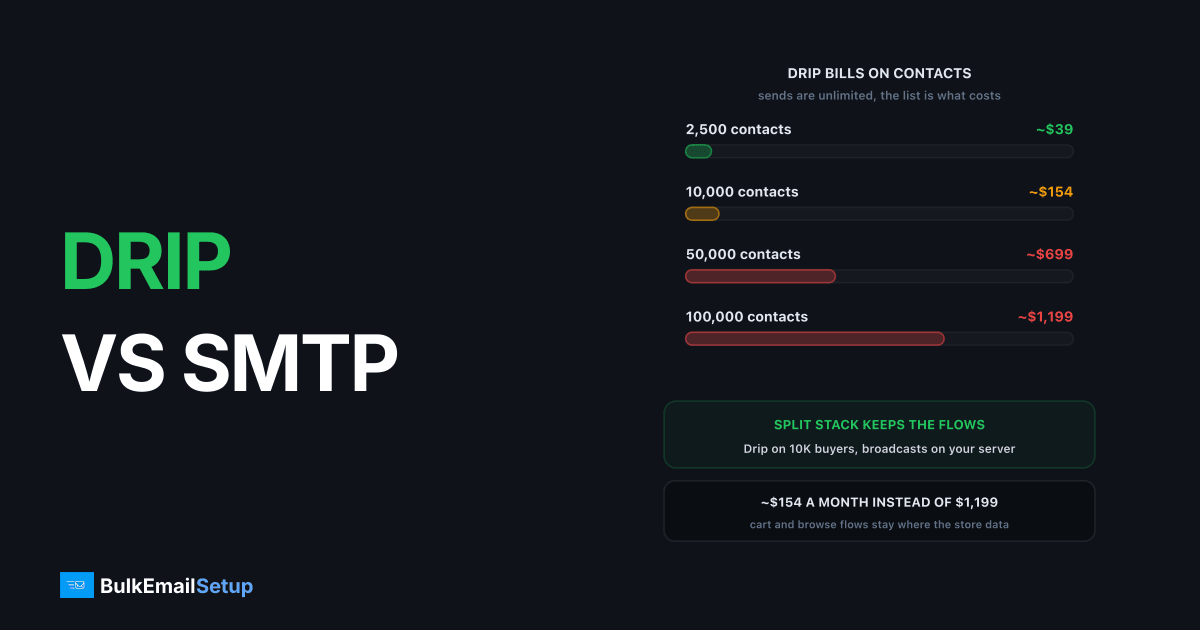
Drip bills on active contacts with unlimited sends, so the meter is your list size, not your volume: roughly $39/month at 2,500 contacts, $154 at 10,000, $699 at 50,000 and US$1,199 at 100,000. A dedicated SMTP server has no contact fee at all, but it cannot do what Drip does best, which is fire store-triggered flows with live product data. The answer for most growing stores is not either one. It is a split stack: keep a small Drip account for cart and browse abandonment on engaged buyers, move the big broadcast list to your own SMTP.
I have run this setup. It takes about two days and the bill difference at 50,000 contacts is close to $6,000 a year.
Drip vs a dedicated SMTP server at a glance
They are not competing products. Drip is a marketing brain, your own SMTP a delivery pipe.
| Factor | Drip | Dedicated SMTP server |
|---|---|---|
| Bills on | Active contacts | Flat, no contact fee |
| Send volume | Unlimited at every tier | Unlimited, capped by plan |
| Store event triggers | Native Shopify, Woo, BigCommerce | None, you build them |
| Product data in email | Live from the store | Manual or custom |
| Revenue attribution | Per flow, per email | None |
| IP reputation | Shared pool | Yours alone |
| Broadcast campaigns | Yes, priced per contact | Yes, priced at zero |
| Warm-up | Drip handles it | Yours, 4 to 8 weeks |
| Suspension risk | Shared-pool policy applies | None, the IPs are yours |
The first row decides everything. Unlimited sends sounds generous until you see what it means: Drip does not care how much you mail, because it already charged you for the names. A 60,000-contact list you mail twice a year costs the same as one you mail daily.
A dedicated server is the mirror image: contacts are free, sending is what you size for. Put the two together and the split falls out.
What Drip actually costs
Drip runs one plan with every feature included, priced purely on active contacts. Verify current tiers on Drip's pricing page before you budget.
| Active contacts | Drip monthly, approximate |
|---|---|
| 2,500 | ~$39 |
| 5,000 | ~$89 |
| 10,000 | ~$154 |
| 50,000 | ~$699 |
| 100,000 | ~US$1,199 |
| 150,000+ | custom quote |
Annual billing takes roughly 25% off. There is a 14-day trial and no free tier.
Klaviyo runs closer to $1,300 to $1,700 at 100,000 profiles, so Drip is genuinely the cheaper of the two, and that is its whole positioning. See Klaviyo vs a dedicated SMTP server for the same maths on the pricier platform, or cheaper than Klaviyo.
Cheaper than Klaviyo is still a contact tax. At 100,000 contacts that is $14,388 a year for software, while delivering a million emails costs single-digit dollars in raw infrastructure. You are buying automation, and it is worth real money on some of those contacts and nothing on the rest.
What Drip does that your own SMTP cannot
Skipping this part is how people ruin their email programme to save $400 a month.
A dedicated SMTP server accepts a message and delivers it. It has no idea who your customers are or what they bought. Drip does, and turns that into three things a self-hosted mailer cannot easily copy.
Store event triggers. Drip holds a live connection to Shopify, WooCommerce or BigCommerce and reacts to events: cart abandoned, checkout started, product viewed, order placed, order refunded. Each can start a flow within minutes. To copy that yourself you need a webhook receiver, a queue, and a state machine that knows if a customer is already mid-flow. That is a small application, not a config change.
Product data inside the email. A Drip cart-abandon email pulls the exact items, images, prices and a working checkout link at send time. A self-hosted mailer sends the template you gave it. You can build dynamic product blocks yourself, but that means a rendering service and a synced product feed.
Revenue attribution. Drip tells you the browse-abandon flow made $4,200 last month and the Tuesday newsletter made $310. That is what tells you which half of your programme to keep. A raw SMTP server reports deliveries, bounces and complaints. Nothing about money.
None of that is impossible to build. It is months of work that pays back less than the flows do. So keep it, and shrink what you pay for it.
The split stack: which mail belongs where
Drip charges per contact, so only the contacts that earn their fee go in Drip. Everyone else lives on the list your own server mails for free.
| Mail type | Where it belongs | Why |
|---|---|---|
| Cart abandonment | Drip | Needs live cart data and product blocks |
| Browse abandonment | Drip | Needs on-site behaviour tracking |
| Post-purchase and shipping | Drip | Order event triggered, high value |
| Win-back for past buyers | Drip | Needs purchase history and timing |
| Weekly or monthly newsletter | Own SMTP | Same content to everyone, no store data |
| Sale and promo blasts | Own SMTP | Volume driven, segment by tag not behaviour |
| Product launch announcements | Own SMTP | One-off broadcast, no triggers |
| Cold or reactivation lists | Own SMTP | Keeps risky sending off the flow reputation |
| Never-purchased subscribers | Own SMTP | Contacts you should not pay per head for |
The dividing line is behaviour. If the email only makes sense because of something the customer did on the store this week, it belongs in Drip. If it goes to a segment on a schedule, it belongs on your own server, where the marginal cost per name is zero. In practice: a Drip account holding 10,000 to 15,000 engaged buyers, and a self-hosted mailer holding the full 60,000 or 100,000 name list. More in SMTP for ecommerce abandoned cart.
The cost table at 10K, 50K and 100K contacts
Three options, three list sizes. The split assumes 10,000 engaged buyers stay in Drip and the rest moves.
| Setup | 10K contacts | 50K contacts | 100K contacts |
|---|---|---|---|
| Drip all-in | ~$154/mo | ~$699/mo | ~US$1,199/mo |
| Drip flows only plus own SMTP | ~$154/mo plus server | ~$154/mo plus server | ~$154/mo plus server |
| Full self-hosted, no Drip | server only | server only | server only |
| Annual saving, split vs all-in | none | ~$6,540 | ~$12,540 |
At 10,000 contacts the split saves nothing, because your whole list is already the Drip tier. At 50,000 the gap is roughly $545 a month. At 100,000 it is about $1,045 a month, and it widens as Drip's tier climbs while your server bill does not.
Full self-hosted with no Drip is the cheapest line and usually the wrong choice for a store, because you lose the flows that produce most revenue per email. It fits publishers, newsletters and B2B lists with no store events. For the general crossover maths, see the break-even point for a dedicated SMTP server.
If your Drip bill has already crossed $700 a month and you want the shorter list of exits, the Klaviyo bill too high playbook applies almost unchanged to Drip.
Migration effort, honestly
Two days of work, spread over about six weeks because of the warm-up.
- Export suppressions from Drip first. Unsubscribes, hard bounces and complainers, loaded into the new mailer before it sends anything. Mailing someone who opted out is a complaint generator and a legal problem.
- Pick the mailer. MailWizz, Sendy, Mautic or Listmonk all take custom SMTP credentials and handle lists, templates and unsubscribes. Half a day.
- Split the sending domain. Broadcasts go out on a subdomain like
news.yourstore.comso a bad campaign cannot damage the reputation carrying your Drip flows and receipts. See subdomain vs root domain. - Warm the new IP for 4 to 8 weeks. Start with recent openers and buyers, a few thousand a day, while Drip carries the full list.
- Prune the Drip account last. Only once broadcasts are landing well do you delete non-buyer contacts and drop a tier. Deleting first and finding a problem later costs a month of revenue.
- Keep the flows untouched. Do not migrate cart abandonment. That is the part you are paying Drip for.
The trap is step 5. The saving only lands when the Drip contact count actually drops, and it only drops when you delete or archive people. Leave 50,000 names in Drip while your own server mails them too and you pay twice.
Deliverability: shared pool vs your own IP
Drip sends from shared IP pools, so your inbox placement partly reflects other Drip customers' behaviour. Fair trade at small scale: their abuse team does reputation work you would otherwise do, and you send from day one with no warm-up.
| Metric | Drip shared pool | Your own dedicated IP |
|---|---|---|
| Reputation owner | Drip, shared | You alone |
| Warm-up needed | None | 4 to 8 weeks |
| Neighbour complaint spike | Can slow your mail | Impossible |
| Your own complaint spike | Can get you suspended | Only hurts you |
| Blacklist remediation | Drip's team | You or your provider |
| Visibility into the pool | None | Full, it is one IP |
For flows this barely matters. Cart-abandon mail goes to people who were on your site an hour ago, so engagement is high and it lands almost anywhere. For a 100,000-name broadcast list with mixed engagement, an owned warmed IP usually wins: you are big enough to hold your own reputation and you stop subsidising riskier senders.
Either way the receiver rules are the same. Google's bulk sender guidelines require SPF, DKIM, DMARC, one-click unsubscribe and a spam rate under 0.3% for anyone sending more than 5,000 messages a day to Gmail. Moving off Drip does not exempt you from any of that. It just makes you the one responsible for it.
Who should stay on Drip, and who should split
Short version, by list shape.
- Under 15,000 contacts: stay all-in on Drip. Roughly $154/month is less than a contractor day rate for the whole stack.
- 15,000 to 50,000 contacts, flow-driven revenue: stay, unless broadcasts are more than half your sends. If cart and browse abandonment make the money, you are paying for the right thing.
- 25,000 to 100,000 contacts, broadcast-heavy: split the stack. Clearest win: $500 to $1,000 a month for a two-day setup.
- 100,000+ contacts: split, and do it soon. The tier climbs, your server does not.
- No store events worth automating: skip Drip and self-host. Newsletters and B2B lists get little from the flow engine.
- No one to own warm-up and list hygiene: stay on Drip, or hand the server to a managed provider. A dedicated IP nobody watches is worse than a shared pool with a team watching it.
How BulkEmailSetup helps
BulkEmailSetup builds and runs the delivery half of that split stack: a dedicated SMTP server with your own IPs, warmed properly, with DNS, DKIM, DMARC and blacklist monitoring handled. You keep Drip for the flows that earn their contact fee and stop paying per head for the 80,000 names who only get the newsletter.
Basic is $549 one-time, with 1 SMTP server, 3 dedicated IPs, 25,000 emails a day and unlimited contacts. Higher tiers go to 15 IPs and 200,000 emails a day, still one-time. Against a Drip bill of roughly $699 a month at 50,000 contacts, that pays for itself inside the first quarter. See pricing for the current plans.
Frequently asked questions
How much does Drip cost per month?
Drip charges on active contacts with unlimited email sends at every tier. It starts around $39/month for 2,500 contacts and rises to roughly $154/month at 10,000 contacts, about $699/month at 50,000, and around US$1,199/month at 100,000. Annual billing takes about 25% off. Check the current numbers on Drip's own pricing page before you budget.
Can I send Drip campaigns through my own SMTP server?
No. Drip sends through its own infrastructure and does not relay through an external SMTP host. To use your own server you move campaign building into a mailer that supports custom SMTP, such as MailWizz, Sendy, Mautic or Listmonk, and keep Drip only for the store-triggered flows.
What can Drip automate that a self-hosted mailer cannot?
Store event triggers. Drip listens to Shopify, WooCommerce and BigCommerce for cart abandonment, browse abandonment, order placed and refund events, then fires a flow with live product data in the email and attributes revenue back to it. A self-hosted mailer has no store connection, so you would build that webhook plumbing and revenue attribution yourself.
Is the split stack worth the extra setup?
It is once your contact count passes about 25,000. At 50,000 contacts Drip all-in is roughly $699/month, while keeping 10,000 engaged buyers in Drip plus your own SMTP for broadcasts lands near $154/month plus the server. The saving is a few thousand dollars a year against maybe two days of setup work.
Does moving broadcasts to my own SMTP hurt deliverability?
Only during the warm-up, which runs 4 to 8 weeks on a fresh dedicated IP. Drip puts you on shared pools where reputation is partly other senders' behaviour. Once your own IP is warmed on engaged buyers, an owned reputation usually beats a shared pool for a store mailing consistently. Google's bulk sender rules apply either way above 5,000 messages a day.
Who should stay on Drip entirely?
Stores under about 15,000 contacts, and any store whose revenue comes mostly from automated flows rather than broadcasts. If 70% of your email revenue is cart and browse abandonment on a 10,000-contact list, you are paying roughly $154/month for the thing that makes the money. Splitting the stack there saves very little and adds work.


