
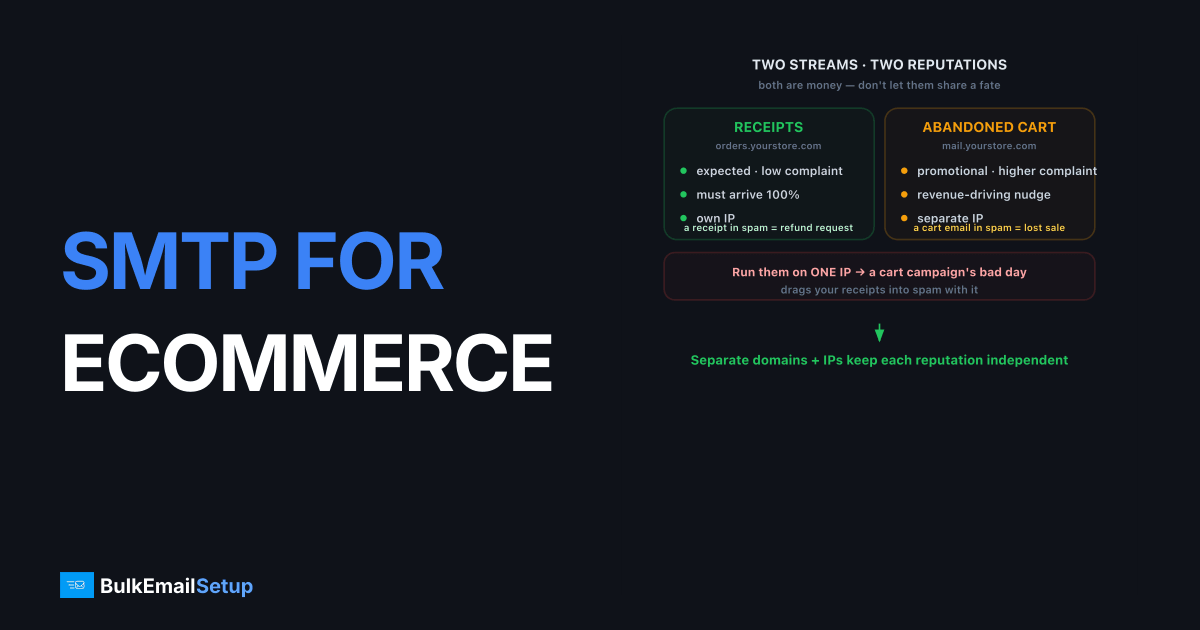
SMTP for ecommerce abandoned-cart and receipts routes two distinct email streams, the must-arrive transactional receipts and the revenue-driving abandoned-cart campaigns, through dedicated SMTP with stream separation, correct authentication, and a dedicated IP you control. These emails are not just messages; they are money. A receipt in spam triggers a support ticket and a refund request. An abandoned-cart email in spam is a lost sale. Keeping the two streams separate and properly authenticated is how high-volume stores protect both the trust and the revenue tied to email.
The key insight: receipts and cart emails have different jobs and different risk profiles, so they should not share a reputation. Treat them as one stream and a cart campaign's bad day takes your receipts down with it.
Why ecommerce email needs stream separation
Ecommerce email needs stream separation because transactional and marketing mail carry very different complaint risk, and mixing them lets the risky stream poison the critical one. Receipts and shipping updates almost never draw complaints, since customers expect them. Abandoned-cart and promotional emails draw far more complaints, because they are unsolicited follow-ups. Run both off one IP and a complaint spike on your cart flow drags your receipt deliverability down with it.
The two streams compared:
- Transactional (receipts, shipping, order updates). Expected, low complaint, must arrive 100% of the time.
- Marketing-flavored (abandoned cart, promotions, win-back). Promotional, higher complaint, revenue-driven but filter-prone.
Sending receipts from orders.yourstore.com and campaigns from mail.yourstore.com, on separate IPs, keeps each stream's reputation independent. The same logic as subdomain separation for sending, applied to ecommerce streams.
Transactional vs abandoned-cart sending
The two streams need different handling. Here is how they differ and why separation matters.
| Factor | Receipts (transactional) | Abandoned cart (marketing) |
|---|---|---|
| Recipient expectation | High, awaited | Lower, a nudge |
| Complaint risk | Very low | Moderate to high |
| Filtering pressure | Light | Promotions-tab, content scoring |
| Must-arrive priority | Absolute | Important, not critical |
| Ideal stream | Dedicated transactional IP | Separate marketing IP |
| Unsubscribe needed | No (transactional) | Yes, one-click |
| Reputation impact | Builds trust | Can swing either way |
Putting both on one IP means your receipts inherit your cart campaign's complaint rate. The dedicated IP versus shared IP analysis applies twice over here, once per stream.
How to set up SMTP for ecommerce streams
Setting up ecommerce SMTP correctly means separating streams, authenticating each one, and warming the IPs before peak season. The infrastructure is straightforward; the discipline of keeping streams apart is what protects revenue.
Separate the sending identities
Route receipts and order updates through one dedicated IP or subdomain, and abandoned-cart and promotional flows through another. This single decision protects the email customers are waiting for from anything your marketing does. If a cart campaign trips a complaint spike, your receipts keep landing.
Authenticate every stream
Set SPF, DKIM, and DMARC on each sending domain. Above 5,000 messages a day to Gmail or Yahoo, even receipts must authenticate or they hit 550 5.7.26, per Gmail's bulk sender guidelines. Keep SPF under the 10-lookup limit to avoid PermError, which matters when you stack a store platform plus marketing tools. The SPF, DKIM, and DMARC guide covers each record.
Add one-click unsubscribe to marketing flows
Abandoned-cart and promotional emails need one-click unsubscribe per RFC 8058 once you cross the bulk threshold, and you must honor opt-outs within two days. Receipts are exempt as pure transactional mail, but your marketing stream is not. Building this in protects your complaint rate.
Warm each stream's IP separately
If you run receipts and cart campaigns on two dedicated IPs, each needs its own warm-up. The receipt IP warms naturally on real order volume, since those messages already go to engaged buyers. The marketing IP needs a deliberate ramp from roughly 50 to 100 a day, sending to your most recent purchasers first. Don't point a cold marketing IP at your full cart-abandoner list on day one; that's a fast route to a listing.
Common ecommerce email mistakes
The mistakes that hurt ecommerce email mostly come from treating two different streams as one, then being surprised when a marketing problem breaks receipts. Stores that separate cleanly and authenticate both streams rarely lose order mail to spam. The recurring errors are easy to avoid once you know them.
- One IP for everything. Receipts riding the same IP as offer-heavy cart campaigns inherit every complaint spike. Split the streams.
- Assuming receipts are exempt. Above 5,000/day to Gmail or Yahoo, even receipts must authenticate or they hit
550 5.7.26. - Default platform From address. A generic
[email protected]From breaks DMARC alignment. Send from your own authenticated domain. - Over-mailing cart abandoners. A five-email cart sequence to someone who already bought elsewhere drives complaints. Cap the flow and suppress converters.
- Warming during peak. A new IP introduced in late November is cold for Black Friday. Warm it in October instead.
Check that your store platform and any separate marketing tool don't both stuff entries into one SPF record past the 10-lookup limit. That PermError silently fails SPF on both streams at once.
Protecting revenue email at peak
Peak season tests ecommerce email hardest, and a warmed, isolated dedicated IP protects revenue when a shared host would buckle. A sale can multiply both receipt and cart volume tenfold in hours. A shared host throttles that burst; a dedicated IP with clean history negotiates higher per-hour ceilings at Gmail and Yahoo, so receipts and cart nudges keep flowing when every send counts.
Warm before the peak, never during it. Ramp a new IP from roughly 50 to 100 a day over four to six weeks, following an IP warm-up schedule, so it is trusted before your busiest week arrives. An IP warmed in October is an asset in November.
We watched one store learn this the hard way. They spun up a fresh dedicated IP on November 20 and pushed their Black Friday cart-abandoner blast through it on the 28th. Gmail throttled the cold IP with 421 4.7.28, and receipts that shared the same untested setup deferred for hours. A confirmation email that lands six hours after checkout generates a "did my order go through?" ticket, which is the exact opposite of what you want during your highest-volume week. The IP itself was fine by mid-December, long after the revenue window closed.
We keep it honest: dedicated SMTP gives you separated, authenticated, warmed streams with throughput headroom. Whether your cart emails convert or land in Promotions still depends on content, targeting, and engagement. No setup guarantees inbox placement for promotional mail.
How BulkEmailSetup helps
We provide dedicated SMTP servers with dedicated IPs you control, full SMTP access on ports 587, 465, and 2525, and SPF, DKIM, DMARC, and PTR configured per stream, so receipts and abandoned-cart campaigns stay separate and protected. We handle warm-up before your peak. See plans on our pricing page.
Frequently asked questions
Should abandoned-cart and receipt emails use the same IP?
Ideally no. Receipts are pure transactional and must always arrive, while abandoned-cart emails are marketing-flavored and carry higher complaint risk. Separating them onto different IPs or subdomains protects your receipt deliverability from any reputation dip your cart campaigns cause.
Why do abandoned-cart emails go to spam?
Abandoned-cart emails are promotional, so they face the same filtering as marketing mail: content scoring, engagement signals, and Promotions-tab sorting. If they also share an IP with low-engagement bulk sends or lack proper authentication, spam placement gets worse. Separation and clean authentication help most.
Do receipts count toward bulk-sender rules?
Yes. Once your total sending to Gmail or Yahoo crosses 5,000 messages a day, transactional receipts count toward the threshold that requires SPF, DKIM, and DMARC. Unauthenticated receipts will be rejected with `550 5.7.26` just like any other unauthenticated bulk mail.
How much volume justifies a dedicated IP for ecommerce?
Around 50,000 emails a month sent consistently is the usual threshold. Many growing stores cross it quickly once you add receipts, shipping updates, abandoned-cart flows, and marketing. At that point a dedicated IP isolates your reputation and protects the revenue emails that must arrive.


