
If you want something cheaper than Klaviyo for ecommerce email, the fastest 60-70% saving comes from separating the two things Klaviyo bundles: the campaign builder and the sending layer. Klaviyo bills by contact count, so a 100K-contact store can pay $1,400-2,500/month in 2026 (check current pricing) whether sales are up or down. Move the actual sending to Amazon SES (~$10 per 100K emails) or a managed dedicated SMTP server (flat ~$50-150/month) and keep a cheaper marketing tool for the UI. Most stores I've migrated land at $200-500/month all-in.
I've moved a dozen ecommerce senders off Klaviyo. The honest math, where the savings really come from, and who should not bother.
Why Klaviyo gets expensive for ecommerce
Klaviyo's pricing model is the whole story. You pay by active profile (contact), not by emails sent. That's great when your list is small and you mail rarely. It turns brutal in two situations every growing store hits.
First, list growth outpaces revenue. You run a giveaway, add 40K emails, and your bill jumps the next month even though most of those contacts never buy. Klaviyo keeps charging for them until you suppress or delete them.
Second, you mail more often. Once you're sending a few campaigns a week plus abandoned-cart and post-purchase flows, your effective send volume is huge, but you're not billed on volume, you're billed on the list. So you're paying a premium price for a list-based model while actually behaving like a high-volume sender.
Rough 2026 Klaviyo numbers look like this, check current pricing:
| Active contacts | ~Klaviyo email plan/month | Effective cost behaviour |
|---|---|---|
| 5K | ~$60 | Fine, hard to beat |
| 20K | ~$375 | Starting to sting |
| 50K | ~$720 | Most stores feel it here |
| 100K | ~$1,400 | Expensive vs send volume |
| 250K | ~$2,500+ | Very expensive |
The SMS add-on stacks on top of this. For email-heavy stores, the email line item alone is where the bleed is.
Where the 70% saving actually comes from
You're paying Klaviyo for two separate jobs:
- The marketing brain: flows, segmentation, the drag-and-drop editor, product feeds, ecommerce integration.
- The pipes: the SMTP infrastructure that physically delivers the mail and manages IP reputation.
Klaviyo charges a premium because job #1 is genuinely good and tightly tied to Shopify data. But job #2, the actual sending, is a commodity. SES sends a million emails for ~$100. A dedicated server sends them for a flat fee. You're overpaying because the two are welded together.
The saving comes from splitting them. Run a cheaper marketing tool (or self-hosted campaign app) for the brain, and route the sending through SES or a dedicated SMTP relay. The cost drops because you stop paying contact-based marketing-suite prices for what is really a relay job. For the full version of this argument across providers, see Klaviyo alternatives and the broader self-hosted vs managed vs ESP TCO breakdown.
The real cost comparison
At 50K contacts mailing roughly 300K emails/month, the real 2026 cost across setups breaks down like this (ballparks, check current pricing):
| Setup | Marketing UI | Sending | ~Total/month | Who owns deliverability |
|---|---|---|---|---|
| Klaviyo (bundled) | Included | Included | ~$720 | Klaviyo (shared infra) |
| Brevo + dedicated IP | ~$65-100 | Add-on IP | ~$150-250 | Shared/add-on |
| Omnisend + SES | ~$130 | ~$30 | ~$160 | You |
| Self-hosted app + SES | $0-40 (server) | ~$30 | ~$70-110 | You |
| Marketing tool + managed dedicated SMTP | ~$65-130 | Flat ~$50-150 | ~$200-280 | Managed for you |
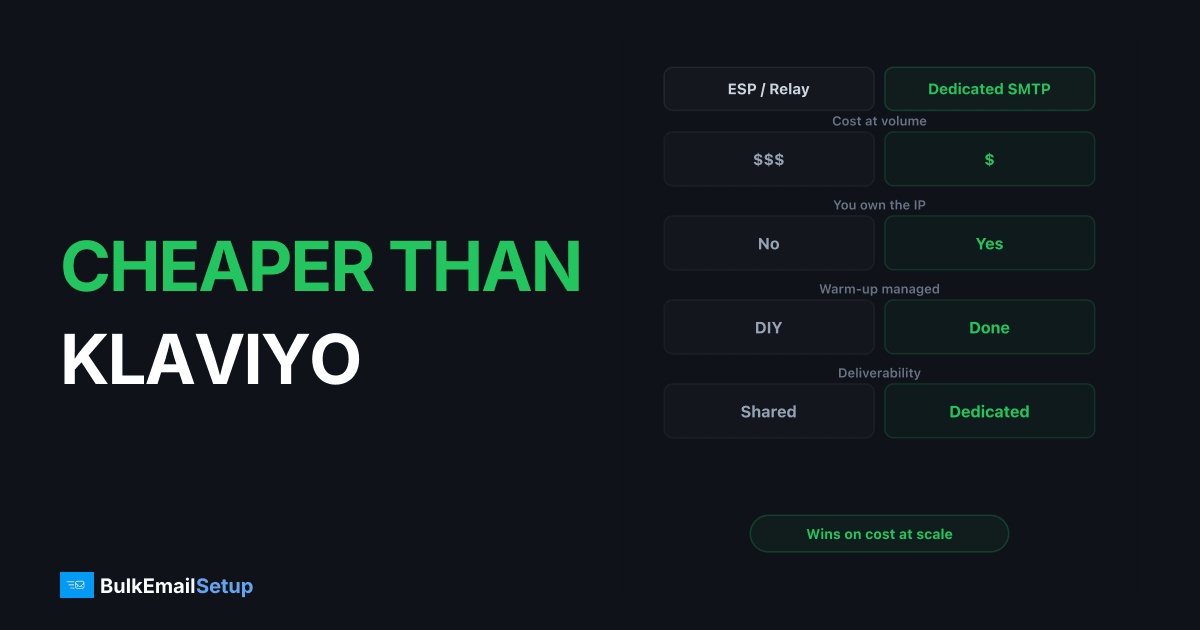
The managed dedicated SMTP line isn't the absolute cheapest, but it's the one where deliverability is handled and the price doesn't move when your list grows. Going from $720 to ~$220 is a 70% cut, and the bill stays flat at 100K or 250K contacts where Klaviyo would be at $1,400-2,500.
If your store is smaller, the picture flips. Below 10K contacts, Klaviyo's starter tiers run ~$45-60 and the engineering effort to split things isn't worth it. Don't migrate to save $30.
The catch nobody mentions: Klaviyo won't relay through your SMTP
Here's the honest caveat. Klaviyo does not let you bring your own SMTP server for its native sends. You can't keep the Klaviyo editor and just swap the pipes underneath. So "cheaper than Klaviyo" really means "replace Klaviyo," not "make Klaviyo cheaper."
That means two real migrations:
- Rebuild your flows in the new marketing tool (or a self-hosted app). Abandoned cart, welcome series, post-purchase, win-back. Plan a weekend for a store with the standard flow set.
- Stand up the sending layer with proper authentication and IP warm-up.
Tools that do allow a custom SMTP relay include Brevo, Omnisend, and most self-hosted campaign apps. Those are what let you point the sending at SES or a dedicated server. That's the combination that gets you the saving.
Picking the sending layer
Once you've chosen a marketing tool that allows custom SMTP, the sending decision is the same one every bulk sender faces:
- Amazon SES is the price floor at ~$10 per 100K emails. Cheapest possible, but you own warm-up, blacklist monitoring, and bounce handling. SES will also auto-pause you if complaint rates climb, which ecommerce promo blasts can trigger. See Amazon SES alternatives and Amazon SES vs dedicated SMTP server.
- Managed dedicated SMTP gives you your own dedicated IP with warm-up and monitoring handled, at a flat ~$50-150/month. Reputation is fully yours, which matters for ecommerce where one bad Black Friday blast shouldn't tank your order-confirmation deliverability. Read is managed SMTP worth it.
- Self-hosted Postal/Postfix is cheapest at scale but you carry all the ops. Fine if you have sysadmin time.
The reason I push dedicated IP for ecommerce specifically: your list quality is variable (giveaways, one-time buyers, cold leads), and on shared IPs you inherit other senders' reputation. On a warmed dedicated IP, your sending stands on its own. More on that in dedicated IP vs shared IP and how long IP warm-up takes.
Cost at different store sizes
| Contacts / volume | Klaviyo | SES (send only) | Managed dedicated SMTP (send only) |
|---|---|---|---|
| 5K / 20K sends | ~$60 | ~$2 | ~$50 (overkill) |
| 50K / 300K sends | ~$720 | ~$30 | ~$50-150 flat |
| 100K / 600K sends | ~$1,400 | ~$60 | ~$100-150 flat |
| 250K / 1.5M sends | ~$2,500+ | ~$150 | ~$150-200 flat |
Add a marketing tool (~$65-130) on top of the SES and dedicated columns for the full all-in number. The pattern: Klaviyo's contact-based bill climbs with list size, flat-fee sending doesn't move. For the raw send economics, see cost to send 1 million emails per month and cheapest way to send 100K emails per month.
Who should stay on Klaviyo
I'll be blunt. Klaviyo is worth the money for some stores:
- Under 10K contacts. The starter tiers are cheap and the migration effort isn't worth it.
- You live in the flows and SMS. If Klaviyo's predictive analytics, product recommendations, and tight Shopify sync are driving real revenue, ripping that out to save a few hundred dollars can cost you more in lost sales.
- No technical resource at all. Splitting the stack means owning a sending layer. If nobody on your team can manage that or pay someone who can, the all-in-one is safer.
The stores that should switch: 50K+ contacts, email-heavy (not SMS-heavy), where the Klaviyo email line item is $700+/month and the flow set is stable enough to rebuild once. That's where the 60-70% saving is real and durable.
Migration sequence that works
- Export everything from Klaviyo first. Profiles, suppression list, unsubscribes, bounces. Mailing a previously-unsubscribed contact is a complaint generator and a compliance problem. See how to reduce email bounce rate.
- Rebuild flows in the new tool before cutting over. Test each with a seed list.
- Set up authentication on a sending subdomain. SPF, DKIM, DMARC alignment. Use a subdomain so the new reputation is isolated, see subdomain vs root domain for email sending.
- Warm the new IP over 2-4 weeks, starting with your most engaged buyers while Klaviyo carries the rest.
- Keep Klaviyo on a downgraded plan for 30 days as fallback.
For the relay-cost side of this, SMTP relay pricing comparison and cheaper than Mailchimp cover adjacent moves; bulk email setup under $100 shows a budget build.
How BulkEmailSetup helps
BulkEmailSetup provides dedicated SMTP servers with managed IP warm-up, blacklist monitoring, and full DNS setup, so you keep whatever marketing tool you like and route its sending through your own warmed dedicated IP. For a 50K-100K contact ecommerce store paying $700-1,400/month to Klaviyo, the flat sending fee typically cuts total email cost by 60-70%, and it stays flat as your list grows. See pricing for current plans, or best dedicated SMTP server providers to compare vendors first.
Frequently asked questions
What is a cheaper alternative to Klaviyo?
For the sending layer, Amazon SES (~$10 per 100K emails) or a managed dedicated SMTP server (flat ~$50-150/month) are far cheaper than Klaviyo, which can run $700-2,500/month at 50K-100K contacts. The trade-off is you keep a separate tool for the campaign builder and flows, since Klaviyo bundles both.
Why is Klaviyo so expensive?
Klaviyo prices by active contact count, not by emails sent. A 100K-contact list costs roughly the same whether you mail it once a month or ten times. As your list grows the bill climbs even if revenue is flat, which is why high-volume senders feel the squeeze.
Can I keep Klaviyo flows but send through a cheaper SMTP?
Partly. Klaviyo doesn't let you bring your own SMTP relay for its native sends. To cut the sending cost you move the actual mailing to a tool like a self-hosted campaign app or a marketing suite (Brevo, Omnisend) that allows a custom SMTP relay, then point that relay at SES or a dedicated server.
Is dedicated SMTP cheaper than Klaviyo for ecommerce?
At sustained volume, yes, usually by 60-70%. A flat-fee dedicated SMTP server doesn't care about list size or send count, while Klaviyo charges more as both grow. Below ~10K contacts Klaviyo's free and starter tiers are hard to beat on convenience.


