
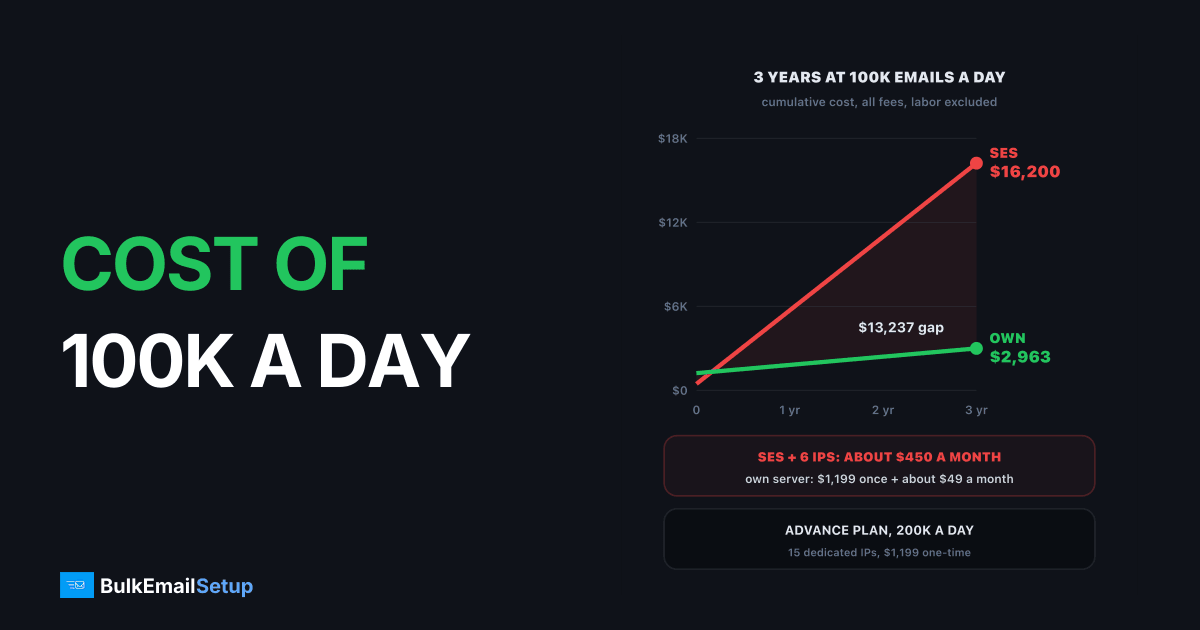
Sending 100,000 emails a day means about 3 million emails a month, and the bill runs from roughly $300 a month on Amazon SES to four figures on most email platforms. SES is $0.10 per 1,000 emails, so 3 million is about $300 in send fees before you add dedicated IPs and your own engineering time. SendGrid, Mailgun and Postmark all push you onto a quote-only tier at this volume. Owning the server flips the math: a one-time build, then around $49 a month in hosting with no per-email fee.
Below is the full breakdown, how many IPs 100K a day actually needs, and where each route stops making sense.
100,000 a day is a 3 million a month problem
Most pricing pages quote monthly volume, so convert first. 100,000 a day over a 30-day month is 3,000,000 emails. That single number decides which tier you land on, and at most providers it lands you past the last public price.
| Daily volume | Monthly volume | Where most ESP pricing pages stop |
|---|---|---|
| 10,000 | 300,000 | well inside public tiers |
| 50,000 | 1,500,000 | top public tiers |
| 100,000 | 3,000,000 | past public tiers, sales quote |
| 200,000 | 6,000,000 | enterprise contract |
That last column matters more than the per-email rate. Once you are on a quote, the price depends on your negotiating position, the contract length and the add-ons sales bundles in.
Cost to send 100,000 emails a day, by provider
All figures are list prices from each provider's own pricing page in October 2026, scaled to 3 million emails a month. Where the page stops, the "at list rates" figure shows what the overage maths would produce. Nobody should pay that; it is there to show why you need a quote.
| Route | What 3M a month costs | Dedicated IPs | Notes |
|---|---|---|---|
| Amazon SES (a la carte) | ~$300 send fees | $24.95 per IP a month | you build bounce handling, warm-up, monitoring |
| SES managed dedicated IP | ~$255 ($15 + $0.08 per 1,000) | pool managed by AWS | still DIY for everything else |
| Resend | past the $1,150 Scale tier (2.5M) | $30 a month add-on | 3M needs a custom quote |
| SMTP2GO | $2,540 at list rates | included on Professional | Premier is a quote above 3M |
| Mailgun | $3,280 at list rates | 1 included, extras $59 a month | Enterprise quote above 2.5M |
| SendGrid | Premier quote | included on Pro and up | public Pro tiers stop below this volume |
| Own server (Advance plan) | $1,199 once + ~$49 a month | 15 included, you own them | 200,000 a day capacity |
Two lines on that table need explaining.
Mailgun at list rates is the Scale plan at $90 for 100,000 emails plus 2.9 million overage emails at $1.10 per 1,000. That is $3,280. SMTP2GO is Professional at $75 for 100,000 plus 2.9 million at $0.85 per 1,000, so $2,540. Both providers will quote lower than that for a committed contract, but the overage line is what you pay if you just grow into this volume without renegotiating.
The Amazon SES pricing page is the one public price that scales flat all the way: $0.10 per 1,000 at 3 million, at 30 million, at any volume. That is why SES is the cost floor in every comparison on this site.
What 3 million emails a month costs at list prices, October 2026
The costs the pricing page leaves out
The send fee is the line everyone compares. At 100,000 a day it is often not the biggest line.
- Dedicated IPs. SES charges $24.95 per IP a month. Six IPs is about $150. On an ESP, extra IPs are $30 to $59 each.
- Engineering time on SES. Bounce and complaint processing via SNS, suppression lists, a warm-up schedule, blocklist monitoring. Count 20 to 40 hours to build and a few hours a week to run.
- List validation. At 3 million sends you will want to validate new contacts. Mailgun bills validations separately; most platforms do.
- Overage on spike days. A launch that sends 250,000 in a day on a capped plan gets billed at the overage rate.
- Contact fees. If you send from Mailchimp or Klaviyo, you pay for the list, not the sends. A 100,000-contact list is about $800 a month on Mailchimp Standard and about $1,380 on Klaviyo.
Add those up and SES at "$300 a month" usually becomes $500 to $1,500 once a developer's time is priced in. The managed SMTP vs DIY time cost post puts hours against each task.
How many IPs 100,000 a day actually needs
Plan for 4 to 8 warmed dedicated IPs. Mailbox providers throttle per IP. Microsoft and Yahoo start deferring a single well-reputed IP somewhere around 10,000 to 20,000 messages a day, and far less for a young one. Splitting 100,000 across 6 IPs keeps each IP near 17,000 a day.
| IPs in the pool | Per IP per day at 100K | Headroom |
|---|---|---|
| 2 | 50,000 | none, deferrals likely at Microsoft and Yahoo |
| 4 | 25,000 | tight on busy days |
| 6 | ~16,700 | comfortable |
| 8 | 12,500 | room to split streams |
| 15 (Advance plan) | ~6,700 | room to double volume |
Spreading 100K a day across a 6-IP pool keeps each IP inside receiver limits
More IPs is not free on an ESP, where each one is a monthly add-on. On your own server the IP is a line item from your host at about $2 a month, so the pool can be bigger than the bare minimum. The full sizing logic is in how many IPs you need for your volume, and the architecture around the pool is in the infrastructure to send 100K emails per day.
What the hardware looks like
Less than people expect. 100,000 messages a day is about 70 a minute spread evenly, or a few hundred a minute in a campaign burst. A modern MTA on a small VPS handles that without strain. The limit is never CPU. It is reputation per IP and per domain.
The BulkEmailSetup Advance plan, built for 200,000 a day, runs on one 4 GB RAM VPS:
| Hosting line | What it is | Monthly cost |
|---|---|---|
| VPS | Ubuntu 22, 4 GB RAM, 40 GB storage | ~$19 |
| 15 dedicated IPs | rotated per send, about $2 each | ~$30 |
| 4 domains | spare sending domains, about $10 a year each | ~$3 averaged |
| Total | paid to your own hosting provider | ~$49 |
That is three SMTP servers sharing the IP pool, each good for about 67,000 a day, so 100,000 a day uses half the capacity.
SES vs your own server over three years
This is the comparison most 100K-a-day senders are really making. Both routes are cheap per email. The difference is how the money falls over time.
| Year | Amazon SES (6 IPs) | Own server, Advance plan |
|---|---|---|
| Year 1 | $300 + $150 a month = ~$5,400 | $1,199 + 12 x $49 = ~$1,787 |
| Year 2 | ~$5,400 | ~$588 |
| Year 3 | ~$5,400 | ~$588 |
| 3-year total | ~$16,200 | ~$2,963 |
The SES column excludes the engineering hours, which are the expensive part. The own-server column includes everything you pay: setup, VPS, IPs, domains. Our break-even analysis for dedicated SMTP runs this comparison at other volumes.
Cumulative cost over 36 months at 100,000 emails a day
SES still makes sense if you already run serious AWS infrastructure, have an engineer who enjoys mail operations, and need to burst far above 200,000 a day without notice. For everyone else at this volume, paying per email for ever is the expensive habit.
The warm-up decides when you hit 100K, not the plan
None of these routes lets you send 100,000 on day one. New IPs have no history, and Gmail, Microsoft and Yahoo throttle unknown senders hard. Expect 6 to 12 weeks before a fresh pool carries 100,000 a day cleanly.
A realistic ramp across 6 IPs:
- Week 1: 500 to 1,000 per IP per day, only your most engaged contacts.
- Weeks 2 to 3: roughly double every few days while deferrals stay under 2%.
- Weeks 4 to 6: 5,000 to 10,000 per IP per day, add less engaged segments.
- Weeks 6 to 12: reach 15,000 to 17,000 per IP, which is your 100K a day.
Watch 4xx deferrals, not open rates. A rising 421 rate means you are moving faster than the receivers trust you. The week-by-week version is in the IP warm-up schedule.
Which route fits which sender
| Your situation | Best fit at 100K a day |
|---|---|
| Strong AWS team, mail is one of many systems | Amazon SES with dedicated IPs |
| Need templates, a UI and support, cost is secondary | an ESP on an annual contract |
| Want flat cost and your own IPs, no per-email fee | own server with a managed setup |
| Volume swings from 20K to 300K in a day | own server sized for the peak, or SES |
| Already on Mailchimp or Klaviyo with a big list | move sending off contact-based pricing first |
How BulkEmailSetup helps
The Advance plan is built for this volume: 3 SMTP servers, 15 dedicated IPs with rotation, 200,000 emails a day and unlimited contacts. It is $1,199 one-time, and after that you pay only your hosting provider, about $49 a month. SPF, DKIM and DMARC are set up for you, the email marketing platform and customer panel are included, and IP warm-up runs automatically with our team watching the first sends.
See the full cost breakdown on the Advance plan page, or compare all three tiers on pricing. Every plan comes with a 15-day money-back guarantee.
Frequently asked questions
How much does it cost to send 100,000 emails a day?
100,000 a day is about 3 million emails a month. On Amazon SES the send fees are about $300 a month plus dedicated IPs at $24.95 each and your own labor. Most ESPs push you onto a quote-only enterprise tier at this volume, usually four figures a month. Your own server costs a one-time build plus roughly $49 a month in hosting.
How many IPs do I need for 100K emails a day?
Plan for 4 to 8 warmed dedicated IPs. Microsoft and Yahoo start deferring a single IP somewhere around 10,000 to 20,000 messages a day, so spreading 100,000 across 6 IPs keeps each one well inside that range. More IPs also give you room to split marketing and transactional mail into separate streams.
Is SES or a dedicated server cheaper at 100K a day?
On cash, SES wins month one: about $300 in send fees plus $75 to $200 for IPs. A dedicated server costs more on day one but nothing per email afterwards. On the BulkEmailSetup Advance plan, $1,199 one-time plus about $49 a month in hosting, year two costs about $588 in total versus roughly $5,400 a year on SES with 6 IPs.
What hosting does 100K a day need?
One 4 GB RAM VPS can run three SMTP servers that share 15 rotating IPs, which is enough for 200,000 emails a day. The BulkEmailSetup Advance plan uses exactly that, at about $19 a month for the VPS and $30 for the IPs. CPU is rarely the limit at this volume. Per-IP reputation and receiver throttling are.
How long does it take to reach 100,000 emails a day on new IPs?
Budget 6 to 12 weeks. New IPs have no history, so you start each one at a few hundred to a few thousand messages a day to your most engaged contacts and ramp up as deferrals stay low. Pushing 100,000 on week one produces 421 deferrals at Gmail, Microsoft and Yahoo and can damage the IPs before they ever earn trust.
Can I send 100,000 emails a day with Mailchimp or Klaviyo?
Yes, but those tools bill by contacts, not sends. Sending 100,000 a day usually means a list of 100,000 or more contacts, which is about $800 a month on Mailchimp Standard and about $1,380 on Klaviyo at 2026 list prices. That is before extra seats or SMS. Contact-based pricing is the most expensive route at this volume.


