
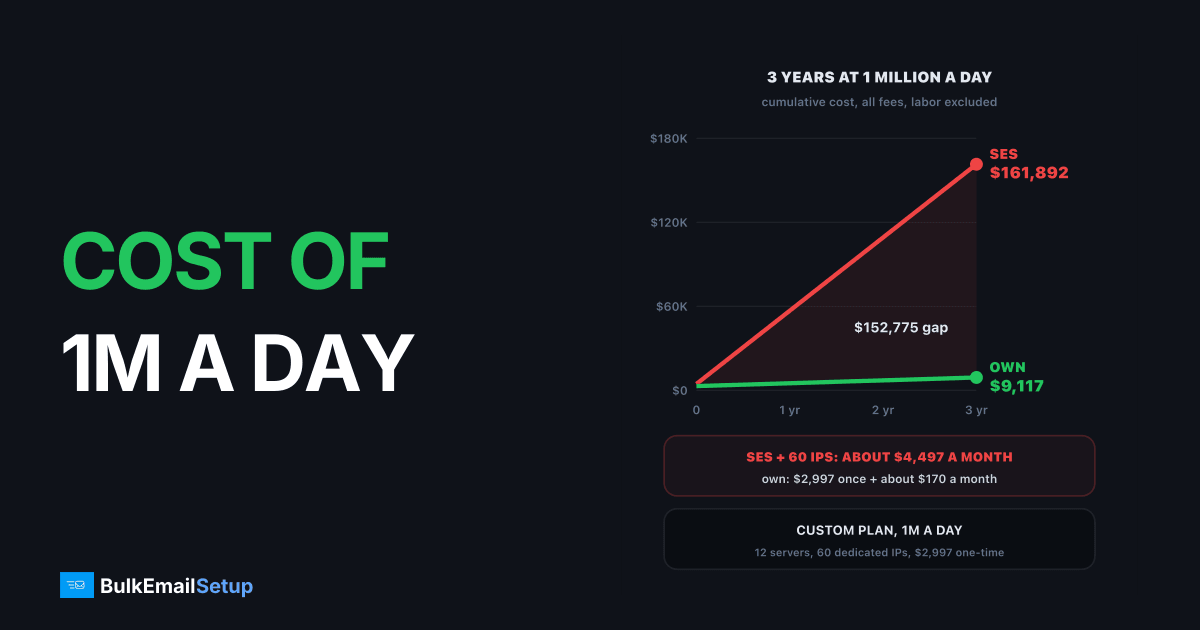
Sending 1 million emails a day means about 30 million a month, and the bill runs from roughly $4,500 a month on Amazon SES to a custom enterprise quote on most email platforms. SES charges $0.10 per 1,000, so 30 million is about $3,000 in send fees, and a pool of 60 dedicated IPs adds about $1,500 more. SendGrid, Mailgun and Postmark have no public price at this size. Owning the setup costs a one-time build plus about $170 a month in hosting, which is where the three-year numbers split wide open.
1 million a day is a 30 million a month problem
Convert first, because every pricing page talks in months.
| Daily volume | Monthly volume | Where it lands on most ESPs |
|---|---|---|
| 100,000 | 3,000,000 | past public tiers, sales quote |
| 250,000 | 7,500,000 | enterprise contract |
| 1,000,000 | 30,000,000 | enterprise contract, dedicated account team |
At 30 million a month you are no longer shopping from a price list. You are negotiating. That makes it important to know the floor, which is what the rest of this post works out.
Cost to send 1 million emails a day, by route
| Route | Monthly cost at 30M | What is included | What you still build |
|---|---|---|---|
| Amazon SES + 60 standard IPs | ~$3,000 + | sending, IPs | bounces, warm-up, monitoring, campaign tool |
| Amazon SES + managed dedicated IPs | ~$3,000 + | sending, AWS-managed IP pool | bounces, campaign tool |
| SendGrid Premier | custom quote | sending, IPs, support | integration |
| Mailgun, Postmark, SMTP2GO | custom quote | sending, IPs | integration |
| Own setup (Custom plan) | ~$170 hosting after $2,997 once | 12 SMTP servers, 60 IPs, panel | warm-up runs automatically |
The SES figures come straight from the Amazon SES pricing page: $0.10 per 1,000 emails, $24.95 per standard dedicated IP a month, and for managed dedicated IPs a $15 base fee plus $0.08 per 1,000 for the first 10 million and $0.04 per 1,000 from 10 to 50 million. At 30 million that managed fee is $15 + $800 + $800 = $1,615.
Monthly cost at 1 million emails a day, list prices November 2026
What SendGrid and the other ESPs charge at 30 million
None of them publish it. SendGrid's public Essentials and Pro plans stop far below 30 million a month, so you are on Premier, a quote. Mailgun, Postmark and SMTP2GO all move to custom contracts long before this volume too.
What a quote at this size usually bundles:
- a committed monthly volume, billed whether you send it or not
- a dedicated IP pool sized by the vendor
- a contract term, usually 12 months or more
- a support tier, often priced separately
Walk into that call with the SES numbers above. A shared-infrastructure vendor charging several times the AWS floor needs to justify it with support, tooling or deliverability services you would otherwise build. Our SMTP pricing per 1,000 emails comparison has rates across providers to hold a quote against.
How many servers and IPs 1 million a day needs
Less hardware than most people picture, and more IPs.
| Piece | What 1M a day needs | Why |
|---|---|---|
| Physical server | 1 dedicated machine, 32 GB RAM | an MTA is light; CPU is not the limit |
| SMTP instances | 12 | about 83,400 a day each, spreads load and risk |
| Dedicated IPs | about 60 | ~16,700 a day per IP, inside receiver comfort |
| Sending domains | about 13 | spread reputation, isolate a problem domain |
| Bounce processing | automatic | 30M sends means thousands of bounces a day |
One machine, 12 SMTP instances, 60 IPs: the shape of a 1M a day setup
The IP count is the number that matters. Microsoft and Yahoo start deferring a single IP somewhere around 10,000 to 20,000 messages a day, and less for a young one. Divide a million by 60 and each IP carries about 16,700. Go down to 20 IPs and each one has to push 50,000 a day, which is how pools get throttled. The full sizing logic is in how many IPs you need for your volume.
SES vs owning the setup over three years
Both routes are cheap per email. The difference is that one has a meter.
| Year | Amazon SES + 60 IPs | Own setup, Custom plan |
|---|---|---|
| Year 1 | 12 x $4,497 = ~$53,964 | $2,997 + 12 x $170 = ~$5,037 |
| Year 2 | ~$53,964 | ~$2,040 |
| Year 3 | ~$53,964 | ~$2,040 |
| 3-year total | ~$161,892 | ~$9,117 |
The own-setup column is everything you pay: the one-time fee, the dedicated server at about $50 a month and 60 IPs at about $2 each. Spare domains add about $130 a year. The SES column leaves out engineering, which at this volume is at least part of a full-time role: SNS bounce pipelines, suppression, monitoring, warm-up, and a campaign front end, because SES does not include one.
Cumulative cost at 1 million emails a day
SES still wins in one case: you already run a large AWS estate, you have mail engineers, and your volume swings from zero to several million a day with no warning. For steady daily volume, paying per email for ever is the expensive choice. The break-even point for dedicated SMTP post shows where the lines cross at lower volumes.
The warm-up decides when you reach a million
No route sends a million on day one. A fresh pool of 60 IPs needs 8 to 12 weeks.
- Week 1: a few hundred to 1,000 per IP per day, only your most engaged contacts. About 30,000 to 60,000 a day across the pool.
- Weeks 2 to 4: roughly double every few days while 4xx deferrals stay under 2%.
- Weeks 5 to 8: 8,000 to 12,000 per IP, add older segments.
- Weeks 8 to 12: reach about 16,700 per IP, which is your million.
Watch deferrals by receiver. Microsoft often lags Gmail by a week or two. If one domain falls behind, slow that domain, not the whole pool. Week-by-week numbers are in the IP warm-up schedule.
Costs nobody puts on the pricing page
- Bounce handling. Even a clean list throws thousands of bounces a day at 30 million a month. Without automatic suppression, they pile up and hurt reputation.
- Feedback loops. Microsoft JMRP and Yahoo's complaint feed need to be wired into suppression, per IP or per domain.
- Monitoring. Blocklist checks across 60 IPs, Google Postmaster Tools per domain, Microsoft SNDS per IP range.
- Contact pricing if you stay on a marketing platform. Mailchimp and Klaviyo bill by list size, so a 500,000 contact list costs thousands a month before a single send.
Which route fits which sender
| Your situation | Best fit at 1M a day |
|---|---|
| Large AWS estate, mail engineers on staff | Amazon SES with dedicated IPs |
| Need vendor support and an SLA more than low cost | an ESP enterprise contract |
| Steady daily volume, want flat cost and your own IPs | own setup with a managed build |
| Several brands or clients on one platform | own setup with white label |
Our best SMTP setup for 1M a day compares the vendors one by one, and what 10 million emails a month costs covers the step below this one.
How BulkEmailSetup helps
The Custom plan is built for this volume: 12 dedicated SMTP servers on one dedicated host, 60 dedicated IPs with rotation, 13 sending domains, 1,000,000 emails a day and unlimited contacts. It is $2,997 one-time, and after that you pay your hosting provider about $170 a month. SPF, DKIM and DMARC are set up on every domain, the campaign platform and customer panel are included, IP warm-up runs automatically, and you get priority support.
There is no monthly fee to us. The 15-day money-back guarantee applies until server access is handed over. See the full breakdown on the Custom plan page or compare tiers on pricing.
Frequently asked questions
How much does it cost to send 1 million emails a day?
1 million a day is about 30 million emails a month. Amazon SES charges $0.10 per 1,000, so about $3,000 in send fees, plus around $1,500 for 60 dedicated IPs at $24.95 each, before engineering time. Most ESPs only quote at this size. A self-owned setup like BulkEmailSetup's Custom plan is $2,997 one-time plus about $170 a month in hosting.
How many servers send 1 million emails a day?
One well-sized physical server is enough for the hardware. A typical build runs 12 SMTP server instances on a single dedicated machine with 32 GB of RAM, each sending about 83,400 a day. What really takes capacity is IPs: plan for around 60 dedicated IPs so each stays near 16,700 messages a day, inside what Gmail, Microsoft and Yahoo accept from a warmed IP.
What does SendGrid charge at 30 million a month?
SendGrid does not publish a price at that volume. Its public Essentials and Pro tiers stop well short of 30 million a month, so you land on Premier, which is a custom quote. Expect the quote to depend on contract length, dedicated IP count and support level. Use Amazon SES at about $3,000 in send fees as the floor when you negotiate.
What is the cheapest way to send 1M a day?
On monthly cash, Amazon SES with your own engineering team is the cheapest metered option at about $4,500 a month with 60 IPs. Over three years, owning the setup is far cheaper: about $9,117 all-in on BulkEmailSetup's Custom plan versus roughly $161,900 on SES with the same IP count. Either way, the warm-up takes 8 to 12 weeks.
How long does it take to reach 1 million emails a day?
Plan for 8 to 12 weeks with a fresh pool of 60 IPs. Each IP starts at a few hundred to a thousand messages a day to your most engaged contacts and roughly doubles every few days while deferrals stay low. Sending a million on week one from new IPs gets throttled at every major mailbox provider and can damage the IPs for months.
Do I need a list of 1 million contacts to send 1 million a day?
No. Many senders reach 1 million a day with a few hundred thousand contacts mailed more than once a day, or with several brands and streams combined, such as newsletters plus transactional mail. Volume is what drives the infrastructure. On per-contact platforms the list size drives the bill instead, which is why big senders move off them first.


