
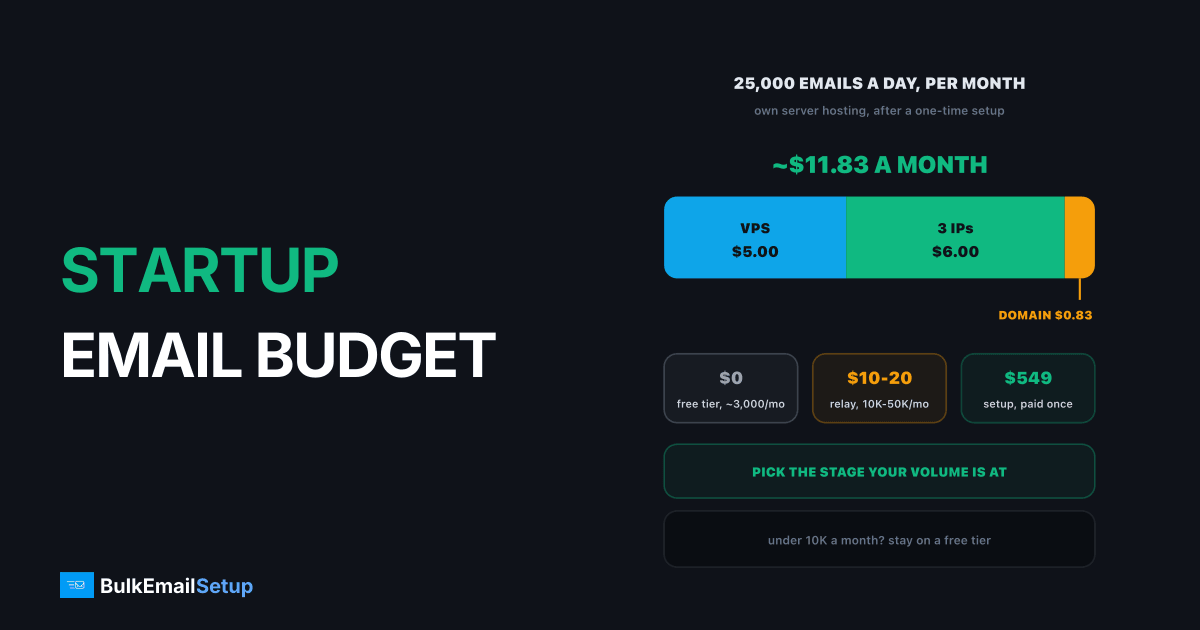
The cheapest bulk email setup for a startup depends on one number: how many emails you send a month. Under about 3,000, a free tier costs nothing. From 10,000 to 50,000, a paid relay costs $10 to $20 a month, or a few dollars on Amazon SES at $0.10 per 1,000 if you have a developer. Once you are steadily past about 25,000 a day, your own server at roughly $11 a month in hosting, after a one-time setup, undercuts every per-email price. Most startups waste money by jumping a stage early, or by staying on a free tier until it breaks mid-launch.
Stage 1: free tiers, up to a few thousand a month
Every free tier is shaped differently, and the daily cap matters more than the monthly one. These are the figures from each provider's pricing page, checked for our SMTP free trial comparison:
| Provider | Free volume | Daily cap | First paid step |
|---|---|---|---|
| Mailjet | 6,000 a month | 200 a day | Essential $19 a month (15,000) |
| Resend | 3,000 a month | 100 a day | Pro $20 a month (50,000) |
| SMTP2GO | 1,000 a month | none stated | Starter $10 a month (10,000) |
| Brevo | 300 a day | 300 a day | Starter, low monthly fee |
| Postmark | 100 a month | none stated | Basic $15 a month (10,000) |
| Mailgun | 100 a day | 100 a day | Basic from $15 a month |
The daily cap is what bites first. A free tier with a big monthly allowance and a small daily one cannot send a single campaign to a real list in one go.
A 5,000-person list through a 300-a-day free plan takes 17 days. That is not a campaign.
If your launch list is 2,000 people, any of these works. If it is 8,000 and you want everyone to get the announcement the same morning, none of them do. Our guide to Brevo's daily sending limit shows what that looks like in practice.
Stage 2: paid relays and SES, 10,000 to 50,000 a month
This is where most startups sit for their first year, and where the cheapest option depends on who is doing the work.
| Option | Cost at 10,000 a month | Cost at 50,000 a month | Needs |
|---|---|---|---|
| Amazon SES | about $1 | about $5 | a developer, DNS work, out of the sandbox |
| SMTP2GO Starter | $10 | higher tier | an app or mailer to send from |
| Postmark Basic | $15 | higher tier | an app or mailer, and approval |
| Resend Pro | $20 | $20 | an app, developer-friendly API |
| Mailjet Essential | $19 (15,000) | higher tier | a campaign editor included |
Amazon SES wins on price by a wide margin; its pricing page lists $0.10 per 1,000 emails. But SES is plumbing. There is no list management, no campaign editor and no unsubscribe page until you build or plug one in, and new accounts start in a sandbox of 200 a day. If nobody on the team writes code, a relay with a dashboard is cheaper in practice.
Stage 3: your own server, past about 25,000 a day
Per-email pricing has no ceiling. Hosting does. Somewhere around 25,000 emails a day, roughly 750,000 a month, owning the sending server becomes cheaper than paying per email or per contact.
The highest step sends the most and costs about the same as the middle one, after a one-time setup.
What the monthly bill looks like on your own server, from the hosting you pay your provider directly:
The ongoing cost of 25,000 emails a day is a VPS, three IPs and a domain.
| Line | Monthly | Notes |
|---|---|---|
| VPS (2 GB RAM, 20 GB) | $5 | paid to your host |
| 3 dedicated IPs at $2 each | $6 | rotated per send |
| 1 domain at $10 a year | about $0.83 | spare sending domain |
| Total | about $11.83 | after a one-time $549 setup |
The trade-off is time. New IPs need 4 to 8 weeks of warm-up before they carry full volume, so plan the move a couple of months before your list outgrows stage 2. At what volume a dedicated SMTP pays for itself does the break-even maths in detail.
Mistakes that cost startups the most
- Buying a list to "seed" the launch. It burns the domain before you have customers. Every reputable provider bans it, and so does our anti-spam policy.
- Sending from a free Gmail address. No SPF, DKIM or DMARC on your domain, and Gmail's own 500-a-day cap. See outgrew Gmail SMTP.
- Paying per contact for a list that never opens. Per-contact pricing charges you for dead weight. Clean the list or move to per-email or flat pricing.
- Jumping to dedicated IPs at 5,000 emails a month. Too little volume to warm them or keep them warm. Stay on a relay.
- Waiting until the free tier fails mid-launch. The next stage takes days to approve and weeks to warm. Start it early.
When the free tier finally runs out, outgrew the free SMTP tier lays out the next move by volume, and the cheapest way to send 100K emails a month prices the step after that.
How BulkEmailSetup helps
When a startup reaches stage 3, we set up a dedicated SMTP server it owns, with 3 or more dedicated IPs, SPF, DKIM, DMARC and PTR configured, bounce handling, a campaign platform and a warm-up plan. You pay once, then only your hosting.
| Plan | One-time fee | Emails per day | Dedicated IPs | Hosting you pay your host |
|---|---|---|---|---|
| Basic | $549 | 25,000 | 3 | about $11 a month |
| Advance | $1,199 | 200,000 | 15 | about $49 a month |
No monthly fee to us, no contact limit, and a 15-day money-back guarantee that applies until server access is handed over. Opt-in lists only. If you are still under 10,000 emails a month, stay on a free tier or SES for now. See the Basic plan when you are ready.
Frequently asked questions
What is the cheapest way for a startup to send bulk email?
Under about 3,000 emails a month, a free tier: Resend allows 3,000 a month, Mailjet 6,000 with a 200-a-day cap, SMTP2GO 1,000. From 10,000 to 50,000 a month, Amazon SES at $0.10 per 1,000 is the lowest per-email price, but it has no campaign editor. Past roughly 25,000 a day, your own server at about $11 a month in hosting beats per-email pricing.
Are free ESP plans enough for a startup?
For a launch list and product updates, often yes. They stop working when you hit the daily cap mid-campaign, need a dedicated IP, or want support. Brevo's free plan sends 300 a day, so a 5,000-person list takes 17 days to reach everyone. Free tiers are for testing and small lists; plan the next step before your list outgrows them.
When should a startup get its own SMTP?
When volume is steady and above roughly 25,000 emails a day, or when per-contact pricing starts costing more than the server would. BulkEmailSetup's Basic plan is $549 one-time plus about $11 a month in hosting for 25,000 a day on 3 dedicated IPs. Below that volume, a free tier or SES is cheaper, and you avoid the 4 to 8 weeks of IP warm-up.
What does a startup email stack cost per month?
At launch, $0 on a free tier plus a domain at about $10 a year. At 10,000 to 50,000 emails a month, $10 to $20 on a paid relay such as SMTP2GO Starter, Postmark Basic or Resend Pro, or a few dollars on SES. At high volume on your own server, about $11 a month after a $549 one-time setup.
Is Amazon SES the cheapest option for a startup?
Per email, usually yes: $0.10 per 1,000, so 50,000 emails cost about $5. The catches are the sandbox, which caps new accounts at 200 a day until production access is approved, no built-in campaign editor or list management, and setup work in DNS and code. For developers it is the cheapest route. For a marketer without one, it rarely is.
What does a startup give up on free email plans?
Mostly control. Free tiers send from shared IPs, so other senders affect your reputation, and they cap daily volume, which turns one campaign into several days of sending. Support is limited, dedicated IPs are not offered, and the provider can review or pause the account after a bad send. None of that matters at 500 subscribers. It matters a lot at 20,000.


