
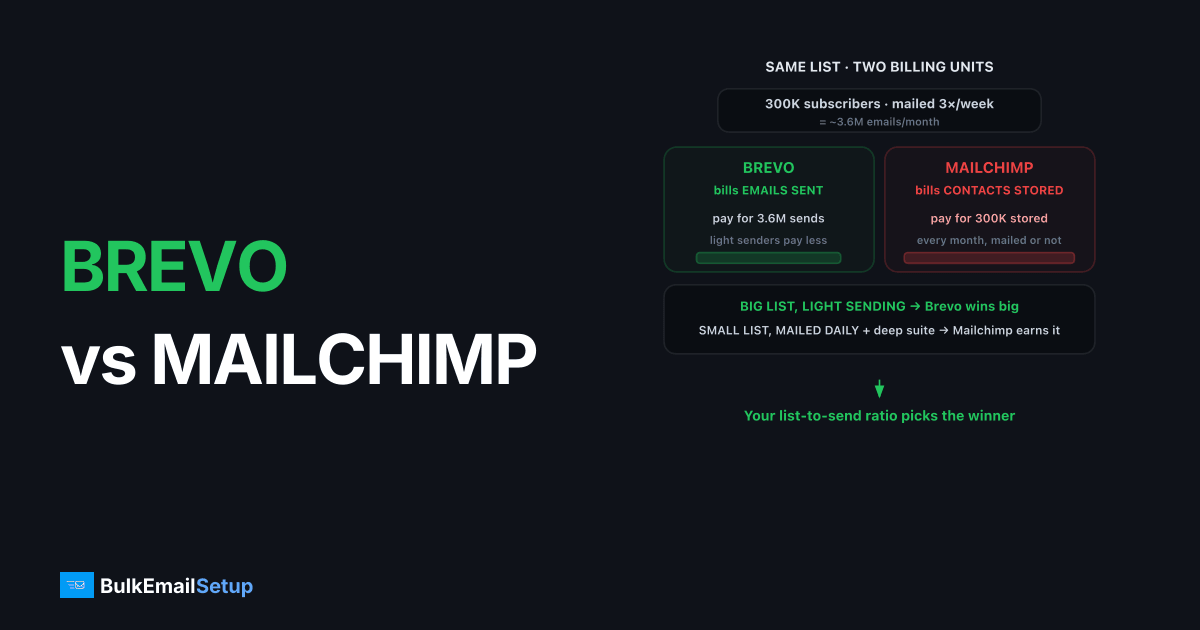
For high-volume senders, Brevo is usually cheaper than Mailchimp because Brevo prices by emails sent while Mailchimp prices by stored contacts. A 200,000-contact list mailed twice a month costs Mailchimp by the full list size, every month, regardless of sends. Brevo bills the actual send volume, so large lists stay affordable. Mailchimp counters with a stronger marketing-suite ecosystem and brand familiarity. The decision comes down to your list-to-send ratio and whether you need the wider toolset.
Brevo vs Mailchimp: the pricing models compared
The single biggest difference is the billing unit, and it decides the whole comparison for large senders. Brevo charges by emails sent. Mailchimp charges by contacts stored. Those two models produce wildly different bills for the same list.
| Factor | Brevo | Mailchimp |
|---|---|---|
| Billing unit | Emails sent | Contacts stored |
| Large list, light sending | Cheap | Expensive |
| Dedicated IP | Add-on (higher tiers) | Add-on (Premium) |
| Transactional email | Built in (API) | Separate product (Transactional) |
| Marketing suite depth | Solid, leaner | Broad (CRM, ads, automation) |
| Free tier | Yes (daily send cap) | Yes (contact cap) |
| Best for | Volume senders, big lists | Marketers wanting full suite |
If your list is large but you mail it occasionally, Brevo's send-based pricing is dramatically cheaper. If you mail a smaller list constantly and want deep automation and CRM features, Mailchimp's per-contact cost may be justified.
Run the numbers with a concrete case. A publisher with a 300K-subscriber newsletter mailed three times a week sends roughly 3.6M emails a month. On Brevo's send model you pay for those 3.6M sends. On Mailchimp you pay for storing 300K contacts every month, mailed or not, which lands in a high tier regardless of frequency. For that profile, Brevo typically wins by a wide margin. Flip it to a 30K-contact list mailed daily with heavy automation, and Mailchimp's suite can earn its keep.
Why Mailchimp gets expensive for high-volume senders
Mailchimp gets expensive at volume because you pay for every stored contact whether or not you email them. A list that grows past 100K, 200K, or 500K contacts pushes you up Mailchimp's pricing tiers based on list size alone. Inactive subscribers you keep "just in case" cost real money every month.
This contact-based model punishes the exact thing high-volume senders accumulate: large lists. It also nudges bad habits, because cleaning your list saves money but feels like deleting assets. The healthier move is regular list hygiene, which both cuts cost and protects deliverability, our email list cleaning guide covers how to do it without torching engagement. For a broader set of options, Mailchimp alternatives for high-volume senders compares the field.
There is a deliverability angle to the cost model too. When keeping a contact costs money, the temptation is to delete unengaged subscribers purely to save on the bill, which is good hygiene by accident. But teams often do the opposite: they keep paying to store dead addresses because deleting them feels like losing reach. Those stale addresses then drive up bounces and complaints, the exact metrics Gmail and Yahoo now police at the 0.3% complaint threshold. A pricing model that rewards holding onto inactive contacts quietly works against your inbox placement.
Where Brevo hits its ceiling
Brevo hits its ceiling when your volume becomes large and steady enough that even send-based pricing adds up, and when you want control its platform cannot give you. Brevo is cheaper than Mailchimp for big lists, but it is still a hosted ESP: you send through shared pools by default, and dedicated IPs are paid add-ons locked to higher tiers.
Past roughly 100K-500K emails/month sent consistently, the per-send model and add-on IPs start to look like the same metered-cost problem in a cheaper coat. You also cannot touch the MTA, tune connection limits, or fully isolate streams the way owning infrastructure allows. If you are comparing Brevo against the next tier of options, Brevo (Sendinblue) alternatives and Brevo vs a dedicated SMTP server go deeper.
Cost at a 200K list: Brevo vs Mailchimp
For a 200K-contact list, the bill depends almost entirely on how often you mail, and the two models answer that question in opposite ways. Brevo charges for sends, so frequency drives cost. Mailchimp charges for the stored 200K contacts every month, so list size drives cost regardless of how often you press send.
Treat these as model shapes, not quotes, since both vendors shift tiers and promotions.
| Sending pattern (200K list) | Brevo (per send) | Mailchimp (per contact) | Cheaper model |
|---|---|---|---|
| Mailed twice a month (400K sends) | Pays for 400K sends | Pays for 200K stored, every month | Brevo |
| Mailed weekly (~800K sends) | Pays for 800K sends | Same 200K-contact tier | Closer, often Brevo |
| Mailed daily (~6M sends) | Pays for 6M sends | Same 200K-contact tier | Mailchimp can win |
The crossover point is real. Brevo wins decisively for big lists mailed occasionally, the most common high-volume newsletter pattern. Mailchimp's flat-per-contact model only pulls ahead when you mail the same list extremely often, because at that point the per-send meter on Brevo runs hot while Mailchimp's contact count stays fixed. Most publishers and agencies sit in the occasional-to-weekly range, which is exactly where Brevo's send-based pricing is cheaper.
Where each one wins: a decision table
The right pick comes down to your list-to-send ratio and how much marketing tooling you actually use. Match the tool to your dominant pattern rather than the brand you already know.
| Your situation | Best pick | Why |
|---|---|---|
| Large list, mailed occasionally | Brevo | Send-based pricing ignores list size |
| Small list, mailed often, heavy automation | Mailchimp | Per-contact cost is low, suite earns its keep |
| Need CRM, ads, deep automation in one place | Mailchimp | Broader marketing suite |
| Transactional + marketing in one tool | Brevo | Transactional API bundled in |
| High, steady volume, cost and control matter | Dedicated SMTP server | Flat cost, dedicated IP you own |
When a dedicated SMTP server beats both
A dedicated SMTP server beats both Brevo and Mailchimp when your volume is high and predictable and you want flat costs plus a dedicated IP you control. Instead of paying per contact or per send, you rent the sending infrastructure on a flat plan and send within its capacity. No list-size penalty, no per-send metering.
The trade is that you handle warm-up, reputation, and authentication yourself, or with a managed provider. A new dedicated IP needs a 4-6 week ramp, and you must keep your complaint rate under Gmail and Yahoo's 0.3% threshold to stay deliverable, see the Gmail bulk sender requirements for 2026. For senders mailing large lists every week, owning the IP and paying flat usually wins on both cost and control.
The control matters as much as the cost for serious senders. On a dedicated IP you can split a 3.6M-monthly newsletter across multiple IPs, isolate any transactional traffic so a marketing complaint spike never delays an account email, and read your own logs when a mailbox provider starts deferring. Brevo and Mailchimp both abstract that away. For a publisher or agency whose revenue depends on reaching the inbox at volume, owning the sending reputation is the point, not a side benefit. If you are mapping out the threshold, how many emails before you need dedicated infrastructure lays out where the line sits.
How to switch between them without losing the inbox
Switching between Brevo and Mailchimp, or off either to your own infrastructure, only risks deliverability if you skip warm-up, because IP reputation does not transfer. Your domain reputation, including SPF, DKIM, DMARC, and sending history, moves with the domain. Any new sending IP starts cold.
For a large list, split the migration by engagement rather than moving everything at once. Send your most active subscribers through the new platform or IP first, since their opens and low complaint rates build positive reputation fastest, then layer in the rest as the IP warms over 4-6 weeks. Mailing your least engaged segment on a cold IP is the classic way to earn an early 550 5.7.1 block. We've watched a team port a 300K list and lead the warm-up with their oldest, never-opened addresses to "test the new setup," then hit Gmail spam-foldering within two sends as complaints climbed past 0.3%. Reversing the order, engaged first, would have spent the same volume building reputation instead of burning it. Confirm SPF stays under the 10-DNS-lookup limit, DKIM signs at 2048-bit, and DMARC sits at quarantine or reject first, and keep complaints under the 0.3% Gmail and Yahoo threshold throughout the move.
How BulkEmailSetup helps
If Mailchimp's per-contact billing or Brevo's per-send metering is outpacing your list growth, a dedicated SMTP server gives you flat monthly pricing and a dedicated IP you control. We set up SPF, DKIM, DMARC, and PTR correctly, run the warm-up, and monitor reputation so big sends keep landing in the inbox. Compare plans on our pricing page.
Frequently asked questions
Is Brevo cheaper than Mailchimp for high volume?
Usually yes. Brevo prices by emails sent, so a large list mailed occasionally stays cheap. Mailchimp prices by stored contacts, so list size alone drives cost up. For big lists, Brevo's send-based model is typically far cheaper.
Does Brevo or Mailchimp offer a dedicated IP?
Both do, on higher tiers, as paid add-ons. Brevo offers dedicated IPs on its enterprise and higher plans; Mailchimp offers them on Premium. Each costs extra monthly, and you still send through the vendor's platform rather than your own server.
Which has better deliverability, Brevo or Mailchimp?
Neither wins by brand. Both run shared pools policed to varying degrees, plus dedicated IP options at scale. Inbox placement depends on your authentication, list hygiene, and complaint rate (keep it under 0.3%), not the logo on the dashboard.
Can I send transactional and marketing email from both?
Yes. Brevo includes a transactional email API alongside marketing campaigns. Mailchimp handles transactional through its Mailchimp Transactional product (formerly Mandrill), billed separately. Brevo's bundling is simpler for teams wanting both in one place.


