
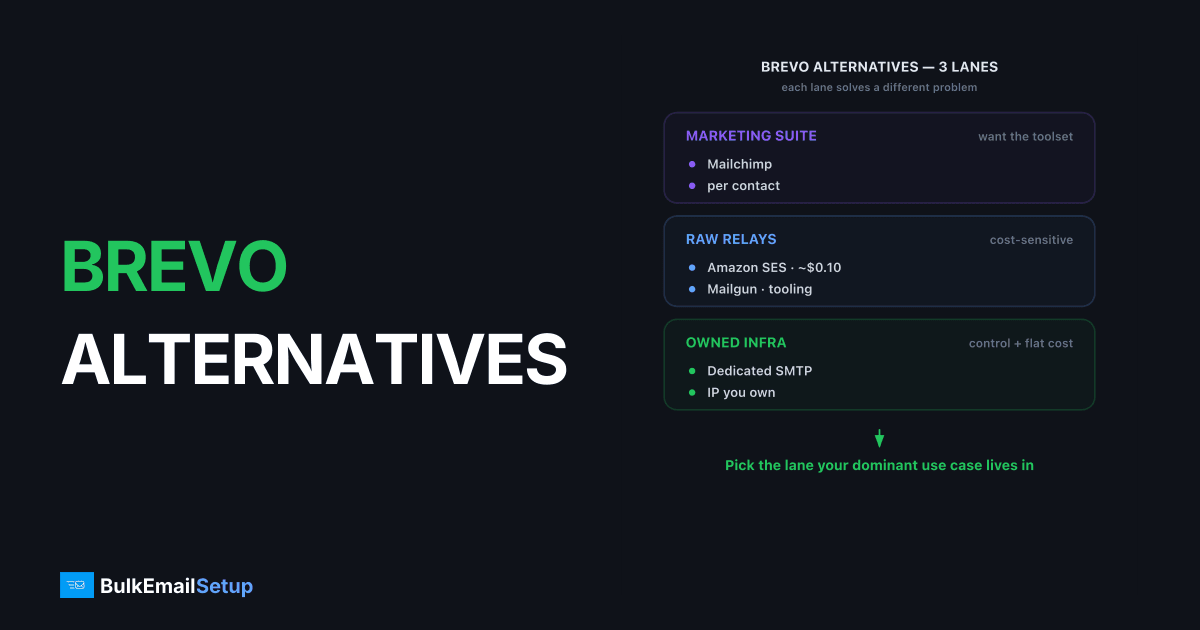
The best Brevo (Sendinblue) alternatives are Mailchimp for a full marketing suite, Amazon SES for the lowest raw cost, Mailgun for developer tooling, and a dedicated SMTP server for flat pricing with a dedicated IP you control. Brevo is strong value because it prices by emails sent rather than stored contacts. But its per-send tiers and add-on dedicated IPs limit high-volume senders who want predictable cost and full control over their sending reputation.
Why look for a Brevo alternative?
Senders move off Brevo when per-send tier pricing, limited platform control, or feature gaps start to constrain them at scale. Brevo handles small and mid-volume marketing and transactional email well, and its send-based pricing beats contact-based ESPs for large lists. The friction shows up as volume and requirements grow.
Common reasons to switch:
- Per-send tiers add up. At high, steady volume, metered pricing loses to flat infrastructure.
- Dedicated IPs are locked high. You need higher tiers to get a dedicated IP, and you still do not own it.
- Limited control. You cannot touch the MTA, tune connection limits, or fully isolate transactional from marketing at the server level.
Brevo alternatives compared
Here is how the main alternatives line up. Note the split between full marketing suites, raw relays, and owned infrastructure, each solves a different problem.
| Option | Pricing model | Dedicated IP | Best for |
|---|---|---|---|
| Brevo | Per email sent | Add-on (higher tiers) | Big lists, light sending |
| Mailchimp | Per contact stored | Add-on (Premium) | Full marketing suite |
| Amazon SES | ~$0.10/1,000 | Add-on (std/managed) | Lowest raw cost |
| Mailgun | Plan + overage | Add-on (higher plans) | Developer tooling |
| Dedicated SMTP server | Flat monthly | Included, you control it | Flat cost + control |
For the closest marketing-suite comparison, see Brevo vs Mailchimp.
Which alternative fits your sending?
The right alternative depends on whether you mail large lists, send transactional volume, or want full control, and on how much you mail per month. Match the tool to your dominant use case rather than chasing a single "best" pick.
- Large marketing lists mailed often: Mailchimp if you want the suite; a dedicated SMTP server if you want flat cost at volume.
- Mostly transactional, cost-sensitive: Amazon SES for the lowest unit price, Mailgun if you want tooling.
- High, steady volume, control matters: A dedicated SMTP server with a dedicated IP you own.
For where the volume threshold sits, see how many emails before you need dedicated infrastructure.
The cost math behind those choices tracks your list-to-send ratio. Brevo's per-send pricing wins for big lists mailed occasionally, the most common newsletter pattern. Mailchimp's per-contact model only pulls ahead when you mail a list extremely often, since its cost stays fixed to list size while Brevo's meter runs hot. A flat dedicated plan ignores both axes: it holds the same number whether you store 50K or 500K contacts and mail them once or thirty times a month. Past roughly 50K+/month sent consistently, that flat figure usually undercuts both metered models while handing you a dedicated IP the ESPs lock behind higher tiers.
How do the alternatives compare on deliverability?
No alternative guarantees better deliverability, because inbox placement is earned through authentication, list hygiene, and complaint rates, not chosen on a pricing page. What the options differ on is how much control they give you when something goes wrong. Brevo, Mailchimp, Amazon SES, and Mailgun all run shared pools by default, with dedicated IPs available higher up.
The practical difference is diagnosis and isolation. On a shared pool, a poolmate's bad behavior can land the IP on a Spamhaus listing and tank your placement, and you wait in the provider's queue for a fix. On a dedicated IP you control, the reputation is yours alone, so the only sender who can damage it is you, and the only one who can fix it is you. We've taken on senders who watched their Brevo open rate sag for a week with no change to their own list, then found the shared pool IP sitting on a Spamhaus CSS listing they had no way to clear themselves. On a dedicated IP, that delisting is a request we file directly and resolve in hours, not a ticket in someone else's queue. That cuts both ways: a dedicated IP is an upgrade only when your own practices are clean and your volume is steady enough to hold a reputation, roughly 50K+/month. Our dedicated IP vs shared IP for email guide covers exactly when the trade pays off.
What to look for in a Brevo alternative
The features worth checking in a Brevo alternative are the ones its per-send tiers and locked-away IPs constrain at scale: pricing that fits your list-to-send ratio, a dedicated IP you control, and real diagnostic access. Score each option against these rather than chasing a single best pick.
- Pricing model versus your pattern. Send-based pricing (Brevo, a dedicated server's flat plan) suits big lists mailed occasionally. Contact-based pricing (Mailchimp) suits small lists mailed often. Match the model to your ratio.
- Dedicated IP ownership. Brevo locks dedicated IPs to higher tiers and keeps the MTA inside its platform. An owned IP means the reputation is yours alone to build and protect.
- Stream isolation. Can you split transactional from marketing so a campaign complaint spike never delays an account email? On owned infrastructure, yes; on shared pools, not really.
- Authentication and monitoring. SPF under the 10-lookup limit, DKIM at 2048-bit, DMARC at
quarantineorreject, and visibility into your complaint rate against the 0.3% threshold. - Warm-up support. Any new IP needs a 4-6 week ramp. A good provider runs or guides it instead of leaving you to guess the schedule.
Weight these by your dominant use case. A publisher with a huge list cares most about send-based pricing and a dedicated IP; a small marketer cares more about suite depth.
One trap to avoid: do not pick on headline price alone. A relay that looks cheaper per email can cost more once you add dedicated IPs, validation, and the engineering hours to wire up bounce handling. A suite that looks pricier per contact can be cheaper than running your own infrastructure if you actually use its automation and reporting. The honest comparison is total cost of ownership at your real volume and sending pattern, including the work each option hands back to you, not the number on the pricing page.
Why a dedicated SMTP server is the strongest option at volume
For high, steady volume, a dedicated SMTP server is the strongest Brevo alternative because it removes per-send metering and gives you a dedicated IP you fully own. Brevo is already cheaper than contact-based ESPs for big lists, but it still meters every send and rents you an IP inside its platform on higher tiers. A dedicated server replaces both with a flat plan and an IP whose reputation is yours alone.
The economics flip past roughly 50K+/month sent consistently, where a dedicated IP can hold a stable reputation. Above that line, owning the infrastructure lets you split a large newsletter across multiple IPs, isolate any transactional traffic from marketing complaints, and read your own logs when a mailbox provider starts deferring. The trade is operational ownership: warm-up, blocklist monitoring, and authentication, which a managed dedicated provider can handle so you keep the control and flat cost without standing up a deliverability team.
Migrating off Brevo without losing deliverability
You migrate off Brevo cleanly by carrying your authentication intact and warming any new IP before full volume. Domain reputation moves with your domain: SPF, DKIM, DMARC, and sending history are portable. IP reputation is not, which is the part that breaks rushed migrations.
Confirm your records first: SPF under the 10-DNS-lookup limit, DKIM at 2048-bit, DMARC at quarantine or reject with passing alignment. Then ramp the new platform or dedicated IP from roughly 50-100 emails/day over 4-6 weeks, and keep your complaint rate under the 0.3% Gmail and Yahoo threshold. Our Gmail bulk sender requirements for 2026 and Brevo vs a dedicated SMTP server cover the move in full.
For a large list, split the migration by segment rather than moving everything at once. Send your most engaged subscribers through the new IP first, since their opens and low complaint rates build positive reputation fastest, then layer in the rest of the list as the IP warms. Mailing your least engaged segment on a cold IP is the classic way to earn an early 550 5.7.1 block. Sequence the warm-up around engagement and the new infrastructure inherits a clean reputation from the start.
How BulkEmailSetup helps
If Brevo's per-send tiers or locked-away dedicated IPs are holding back your volume, a dedicated SMTP server gives you flat monthly pricing and a dedicated IP you control with full SMTP access. We configure SPF, DKIM, DMARC, and PTR correctly, run the 4-6 week warm-up, and monitor reputation so large sends keep reaching the inbox. Compare plans on our pricing page.
Frequently asked questions
What is the best Brevo alternative for high volume?
It depends on your priority. Mailchimp suits teams wanting a full marketing suite, Amazon SES wins on raw cost, and a dedicated SMTP server wins on flat pricing and control. For large lists mailed weekly, owned infrastructure is often the cheapest at scale.
Is Brevo cheaper than Mailchimp?
Usually yes for large lists, because Brevo prices by emails sent while Mailchimp prices by stored contacts. A big list mailed occasionally stays cheap on Brevo. If you want deep automation and CRM features, Mailchimp's per-contact cost may still be worth it.
Does Brevo offer a dedicated IP?
Yes, on higher and enterprise tiers as a paid add-on. The IP runs inside Brevo's platform, so you do not control the server, MTA configuration, or routing the way you would with a dedicated SMTP server you own and operate.
Can I replace Brevo with my own SMTP server?
Yes, for high, steady volume. You gain flat pricing and a dedicated IP you control, and you take on warm-up and reputation management. Below roughly 50K emails/month, a managed ESP like Brevo is usually simpler and cheaper to operate.


