
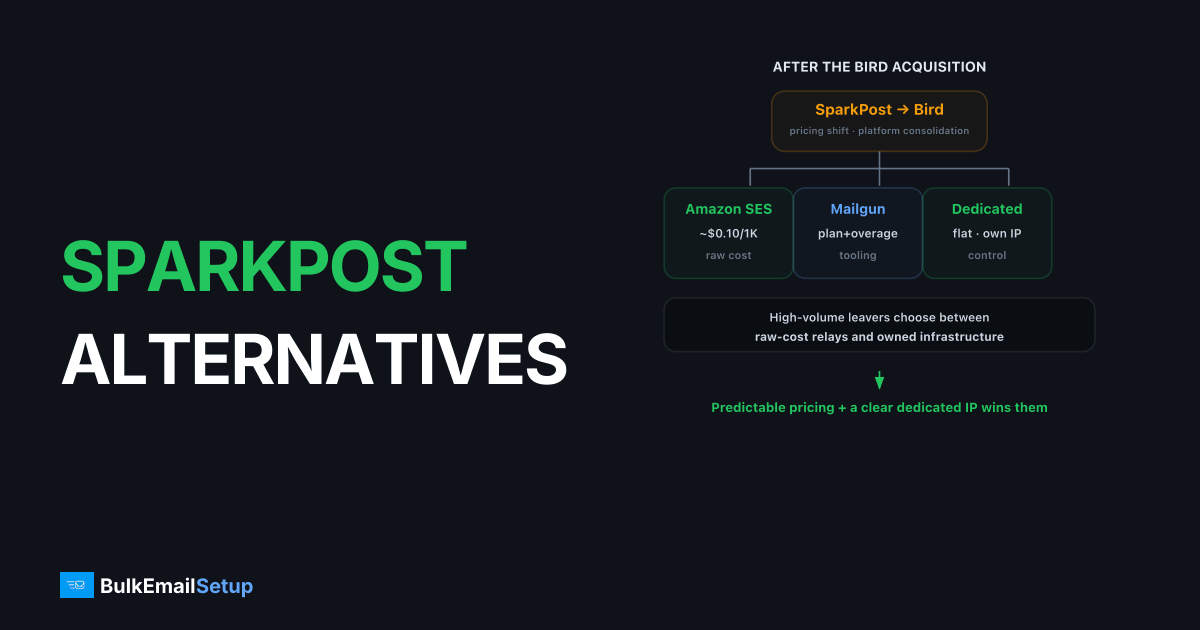
The best SparkPost alternatives after its pricing and positioning changes are Amazon SES for raw cost, Mailgun for tooling, and a dedicated SMTP server for flat pricing with a dedicated IP you control. SparkPost was acquired by MessageBird (now Bird), and its shift toward a broader communications platform pushed many high-volume email senders to re-evaluate. If you want predictable pricing, a dedicated IP, and clear deliverability control, several options now fit that gap better.
Why senders are leaving SparkPost
Senders are leaving SparkPost mainly because its acquisition by MessageBird (now Bird) reshaped its pricing and standalone focus. SparkPost was known as a high-volume email API with strong deliverability tooling and dedicated IPs at scale. After the acquisition, the product folded into a larger platform, and senders who wanted a focused, predictably priced email service started looking around.
The concerns cluster around three things:
- Pricing changes. Plan structures shifted, prompting senders to recheck their cost-per-email at volume.
- Platform consolidation. A focused email API became part of a wider suite, which not every team wanted.
- Predictability. High-volume senders value stable, transparent pricing and clear dedicated-IP terms.
SparkPost alternatives compared
Here is how the main alternatives stack up for a high-volume sender weighing a move. The trade is consistent: lower unit cost means more setup, and owned infrastructure means flat cost plus control.
| Option | Pricing model | Dedicated IP | Setup effort | Best for |
|---|---|---|---|---|
| Amazon SES | ~$0.10/1,000 | Add-on (std/managed) | High | Lowest raw cost |
| Mailgun | Plan + overage | Add-on (higher plans) | Low | Built-in tooling |
| Postmark | Premium per email | Add-on (~$50/mo) | Low | Transactional, time-poor teams |
| SendGrid | Plan + overage | Add-on (~$30-90/mo) | Low | Mixed marketing + API |
| Brevo | Per send | Add-on (higher tiers) | Low | Marketing-led senders |
| Dedicated SMTP server | Flat monthly | Included, you control it | Medium | Flat cost + full control |
For the direct comparison, see SparkPost vs a dedicated SMTP server.
Which alternative fits your volume?
The right pick depends on your monthly volume and whether your scarce resource is budget or engineering time. SparkPost served the high-volume end well, so most leavers are choosing between raw-cost relays and owned infrastructure rather than small-sender tools.
- High volume, cost-driven, has engineers: Amazon SES for the lowest unit price, with managed dedicated IPs if you want automated warm-up.
- Wants tooling without infrastructure work: Mailgun, with logs, validation, and analytics built in.
- High, steady volume, control matters: A dedicated SMTP server with a dedicated IP you own and flat pricing.
For where the threshold sits, how many emails before you need dedicated infrastructure lays out the numbers.
The cost math is the other half of the decision, and it favors flat pricing as volume climbs. SES meters per email at roughly $0.10 per 1,000, cheapest of all if you build the surrounding tooling. Mailgun's plan-plus-overage costs more but bundles the tooling. A flat dedicated plan holds the same figure whether you send one million or three in a month, which is exactly the predictability SparkPost's pricing changes took away. At very high volume, a metered relay plus add-on dedicated IPs often costs more than a flat plan that bundles the IP and the capacity into one number you can forecast to the dollar.
SparkPost's old strength was deep deliverability analytics and dedicated IPs aimed squarely at senders pushing millions of messages. Any replacement has to cover that ground. SES with managed dedicated IPs and your own dashboards can match the scale at a lower unit cost. Mailgun matches the tooling more closely out of the box. A dedicated SMTP server matches the control most directly, because the IP and MTA are yours rather than a tier in someone else's platform.
What to look for in a SparkPost alternative
The features worth checking in a SparkPost replacement are the ones that made it strong: high-volume capacity, dedicated IPs, deep deliverability analytics, and predictable pricing. SparkPost served senders pushing millions of messages, so a replacement has to hold up at that scale. Score each option against these.
- High-volume capacity with predictable cost. Flat plans or a clear per-email rate beat opaque platform pricing when you send millions a month.
- Dedicated IP terms you understand. SparkPost included dedicated IPs at scale. Confirm whether the alternative rents an IP inside its platform or lets you own one outright.
- Deliverability analytics. SparkPost's edge was engagement, bounce, and inbox-placement data in one place. Check what the alternative surfaces natively versus what you assemble from Postmaster Tools, SNDS, and DMARC reports.
- Authentication done right. SPF under the 10-DNS-lookup limit, DKIM at 2048-bit, DMARC at
quarantineorreject. These are non-negotiable at volume. - Stream isolation and raw logs. Separating transactional from marketing and reading your own logs is the fastest path to diagnosing a deferral.
Weight these by what pushed you off SparkPost. If pricing changes were the trigger, predictability ranks first. If it was platform consolidation, focus and control matter most.
Why a dedicated SMTP server is the strongest high-volume option
For senders pushing millions of messages, a dedicated SMTP server is the strongest SparkPost alternative because it matches the scale and the control without tying you to another platform's pricing roadmap. SparkPost's value was dedicated IPs and analytics aimed at high volume. A dedicated server gives you the dedicated IP outright, a flat plan that does not shift under an acquisition, and full MTA access for the diagnosis SparkPost surfaced in a console.
The fit is clearest past roughly 100K emails/month sent consistently, where a dedicated IP holds a stable reputation. In migrations we have run off SparkPost, the senders who isolated transactional onto its own IP saw a real benefit the first time a marketing complaint spike hit: the password-reset and receipt stream kept landing while the promo IP took the reputation hit, instead of one shared pool dragging both down. Above that line, you can split traffic across multiple IPs, isolate transactional from marketing so a complaint spike never delays an account email, and read raw logs the instant a mailbox provider defers. The responsibility is warm-up, blocklist monitoring across Spamhaus and Barracuda, and authentication, which a managed dedicated provider can run for you. That keeps the control and predictable cost of owned infrastructure without rebuilding SparkPost's deliverability team in-house.
What about deliverability tooling after the switch?
You can keep the deliverability visibility SparkPost gave you, but where it comes from changes per option. SparkPost surfaced engagement, bounce, and inbox-placement data in one console. After the move, that visibility comes from a mix of the new platform's reporting plus the free fundamentals every sender should run regardless of vendor.
Set up Google Postmaster Tools and Microsoft SNDS to watch your domain and IP reputation directly at the two biggest mailbox providers, parse your DMARC aggregate reports to catch authentication failures, and monitor your complaint rate against the 0.3% threshold. These work no matter which alternative you land on, and on a dedicated SMTP server they pair with your own raw logs for the clearest possible picture. Our how to monitor email deliverability guide walks through the full monitoring stack.
Moving off SparkPost without a deliverability dip
You move off SparkPost without a deliverability dip by carrying authentication intact and warming new IPs before full volume. Domain reputation is portable: your SPF, DKIM, DMARC records and sending history travel with the domain. IP reputation does not, which is the single most common cause of post-migration spam folder drops.
Before cutover, verify SPF stays under the 10-DNS-lookup limit (or Gmail returns PermError), DKIM signs at 2048-bit, and DMARC sits at quarantine or reject with passing alignment. Then ramp the new platform or dedicated IP from roughly 50-100 emails/day over 4-6 weeks, watching for 421 4.7.28 Gmail rate-limit deferrals as a signal you are pushing too fast. The pattern we see most when a sender ignores that signal is a Gmail inbox-placement rate that started near 90% during a careful ramp collapsing toward 10-15% within a few sends once daily volume jumps too fast, then taking a week of throttled-back sending to recover. Our SPF, DKIM, and DMARC guide and Gmail bulk sender requirements for 2026 cover the checklist.
One mistake SparkPost leavers make repeatedly is rotating to a brand-new DKIM selector at the same moment they switch IPs. You then change the IP reputation and the signing key in one step, which makes any deliverability dip impossible to diagnose, because you cannot tell whether the IP or the signature is the cause. Keep the existing selector live and signing through the cutover, prove the new IP is clean, and rotate the key on a separate week. Change one variable at a time. It is slower by a few days and saves you a guessing game if placement wobbles.
How BulkEmailSetup helps
If SparkPost's changes have you searching for predictable pricing and a dedicated IP you control, a dedicated SMTP server gives you flat monthly costs and full SMTP access. We configure SPF, DKIM, DMARC, and PTR correctly, run the 4-6 week warm-up, and monitor reputation and blocklists so your high-volume sends keep landing in the inbox. See plans and IP counts on our pricing page.
Frequently asked questions
Why are people leaving SparkPost?
SparkPost was acquired by MessageBird (now Bird), and its standalone positioning and pricing shifted toward a broader platform. Senders who wanted a focused high-volume email API have re-evaluated, looking for predictable pricing, dedicated IPs, and clear deliverability tooling elsewhere.
What is the best SparkPost alternative for high volume?
Amazon SES wins on raw cost, Mailgun on tooling, and a dedicated SMTP server on flat pricing and control. For senders past roughly 100K emails/month who want a dedicated IP they own, a dedicated SMTP server is often the strongest fit after SparkPost's changes.
Does the alternative include a dedicated IP?
SES and Mailgun offer dedicated IPs as add-ons; a dedicated SMTP server includes one you fully control. SparkPost historically included dedicated IPs at scale, so senders moving off it usually want an option that keeps a dedicated IP without surprise pricing.
Will switching from SparkPost affect deliverability?
Only if you skip warm-up. Domain reputation (SPF, DKIM, DMARC, history) is portable. IP reputation is not, so any new platform or dedicated IP needs a 4-6 week ramp. Keep complaint rates under 0.3% and inbox placement holds through the move.


