
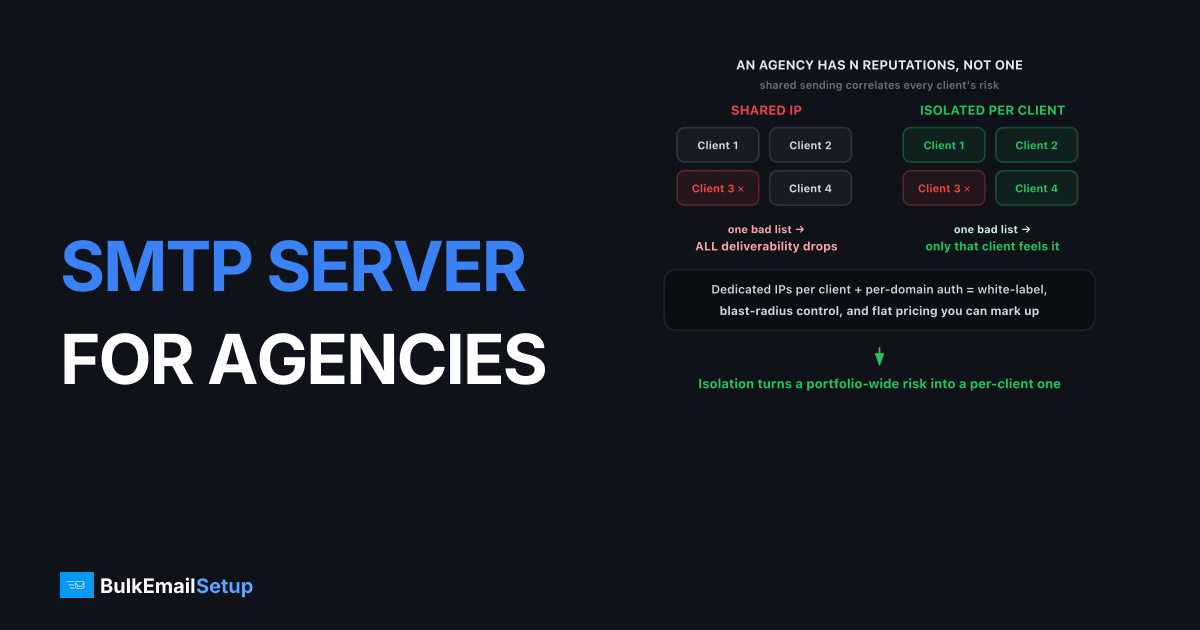
A dedicated SMTP server suits agencies and resellers because it solves the three problems an agency email model creates: per-client reputation isolation, white-label sending, and predictable pricing you can mark up. With dedicated IPs per client or per stream, one account's complaints or blocklist hit can't damage everyone else's deliverability. With correct per-domain authentication, each client sends as themselves under your brand. And with flat pricing, your margins don't evaporate the month a client runs a big launch. It's sending infrastructure built to resell.
Why do agencies need reputation isolation?
Agencies need reputation isolation because shared sending makes every client a liability to every other client. Put all accounts on one IP and a single client's dirty list, complaint spike, or blocklist hit drags down deliverability for your entire book at once. Isolation contains the blast radius.
The fix is dedicated IPs per high-volume client, or at least per stream, so each reputation is independent. We cover the underlying logic in dedicated IP vs shared IP for email.
For an agency, deliverability isn't one reputation to protect, it's N reputations, and they're correlated unless you isolate them. That correlation is the hidden risk in cheap shared sending: you're not exposed to one client's mistakes, you're exposed to all of them, simultaneously, on a shared IP. Isolation turns a portfolio-wide risk into a per-client one.
For agencies and resellers, putting all clients on one shared IP correlates their reputations, so a single client's complaint spike or blocklist hit can degrade deliverability across the entire book (M3AAWG sending best practices). Dedicated IPs per high-volume client isolate each reputation, containing any one account's problems to that account.
How does white-label sending work for resellers?
White-label sending lets a reseller present email infrastructure under their own brand while each client sends authenticated on their own domains. The client sees the agency; the infrastructure handles per-client SPF, DKIM, DMARC, and IP separation underneath.
What a white-label setup involves:
- Per-client domain authentication, SPF, DKIM, and DMARC on the client's domain, not yours. See SPF vs DKIM vs DMARC.
- Per-client or per-stream IPs, so reputations stay separate.
- Central management, one place to provision, monitor, and route all client sending.
- Your brand on top, clients experience your service, not a third party's.
The agencies that scale cleanly treat onboarding a client as a small infrastructure project: authenticate their domain, assign or warm an IP, then route. The ones that struggle bolt every new client onto a shared sender and discover the correlation problem the hard way, usually during a client's first big send.
How should agencies handle per-client warm-up?
Agencies should warm each new dedicated IP before pushing a client's real volume through it, ramping from ~50 to 100 emails/day to full over 4 to 6 weeks. A fresh IP has no reputation, so skipping warm-up means starting a client's sending throttled and at risk of blocklisting.
Practical warm-up handling at agency scale:
- Assign the client a dedicated IP (or stream) before launch.
- Ramp volume on a warm-up schedule, watching bounce and deferral codes.
- Confirm authentication passes and PTR is set before real volume.
- Monitor reputation per client, not just in aggregate.
The honest part: warm-up is real calendar time per client, which is overhead a managed provider can absorb for you. If you run this yourself across many clients, it becomes a recurring operational load. That's exactly the trade-off in managed SMTP vs DIY time cost.
Why does flat pricing matter for agency margins?
Flat pricing matters because it makes your cost base predictable, which is what lets you mark up reliably across clients. Per-email ESP pricing means one client's launch-month spike can trigger overage and blow your budget, turning a profitable account into a loss for that month.
With a flat plan, your infrastructure cost is fixed regardless of which client sends heavily, so your margin per client is stable and your pricing to them can be too. No surprise overage, no scrambling to re-quote a client mid-campaign. For the cost mechanics, see hidden costs of ESP overage fees. The honest caveat: flat pricing rewards predictable, well-managed sending, it doesn't rescue a client with chronically dirty lists.
Shared vs dedicated IP per client: which model fits?
The right isolation model depends on each client's volume, not a blanket rule. A high-volume client earns a dedicated IP; a low-volume one can sit on a well-managed shared pool without much risk. The mistake is treating every client the same, either over-provisioning small accounts or co-mingling large ones that should be isolated.
| Client profile | Recommended model | Why |
|---|---|---|
| High volume, sends consistently | Dedicated IP per client | Reputation worth isolating and warming |
| Multiple streams (txn + marketing) | Dedicated IP per stream | Marketing complaints can't sink transactional |
| Low volume, infrequent sends | Shared pool you police | Dedicated IP would sit too cold to stay warm |
| Cold or high-risk sending | Strict isolation, own IP | Contains blocklist risk to that account |
The honest constraint: a dedicated IP needs consistent volume above roughly 50K/month to hold its reputation. Assign one to a client who sends 5K a month and it goes cold and starts deferring. Match the model to the volume.
What's the per-client onboarding checklist?
Onboard each client as a small, repeatable infrastructure setup rather than an ad-hoc bolt-on. The agencies that scale cleanly run the same sequence every time: authenticate the client's domain, assign and warm an IP, confirm reverse DNS, then route real traffic. Skipping a step is how a client's first big send turns into a deliverability incident.
The repeatable sequence per client:
- Authenticate on the client's own domain, SPF, DKIM, and DMARC, not yours. Start DMARC at
p=noneto monitor. - Confirm SPF stays under 10 DNS lookups to avoid PermError, and set a valid PTR record.
- Assign and warm the IP from ~50 to 100/day over 4 to 6 weeks before pushing real volume.
- Set up bounce and complaint monitoring per client, watching for a complaint rate creeping toward 0.3%.
- Route production traffic only once authentication passes and the IP is warmed.
Across the agency setups we've seen, the accounts that stay healthy are the ones where onboarding is a checklist, not a judgment call. The struggling agencies skip warm-up under client deadline pressure, dump full volume on a cold IP, and spend the next week delisting. The pattern we see most often: a client's launch is moved up, an agency pushes 40K on a day-two IP, Gmail answers with 421 4.7.28 rate limits within the first hour, and the rest of that send sits in deferral for a day. The IP recovers, but the client's launch metrics never do. The discipline of running the same five steps every time is what keeps a growing book of clients out of trouble. That recurring operational load is the trade covered in managed SMTP vs DIY time cost.
How BulkEmailSetup helps
For agencies and resellers, we provide dedicated IPs you control with per-client isolation, full SMTP access, and SPF, DKIM, DMARC, and PTR configured correctly per client domain, all on flat monthly pricing you can build margin on. We run warm-up and reputation monitoring so onboarding a client doesn't become an engineering project. See plans on our pricing page.
Frequently asked questions
Why do agencies need a dedicated SMTP server?
Because client reputations must stay isolated. If all clients share one IP, one client's complaints or blocklist hit damages everyone's deliverability. Dedicated IPs per client, or per stream, keep each account's reputation independent and protect the agency's whole book.
Can I white-label a dedicated SMTP server for clients?
Yes. Agencies and resellers can present sending under their own brand, configure each client's authentication on their own domains, and manage everything centrally. The client sees your brand; the infrastructure handles per-client SPF, DKIM, DMARC, and IP separation.
How should agencies isolate client email reputations?
Use a dedicated IP per high-volume client, or per stream, so one client's behavior can't sink another's deliverability. Authenticate each client on their own domain with SPF, DKIM, and DMARC, and warm new IPs before pushing real volume through them.
Is flat-rate SMTP better for agencies than per-email ESP pricing?
Usually, yes. Flat pricing gives agencies a predictable cost base to mark up across clients, with no overage surprises during a client's launch month. Per-email ESP pricing makes margins unpredictable, since one client's spike can blow the budget.


