
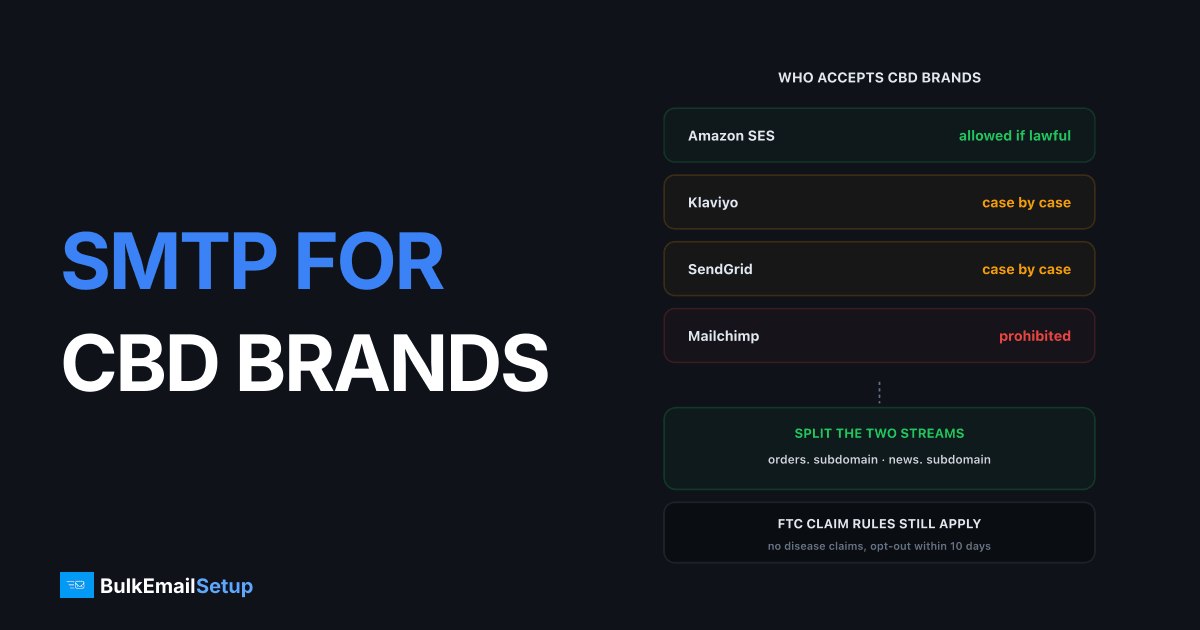
Mailchimp prohibits CBD, Klaviyo and SendGrid treat it as restricted, and most shared-pool ESPs will terminate a hemp or supplement account on policy grounds even where the product is fully legal. Amazon SES and Mailgun review case by case, and a dedicated SMTP server applies no category policy at all. What does not change with your own server is the law: FTC substantiation on every health claim, CAN-SPAM opt-outs, GDPR consent for EU lists, and Gmail's 0.3% complaint ceiling.
I've moved a dozen CBD and supplement senders off shared pools. The pattern is the same every time, so here is the whole picture.
Which providers accept CBD and supplement senders
Confirm in writing before paying. These policies move, and "restricted" often means "we'll approve you, then terminate you at the first complaint spike".
| Provider | CBD and hemp | General supplements | Notes |
|---|---|---|---|
| Mailchimp | prohibited | allowed with restrictions | CBD is in the acceptable-use ban list |
| Klaviyo | restricted, case by case | allowed | approval can be withdrawn later |
| SendGrid | restricted, case by case | allowed with review | health-claim content triggers review |
| Amazon SES | allowed if lawful in the target market | allowed | production access review still applies |
| Mailgun | case by case | allowed | expects proof of consent on request |
| Dedicated SMTP server | your own policy | your own policy | law and receiver rules still apply |
The pattern matches crypto and iGaming: transactional mail is tolerated almost everywhere, promotional mail is where the bans land.
Why providers reject a legal product
It is not about legality. Three separate risks stack up on the provider's side.
Payment-processor risk. Card networks classify CBD as high risk. An ESP that knowingly bills CBD merchants inherits some of that exposure with its own acquirer, so the cheapest move is to ban the category.
FDA and FTC claim exposure. Supplement and CBD mail is full of "helps with sleep", "reduces inflammation", "supports immunity". Every one of those is a health claim the FTC can act on and some are disease claims the FDA treats as unapproved drug marketing. The provider does not want to read your copy, so it excludes the sector.
Complaint rates. Promotional supplement mail runs above the shared-pool average, partly because the category is heavily discounted and heavily mailed. On a shared IP, your 0.4% complaint rate lands on the accountant next to you.
None of these are your fault individually. All of them are why you keep getting the termination email.
Split order mail from promotions before anything else
Two streams, two subdomains, two sets of IPs. This is the single highest-value decision for a supplement brand and it costs nothing extra on a dedicated server.
| Stream | Subdomain | Contains | Complaint risk |
|---|---|---|---|
| Transactional | orders.yourbrand.com | order confirmation, shipping, subscription renewal, account | near zero |
| Promotional | news.yourbrand.com | launches, discounts, restock, education | this is where it lives |
A customer waiting for a tracking number opens that mail. A customer who bought once and now gets three discount emails a week hits spam. Keep them on the same domain and the second customer stops the first one getting their parcel. Details in subdomain vs root domain for email sending.
Subscription renewal notices are the awkward middle. They are transactional in law but read as marketing to a lot of people, so send them from the orders subdomain with no upsell block.
The compliance that does not go away
Own infrastructure removes the provider's policy. It removes nothing else. If anything the bar is higher, because there is no compliance team above you catching the obvious mistakes.
| Requirement | What it means in practice | Who enforces |
|---|---|---|
| Claim substantiation | competent and reliable scientific evidence for every health claim, before you send | FTC |
| No disease claims | no "treats", "cures", "prevents" any condition without drug approval | FDA and FTC |
| CAN-SPAM opt-out | working unsubscribe honoured within 10 business days, physical postal address in every email | FTC, up to $53,088 per email |
| Age gates | 18 or 21 where state law restricts hemp-derived THC products, applied at signup not just checkout | state regulators |
| GDPR and PECR consent | opt-in consent for EU and UK lists, no pre-ticked boxes, provable | ICO and EU DPAs |
| Suppression list | every opt-out kept permanently and applied to every stream | you, and the FTC if you get it wrong |
The FTC's health claims guidance is the primary source and it is short enough to read in an afternoon. The standard is not "is it true". The standard is "can you prove it with evidence you already hold". A testimonial that says "cured my back pain" is a disease claim you made, not one the customer made.
On age gates: several states restrict hemp-derived THC products to 21 and over. If your list includes those products, gate the signup form, not just the checkout, because a 17-year-old on your newsletter is a marketing-to-minors problem regardless of whether they ever bought.
What it costs at 100K and 500K a month
Prices as of this writing, ex tax, from the vendors' own pricing pages. Klaviyo bills by contact count rather than volume, so the range assumes 4 to 8 sends per contact per month.
| Provider | 100,000/month | 500,000/month | Policy status |
|---|---|---|---|
| Amazon SES | about $10 | about $50 | allowed if lawful, review required |
| Mailgun (Scale plan) | $90 | roughly $530 with overage | case by case |
| Klaviyo | $150 to $400 by contact count | $700 to $1,500 by contact count | restricted, if accepted |
| Dedicated server | $549 one-time plus $40 to $80 hosting | same server, add IPs above 25K/day | your own policy |
SES is cheapest on paper. It is also the provider most likely to put you back into review after a complaint spike, and the one with the least help when it does. Mailgun is fair value at 100K and stops being so at 500K. Klaviyo is the best marketing tool on the list and the most expensive, and you can still be terminated after a year of paying.
The dedicated server pays back against Klaviyo inside 2 to 4 months and against Mailgun inside a year at 500K. Against SES it never pays back on price alone; you buy it for the policy certainty and the dedicated reputation. The line-by-line is in what 100,000 emails a month actually costs and the plans are on pricing.
Deliverability specifics for this niche
Reputation beats word filtering. Everyone in supplements worries about the word "CBD" tripping a filter. In 2026 that is a minor factor at Gmail and Microsoft. Your domain and IP reputation, driven by complaints and engagement, decides placement. I have watched a clean CBD sender with the word in the subject line land in the primary tab while a "wellness" brand with a 0.5% complaint rate sat in spam.
Keep complaints under 0.1%. Google's bulk sender guidance puts the hard line at 0.3% in Postmaster Tools and the recommended ceiling at 0.1%. Supplement senders drift above 0.1% by mailing lapsed buyers with discounts. Segment by last purchase, drop anyone past 12 months from promotional mail, and the number falls. The full mechanics are in Gmail's 0.3% complaint rule.
Warm up for 4 to 8 weeks. New IPs start cold whatever your history at Klaviyo. Begin at a few hundred a day per IP to recent buyers only, ramp roughly 30% every two days, and watch deferrals rather than opens. A 4xx rate climbing past 5% means slow down.
Authenticate properly. SPF, DKIM, DMARC at p=none then p=quarantine, PTR matching HELO. Supplement domains get spoofed for counterfeit product scams, and spoofed mail from your domain hurts your real mail.
Watch your copy anyway. Not for filters, for regulators. Every subject line with "anxiety", "pain" or "sleep" is a claim. Write the benefit as a customer experience you can substantiate, not a medical outcome.
What to do right after a termination
The order matters because access disappears fast.
- Export the suppression list, unsubscribes and bounce log today. These are your CAN-SPAM opt-out record. Losing them means you cannot prove you honoured a request.
- Export the full contact list with consent source and date for every address. You will need this for GDPR lists and for any provider that asks for proof.
- Open Google Postmaster Tools for the sending domain. If domain reputation shows low or bad, fix the list before you move, because the reputation moves with the domain.
- Set up the new infrastructure on fresh subdomains. Do not reuse the burned one for promotions.
- Load the suppression list into the new system before the first send. Not after.
- Warm up from your most engaged 5,000 to 10,000 buyers, not the whole file.
Do not open a second Klaviyo account under a new email. It gets linked by domain and payment method, closed within days, and it poisons any future appeal.
How BulkEmailSetup helps
We build dedicated SMTP infrastructure for senders in restricted categories: your own server, your own IPs, full SPF/DKIM/DMARC/PTR configuration, MTA tuning, bounce handling and a warm-up plan, with order and marketing streams separated onto different subdomains and IPs from day one. No shared pool means no acceptable-use team weighing your CBD catalogue against other customers. Meeting FTC, CAN-SPAM and state rules stays yours.
Basic starts at $549 one-time, covering 1 SMTP server, 3 dedicated IPs, 25,000 emails/day and unlimited contacts. Higher tiers scale to 15 IPs and 200,000 emails/day. See pricing.
Frequently asked questions
Which SMTP providers allow CBD companies?
Policies change, so confirm in writing before paying. Mailchimp prohibits CBD outright, Klaviyo and SendGrid treat it as restricted and review case by case, Mailgun reviews case by case, and Amazon SES generally permits it where the product is lawful in the markets you send to. A dedicated SMTP server has no shared pool to protect, so the only policy that applies is the law and the receiver rules.
Why does Mailchimp ban CBD email marketing?
Three reasons stack up. Payment processors treat CBD as high risk, so the provider inherits chargeback and banking exposure. Health claims in CBD and supplement mail create FTC and FDA liability that the provider does not want to police. And promotional supplement mail runs above-average complaint rates, which on a shared IP pool damages every other customer.
Can I make health claims in CBD or supplement emails?
Only claims you can substantiate with competent and reliable scientific evidence, which is the FTC standard. Disease claims such as treats anxiety, cures insomnia or reduces inflammation are off limits without FDA drug approval, in email as much as on the label. Own infrastructure changes who carries your mail, not what you are allowed to say in it.
What does it cost to send 100,000 CBD emails a month?
Roughly $10 a month on Amazon SES, about $90 a month on a Mailgun Scale plan, $150 to $400 a month on Klaviyo depending on contact count if they accept you, or a dedicated server at $549 one-time plus $40 to $80 a month hosting. At 500,000 a month the dedicated server is cheapest within the first year against everything except SES.
Should CBD order emails and promotions send from the same domain?
No. Put order confirmations, shipping and account mail on one subdomain such as orders.yourbrand.com and promotions on another such as news.yourbrand.com, with separate IPs. If a promotional campaign draws complaints, the damage stays on the marketing stream and customers still receive their tracking numbers.
What should I do right after Klaviyo or Mailchimp terminates my CBD account?
Export your suppression list, unsubscribes and bounce log while you still have access, because those are your legal record for CAN-SPAM opt-outs. Then check Google Postmaster Tools for your domain reputation before moving anywhere, since a complaint rate above 0.3% follows the domain to the next provider.


