
Dedicated SMTP for affiliate email marketing gives you IP control, domain isolation, and clean authentication so your offer campaigns can land without burning a shared reputation or your main domain. Affiliate email is one of the harder deliverability cases: the content is offer-heavy, the lists are often large and aged, the margins are tight, and tracking links draw filter scrutiny. That mix produces high complaint and bounce rates that list shared IPs fast. Dedicated infrastructure gives you the control and isolation to manage that risk, though no setup makes a poor list deliver.
Let's be clear up front. Affiliate sending is high-risk, and infrastructure is harm reduction, not a magic fix. The senders who survive treat list quality and sending discipline as seriously as the offers themselves.
Why affiliate email is a deliverability hard case
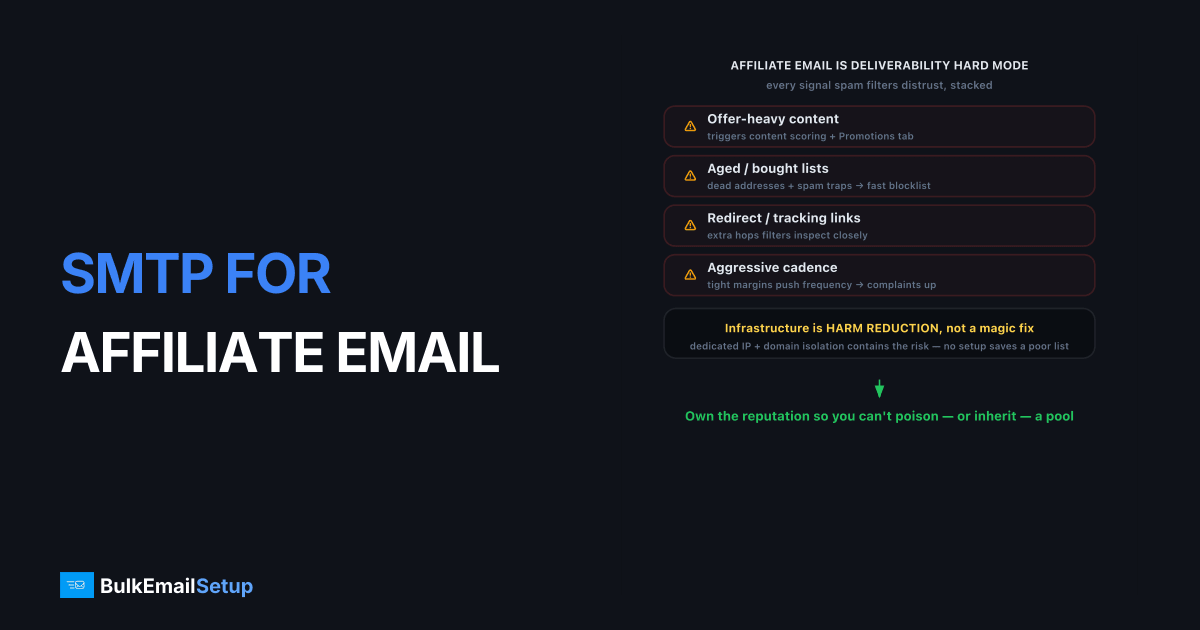
Affiliate email is a deliverability hard case because it combines every signal spam filters distrust: promotional content, big or aged lists, redirect and tracking links, and tight economics that tempt senders to mail aggressively. The result is elevated complaint and bounce rates that blow past the 0.3% complaint ceiling in Gmail's bulk sender guidelines and get shared IPs listed on Spamhaus, producing 550 5.7.1 rejections across a whole pool.
The risk factors stack up:
- Offer-heavy content. Promotional copy and pricing trigger content scoring and Promotions-tab sorting.
- Aged or bought lists. Older lists carry dead addresses and spam traps, the fastest route to a blocklist.
- Redirect links. Affiliate tracking domains add hops that filters inspect closely.
- Aggressive cadence. Tight margins push high frequency, which drives complaints up.
This is exactly why shared pools are dangerous for affiliates: you can poison the pool, or inherit someone else's mess. The dedicated IP versus shared IP tradeoff tilts hard toward dedicated control here.
Shared pool vs dedicated SMTP for affiliates
For affiliate sending, the choice between a shared pool and dedicated SMTP is really a choice about who owns the risk. Here is the comparison.
| Factor | Shared pool | Dedicated SMTP server |
|---|---|---|
| Reputation owner | You plus strangers | You alone |
| Contagion risk | High (offer senders cluster) | Contained to your sending |
| Domain isolation | None | Per domain and IP |
| Delisting | Provider's queue | You control it |
| Diagnosing problems | Guesswork | Your own logs |
| Suitability for offers | Poor | Workable with discipline |
| Cost model | Per-email | Flat monthly |
Dedicated IPs do not lower your inherent risk, but they put that risk under your control. You can isolate domains, rotate cleanly, and delist yourself instead of waiting on a provider, which matters when offer sending goes sideways.
How to protect reputation in affiliate sending
Protecting reputation in affiliate email comes down to list hygiene, domain isolation, and clean authentication, in that order of importance. Infrastructure helps, but list quality is the dominant variable. A clean, engaged list on a dedicated IP lands; a bought list on the same IP burns it.
Clean the list ruthlessly
Verify addresses, remove hard bounces immediately, and sunset anyone who has not engaged. Aged affiliate lists are riddled with spam traps and dead addresses, and a high bounce rate signals a low-quality list to mailbox providers instantly. Disciplined list cleaning and a strict sunset policy do more for affiliate deliverability than any IP swap.
Isolate sending domains
Never send affiliate offers from a domain you rely on for core business email. Use separate, dedicated sending domains so reputation damage stays contained and rotatable. If an offer campaign tanks a domain's reputation, you want to retire that domain, not your primary identity. The domain reputation versus IP reputation guide explains why both layers matter.
Authenticate every domain
Set SPF, DKIM, and DMARC on each sending domain before you send. Missing DKIM triggers 550 5.7.26. Keep DKIM at 2048-bit and DMARC at p=none while warming, then enforce. The SPF, DKIM, and DMARC guide covers the records. Authentication will not save a bad list, but its absence guarantees failure.
Common affiliate sending mistakes
The mistakes that burn affiliate infrastructure are almost all about list quality and restraint, not the SMTP setup, which is the easy part. Affiliates who survive long-term treat their list and cadence as carefully as their offers, while those chasing short-term volume torch domain after domain. The recurring errors are predictable and expensive.
- Mailing bought or scraped lists. These are dense with spam traps, the fastest route to a Spamhaus listing. Send only to addresses you collected with consent.
- Using the main domain. One trap hit can stall your core business mail. Always send offers from separate, rotatable domains.
- Over-mailing for margin. High frequency drives complaints past 0.3% fast. Pace sends and respect engagement signals.
- Cloaking or messy redirect chains. Multiple redirect hops on tracking links draw heavy filter scrutiny. Keep link paths clean and minimal.
- Skipping authentication. Missing DKIM triggers
550 5.7.26on every message. SPF, DKIM, and DMARC on every sending domain, no exceptions.
The single biggest lever is list source. A clean, consented, engaged list on a modest dedicated IP outperforms a huge bought list on perfect infrastructure every time. Infrastructure controls the risk; the list determines the ceiling.
In one affiliate setup we provisioned, a sender ramping to 50,000 a day saw inbox placement at Gmail collapse from roughly 85 percent to about 12 percent inside three days. The cause was not the IP. They had folded a 90,000-address purchased list into an otherwise clean send, and the spam-trap hits got the sending domain listed on Spamhaus within 48 hours. We see this exact sequence often: the infrastructure is fine, one bad list ruins it overnight.
Staying compliant and deliverable
Affiliate email stays both legal and deliverable through the same discipline: honesty and consent. Under US CAN-SPAM, affiliate email is allowed when you identify yourself truthfully, avoid deceptive subject lines, include a real physical address, and honor opt-outs within two days. The EU and other regions demand explicit consent. These rules are not just legal hygiene; deceptive sending generates the complaints and trap hits that get you blocklisted.
Warm any new IP slowly, from roughly 50 to 100 a day over four to six weeks, following an IP warm-up schedule, and send your most engaged contacts first. We will not overpromise: dedicated SMTP gives you control, isolation, and clean authentication. It cannot make an aged or non-consenting list deliver. Affiliate deliverability ultimately depends on list quality, offer relevance, and sending restraint.
How BulkEmailSetup helps
We provide dedicated SMTP servers with dedicated IPs you control, full SMTP access, and SPF, DKIM, DMARC, and PTR configured for every sending domain, so you get the IP control and domain isolation affiliate sending needs. We handle warm-up and reputation monitoring. See plans on our pricing page.
Frequently asked questions
Why do affiliate emails get blocked so often?
Affiliate email is offer-heavy, often sent to large or aged lists, and uses tracking and redirect links that spam filters scrutinize. That combination produces high complaint and bounce rates, which quickly list shared IPs and trip Gmail's 0.3% complaint ceiling. Tight list hygiene and dedicated IPs reduce, but do not erase, the risk.
Do affiliate marketers need a dedicated IP?
Usually yes, once volume is meaningful. A dedicated IP gives you control over your own reputation and keeps your offer sending from poisoning a shared pool, or being poisoned by it. It also lets you delist your own IP rather than waiting in a provider queue when something goes wrong.
Should affiliate email use my main domain?
No. Use separate sending domains for affiliate campaigns, never a domain you rely on for core business email. Offer-heavy sending carries real reputation risk, and you want any damage isolated to a domain you can rotate out rather than your primary identity.
Is affiliate email marketing allowed?
Legitimate affiliate email is allowed when it follows the law: honest sender identity, no deceptive subject lines, a real physical address, and prompt opt-out handling under CAN-SPAM in the US, with stricter consent rules in regions like the EU. The deliverability risk comes from list quality and sending behavior, not affiliation itself.


