
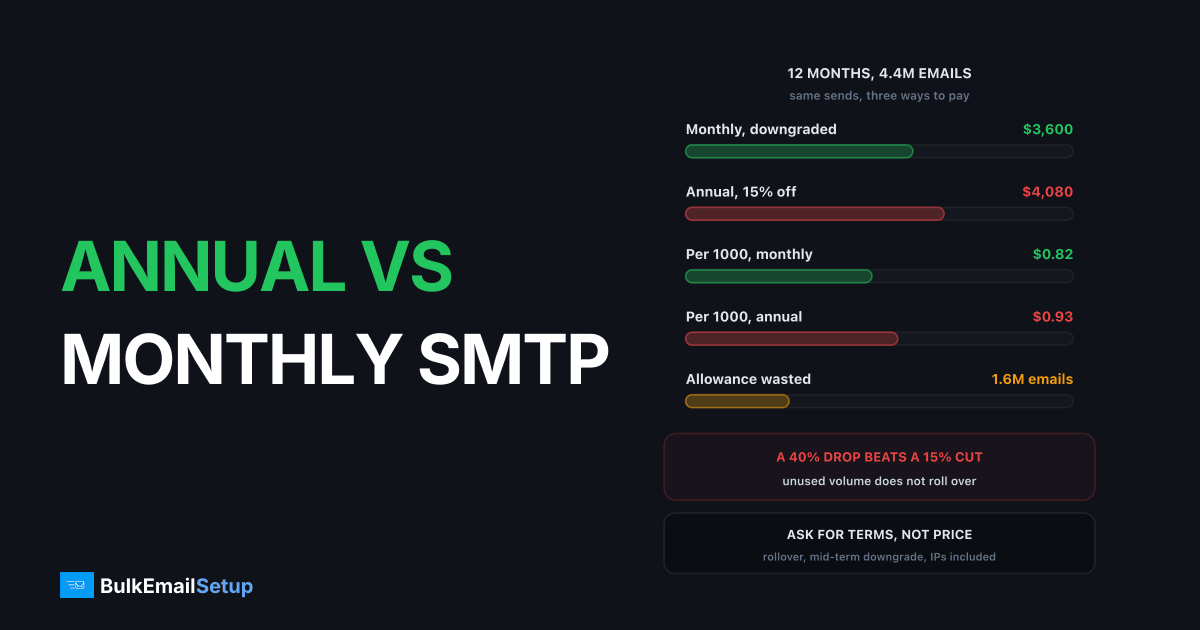
Annual SMTP plans usually cut 10 to 20% off the monthly price, and that discount only survives if your volume holds for all twelve months. Unused allowance does not roll over on any mainstream plan, so a sender on a $400 monthly plan who takes the $4,080 annual deal and then drops 40% of their volume in month five ends up paying about $0.99 per 1,000 instead of the $0.80 the monthly plan would have cost. The discount is real. The saving is conditional. Here is exactly when it holds and when it does not.
What annual actually buys you
An annual plan is a prepayment, not a price cut in the ordinary sense. You pay twelve months up front, the provider hands back one to two months of value, and in exchange you give up the right to change your mind.
| Provider | Annual option | Typical saving |
|---|---|---|
| Mailchimp | Yes, but only on Premium and Standard above 10,000 contacts, quoted by sales | not published |
| Brevo | Yes, yearly billing offered on paid plans | typically 10% |
| Mailgun | No annual option on published pricing | none, monthly only |
| Postmark | Monthly plans, credits bought as you go | none published |
| SendGrid | Annual available on Pro and Premier through sales | typically 10 to 15% |
| Enterprise ESP contracts | Annual commit is the default, monthly is the exception | 15 to 30%, with clauses |
Two of those I checked directly. Mailchimp's own marketing pricing page states annual plans exist for Premium and Standard 10,000-plus contact tiers and directs you to sales for the rate, meaning there is no published annual percentage at all. Mailgun's pricing page lists Basic at $15, Foundation at $35 and Scale at $90 a month with no annual option shown. Everything marked "typical" in that table is the range reps quote, not a published number, so ask for it in writing.
The pattern is worth naming. The providers that push annual hardest are the ones billing on contacts, because contact-based pricing already overcharges anyone who sends infrequently, and an annual commit locks that in.
The three cases where annual wins
Annual billing is genuinely the right call in three situations, and they all come down to certainty.
Your volume is steady or growing. If you sent between 450,000 and 550,000 every month for the last twelve months, and your list is growing, the allowance gets used. A 15% cut on $4,800 is $720 you keep. There is no scenario where you regret it, because even if you outgrow the plan you can usually upgrade mid-term without penalty. Downgrading is the direction they block.
You are certain you are not switching. Deep platform integration, a team trained on the tool, automations built over two years, a CRM sync nobody wants to rebuild. If the switching cost is 80 hours of engineering, you were never leaving inside twelve months, so the option you are selling back to the provider was worthless to you anyway.
The discount is above 15%. Below that, the maths gets thin fast. A 10% cut on a $400 plan is $480 a year. One month where you were forced to stay on a provider you wanted to leave costs more than that in deliverability alone. Above 15%, you are being paid enough for the lock-in that it starts to look like a fair trade.
The three cases where annual loses
You are seasonal. This is the big one. A commit sized to November is dead money from January to September, and a commit sized to February means overage every quarter four. Retail, travel, education and events all have swings over 3x between peak and trough, and no annual plan handles that without a rollover clause.
Your volume might halve. List pruning, a funding change, one product line killed, a re-engagement sweep that removes 30% of the file. Any of these can cut sending by half inside a quarter. On monthly billing you downgrade the following month. On annual you keep paying the old figure until the term ends.
You might get suspended. If your sending sits near any provider's grey zone, cold outreach, affiliate offers, a restricted vertical, or a complaint rate that has touched 0.2%, prepaying nine months is prepaying for something you may not be allowed to use. Suspension is decided under the acceptable use policy, and the refund policy does not override it. Gmail's sender guidelines put the hard spam-complaint ceiling at 0.3% with 0.1% recommended, and every shared-pool provider enforces well below that line, because your complaints land on IPs shared with their other customers. Read what to do when a provider suspends you before you prepay a year.
The worked example: 500K a month, then a 40% drop
Here is the case that gets people. Sender doing 500,000 emails a month on a $400 monthly plan. The annual deal is $4,080, a 15% cut. Both options look identical on day one.
Then month five happens. A list clean removes stale subscribers and monthly volume settles at 300,000. Same plan, 40% less send.
| Metric | Monthly billing | Annual billing |
|---|---|---|
| Cost, months 1 to 4 at 500K | $1,600 | $1,360 (prorated) |
| Cost, months 5 to 12 at 300K | $2,000 on downgraded plan at $250 | $2,720 (prorated, no downgrade) |
| Total 12-month cost | $3,600 | $4,080 |
| Total emails sent | 4.4 million | 4.4 million |
| Effective cost per 1,000 | $0.82 | $0.93 |
| Volume paid for but unused | 0 | 1.6 million |
The annual plan costs $480 more over the year and delivers exactly the same number of emails. The 15% discount was real, and it was smaller than the 40% of allowance thrown away. That is the whole trap in one table.
Run it the other way and the picture flips. If volume had grown to 700,000 by month five, the monthly plan would have moved to a higher tier around $520 and the annual one would have absorbed part of the growth inside the existing allowance. Growth rewards the commit. Contraction punishes it, and contraction is what most senders actually experience after their first serious list clean. The cost by list size breakdown shows where those tier boundaries sit.
24 months, three ways to pay
The prepayment question sits inside a bigger one: whether you should be renting sending capacity at all. Here is the same 500,000 a month sender over two years, on the assumption volume holds.
| Factor | Monthly ESP plan | Annual ESP plan (15% off) | One-time dedicated server |
|---|---|---|---|
| Year 1 outlay | $4,800 | $4,080, paid day one | $549 setup plus about $240 hosting |
| Year 2 outlay | $4,800 | $4,080 plus typical 5 to 10% uplift, about $4,400 | about $240 hosting |
| 24-month total | $9,600 | about $8,480 | about $1,029 |
| Dedicated IPs | $30 to $80 each per month | usually same, sometimes included | 3 included on Basic, up to 15 |
| Cash tied up on day one | $400 | $4,080 | $549 |
| Downgrade mid-term | any month | rarely, needs a clause | not applicable |
| Cost of leaving | one month | remaining months forfeited | none |
| Unused volume | none, you pay for sends | forfeited monthly | none, capacity is yours |
The annual plan saves about $1,120 over two years against monthly. The server saves about $8,570 against monthly, and it does it without any commitment at all, because the one-time fee is spent whether you send 100,000 or 700,000 next month. That is the comparison that matters more than the 15%. The break-even maths for a dedicated server works it through provider by provider.
One honest caveat on that third column. The server column has no support SLA, no named contact, and the warm-up, monitoring and list hygiene are your responsibility even when the build is done for you. That is what the $8,570 buys the ESP customer.
What to negotiate instead of a discount
Sales reps have a floor on price and almost none on terms. Ask for the terms.
| Ask | Why it beats another 5% off | What to say |
|---|---|---|
| Rollover of unused volume | one quarter of carry-forward is worth more than 10% on a variable sender | "Does unused volume carry to the next quarter?" |
| One mid-term downgrade | protects you against exactly the 40% drop scenario | "Can I step down one tier once per year without penalty?" |
| Dedicated IPs included | saves $360 to $960 a year per IP | "Are IPs in the rate, and how many?" |
| Overage at contract rate | annual plans often bill overage at 1.5 to 2x | "Is overage at my rate or a penalty rate?" |
| Termination for convenience | caps the damage of a suspension or a bad year | "What is the exit at 60 days notice, and at what fee?" |
| Auto-renewal off | stops a missed 60-day window costing another year | "Can renewal be opt-in rather than automatic?" |
In practice, rollover and the downgrade right are the two that move most often, because neither costs the rep anything against quota. IP inclusion sometimes moves. The termination clause almost never does at the SMB level and often does above about $50,000 a year. The full clause-level read-through is in hidden fees in ESP contracts, and the overage side is its own separate cost.
One tactical note. Ask for terms before you ask for price. Once a rep has given you 20%, they have spent their room and will tell you the legal template cannot change. Ask for rollover first, then the discount.
The decision checklist
Six questions. Three or more "no" answers and you should stay monthly.
- Has your monthly volume varied by less than 20% over the last twelve months? If you do not have twelve months of history, the answer is no.
- Is your list growing? A shrinking or flat list plus a fixed commit is the losing combination.
- Is the discount above 15%? Below that the lock-in is underpriced.
- Would switching providers cost you more than 40 engineering hours? If not, you are selling an option that has real value.
- Is your complaint rate comfortably under 0.1% and your vertical clearly inside their acceptable use policy? Anything else and prepayment is a bet on their tolerance.
- Did you get rollover or a downgrade right in writing? If yes, most of the above stops mattering.
And one question underneath all six. If the answer to "would I rather own the sending capacity outright" is yes, the annual versus monthly question is a distraction. You are optimising the rent on a thing you could buy.
How BulkEmailSetup helps
We build dedicated SMTP infrastructure you own, so there is no billing term to choose. No commit, no prepayment, no allowance to forfeit in a slow month, no renewal window to diary. Your server, your IPs, full SPF, DKIM, DMARC and PTR configuration, MTA tuning, bounce handling and a warm-up plan. The only recurring bill is the VPS, paid to the host, not to us, and it does not change whether you send 50,000 or 500,000.
Basic is $549 one-time, covering 1 SMTP server, 3 dedicated IPs, 25,000 emails/day and unlimited contacts. Higher tiers scale to 15 IPs and 200,000 emails/day. See pricing, or work the crossover yourself with the break-even calculation.
Frequently asked questions
Is annual SMTP billing cheaper than monthly?
On the sticker rate, yes: annual plans typically cut 10 to 20% off twelve months of the monthly price, so a $400 monthly plan becomes about $4,080 a year instead of $4,800. On the effective rate it depends entirely on whether you use the allowance. Unused monthly volume does not roll over on any mainstream plan, so a 40% volume drop in month five wipes out a 15% discount and then some.
How much discount do annual email plans give?
The common range is 10 to 20% off the monthly price paid twelve times. Mailchimp offers annual plans only on Premium and Standard tiers above 10,000 contacts and quotes them through sales rather than publishing a rate. Mailgun and Postmark publish monthly pricing only. Treat any figure a rep gives you as negotiable, and anything below 15% as not worth the lock-in.
Does unused volume roll over on an annual email plan?
Almost never by default. Standard annual terms give you a monthly allowance that resets, so a 1 million a month plan used at 600,000 in February forfeits 400,000. Rollover is the single most valuable thing to ask for, and some providers will grant a one-quarter carry-forward if you ask before signing. Get it in the order form, not in an email from the rep.
Should a seasonal sender take an annual email plan?
No, unless the plan sizes to your quiet months and bills overage at the contract rate. A retailer sending 1.8 million in November and 400,000 in February pays for the November figure all twelve months on a flat annual commit. Sizing to the floor and paying overage in peak months usually beats sizing to the peak and forfeiting the rest.
What happens to an annual SMTP plan if the provider suspends my account?
You have usually paid for the remaining months and will not see them back. Suspension for complaint rate or policy is handled under the acceptable use policy, not the refund policy, so prepayment gives you no protection. If your vertical is anywhere near a provider's grey list, keep monthly billing so a suspension costs you one month, not nine.
What should I negotiate instead of a bigger annual discount?
Four things beat another 5% off: rollover of unused volume for at least a quarter, a mid-term downgrade right once per year, dedicated IPs included in the rate instead of billed at $30 to $80 each per month, and a termination for convenience clause at 60 days. Reps have more room on terms than on price because terms do not show up in their quota.


