
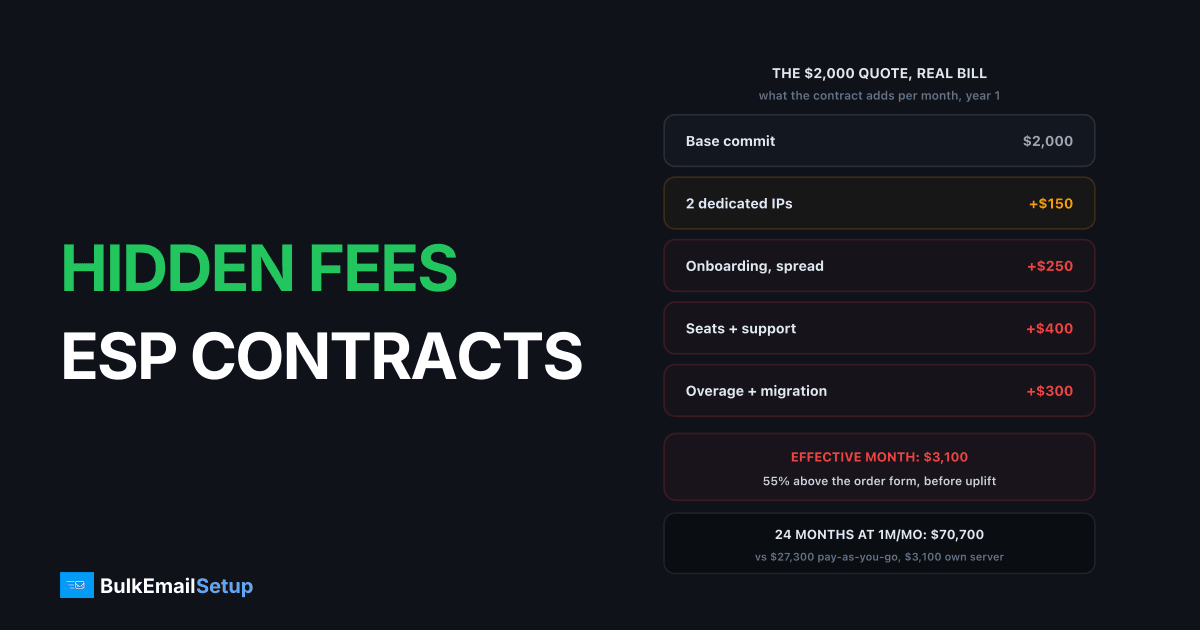
A $2,000 a month ESP contract typically costs about $3,100 a month once the fees written into the clauses are counted, and none of them appear on the pricing page. The ten that do the damage are minimum commit with no rollover, auto-renewal with a 60 to 90 day notice window, a 5 to 10% annual uplift, dedicated IPs billed separately, mandatory onboarding consulting, overage at 1.5 to 2x the contract rate, data export and deletion terms, capped SLA credits, migration services, and per-seat or per-subaccount charges. I've signed, renegotiated and exited enough of these to know where each one hides. This is the read-through I wish someone had handed me before the first signature.
The 10 clauses that cost money
Every one of these is negotiable. Nobody negotiates them because the sales rep sends the order form, not the master agreement, and the order form only shows the headline rate.
| Clause | Typical size | Question to ask before signing |
|---|---|---|
| Minimum commit, no rollover | 12 months of volume, unused months forfeited | "If I send 600K in a 1M month, does the 400K carry forward?" |
| Auto-renewal | 12-month renewal, 60 to 90 day notice window | "What is the exact date and method for non-renewal notice?" |
| Uplift clause | 5 to 10% per year, or CPI plus 3 to 5 points | "Is the renewal price capped in writing?" |
| Dedicated IP fees | $30 to $80 per IP per month, billed separately | "Are IPs included in the quoted rate, and how many?" |
| Mandatory onboarding | $1,000 to $5,000 one-time "deliverability consulting" | "Can onboarding be waived or self-served?" |
| Overage rate | 1.5 to 2x the contract per-email rate | "What is the overage rate, and does it bill or suspend?" |
| Data export and deletion | 30-day deletion, $500 to $2,000 export fee | "Can I export the suppression list and logs at no charge?" |
| SLA credits | capped at 10% of monthly fee | "What is the uptime target and the maximum credit?" |
| Professional services | $150 to $300 per hour for migration and integration | "What exactly is included at no charge?" |
| Per-seat or subaccount | $25 to $100 per user or subaccount per month | "How many seats and subaccounts are included?" |
The pattern: the contract rate per email is real, and everything around it is where the margin sits. An ESP quoting $2 per 1,000 on an annual deal knows the effective rate will land closer to $3.
Why the commit clause hurts more than the rate
A minimum commit with no rollover means you pay for volume you did not send. Most senders are seasonal. A retailer sending 1.8 million in November and 600,000 in February is paying for 1 million every month, so the February shortfall is simply gone.
Two variants make it worse. Some contracts bill the commit annually up front, so you fund 12 months on day one. Others set a monthly commit and then charge overage on months above it, which means a seasonal sender pays for the empty months and pays penalty rates on the busy ones. Ask for a quarterly or annual true-up instead of monthly, and for unused volume to roll forward at least one quarter.
The worked example, $2,000 quoted to $3,100 paid
Here is a contract I've seen in close to this exact shape, for a sender doing about 1 million emails a month. Quoted rate $2 per 1,000, 1 million commit, so $2,000 a month on the order form.
| Line item | How it arrives | Monthly effect |
|---|---|---|
| Base commit | $2 per 1,000 x 1M | $2,000 |
| Dedicated IPs | 2 IPs at $75 each | $150 |
| Overage | 2 spike months a year, 200K over, at $3 per 1,000 | $100 (annualised) |
| Onboarding consulting | $3,000 one-time, spread over year 1 | $250 |
| Migration professional services | 12 hours at $200 | $200 |
| Subaccounts | 4 brands at $50 each | $200 |
| Priority support tier | required for a named contact | $200 |
| Effective month, year 1 | $3,100 |
That is 55% above the quote, and year two adds a 7% uplift on the base, so the commit alone rises to $2,140 before anything else changes. The onboarding and migration lines drop off in year two, but the uplift and the IP, seat and support lines stay, so year two settles near $2,790. Over 24 months the "$2,000 a month" deal costs roughly $70,700.
The overage side of this is a separate problem with its own mechanics. This article is about what the contract locks in before a single email leaves.
Contract vs pay-as-you-go vs one-time dedicated server, 24 months at 1M a month
Three ways to send 1 million emails a month for two years. The pay-as-you-go column uses Mailgun's published Scale plan, which I checked on the Mailgun pricing page: $90 a month for 100,000 included, $1.10 per 1,000 overage, one dedicated IP included and $59 for each extra one. The dedicated server column uses our Advance tier and a typical VPS bill.
| Factor | Annual ESP contract | Pay-as-you-go ESP (Mailgun Scale) | One-time dedicated server |
|---|---|---|---|
| Monthly base | $2,000 commit | $90 plan + $990 overage | $0 after setup |
| Dedicated IPs | 2 at $75, $150/mo | 1 included, 1 extra at $59 | 15 included |
| One-time fees | $3,000 onboarding + $2,400 migration | $0 | $1,199 setup |
| Year 2 uplift | 7%, adds $140/mo | none, list price can change anytime | none |
| Hosting | included | included | about $80/mo VPS |
| 24-month total | about $70,700 | about $27,300 | about $3,100 |
| Notice to leave | 60 to 90 days, or auto-renew | none | none |
| Keep IPs on exit | no | no | yes, they are allocated to you |
| Suspension risk | contract protects you somewhat | can be paused any day | none, you own the server |
The contract is the most expensive and the least flexible, and what you get for that is a named support contact, an SLA, and a sales rep who answers the phone. Pay-as-you-go is cheaper but carries the shared-pool risk and no protection against a sudden price change. The server has the lowest bill by a wide margin and the highest responsibility: warm-up, monitoring and list hygiene are yours, even when the setup is done for you. The full route-by-route breakdown is in cost to send 1 million emails a month.
The exit terms that matter
Most people read the entry price and skip the exit clauses. The exit clauses decide whether you can ever leave.
Your IPs. They belong to the ESP. Two years of reputation on those addresses stays behind when you go, and the next provider starts you cold. Warm-up runs 4 to 8 weeks at roughly 30% growth every two days per IP, so the lock-in is measured in lost campaigns, not dollars.
Your suppression list. This is the most valuable data you hold, because it is the record of everyone who unsubscribed, bounced or complained. Some contracts delete it 30 days after termination, and some make the export a paid professional service. Mailing a suppressed address after a migration is how a clean domain earns a Gmail complaint spike, and Gmail's sender guidelines set the spam-rate ceiling at 0.3% with 0.1% recommended, which a stale suppression list can blow through in one send.
Your logs and stats. Bounce logs by recipient domain, engagement history, per-campaign complaint rates. You need these to segment the warm-up on the new infrastructure. Export them before giving notice, because access often ends the day the contract does.
Your subdomain reputation. This one you do keep, as long as you sent from your own domain with your own DKIM key. If the ESP signed with its own domain, the reputation you built was theirs, so check the DKIM d= tag in your headers before you assume anything follows you.
The negotiation checklist
Send the master agreement to whoever reads contracts for you, and take this list into the call with the rep. Everything below has been agreed by an ESP at least once, so none of it is unreasonable.
- Strike or cap the uplift at 3%, or tie it to CPI with no floor.
- Rollover of unused commit for at least one quarter, or an annual rather than monthly true-up.
- Overage at the contract rate, or at most 1.25x, and billed rather than suspended.
- Auto-renewal off, or the notice window cut to 30 days with email notice accepted.
- IPs included in the rate, with the count in writing.
- Onboarding waived or replaced with self-serve docs, since most of it is DNS records you can publish yourself.
- Free data export of suppression list, logs and stats for 90 days after termination.
- SLA credit cap raised to 25 to 50%, with a termination right after two missed months.
- Seats and subaccounts included at the number you actually use plus 20%.
- A termination for convenience clause at 60 days, even if it costs a fee, so a bad year does not become two.
Rank them before the call. In my experience the uplift, the rollover and the export terms are the three that move, and the IP ownership one never does. If the rep says the legal team will not change the template, ask for a side letter. It carries the same weight and gets signed faster.
The walk-away list
Some terms mean the contract is not worth the discount at any rate.
| Term | Why it is a walk-away |
|---|---|
| Overage suspends instead of billing | your biggest campaign of the year stops mid-send |
| No data export after termination | you lose the suppression list and inherit a compliance problem |
| Uplift above 10% or uncapped | year three costs more than a competitor's list price |
| Auto-renewal with 90+ day notice and no email notice accepted | designed to catch you |
| Deliverability consulting mandatory every year | a recurring fee for work that is mostly DNS |
| IPs can be reassigned or pooled at the ESP's discretion | you are paying dedicated prices for shared risk |
| Acceptable use can change without notice | your legal use case can become a breach mid-term |
The last one is the quiet killer. An ESP that can rewrite its acceptable use policy unilaterally can also decide your vertical is no longer welcome, and the contract you signed does not protect you from a policy that did not exist when you signed it. That risk overlaps with the red flags in cheap SMTP providers, and the fix is the same: ask in writing and get the answer in the agreement.
When an annual contract is still the right call
I'm not against contracts. They make sense in three cases. You send a steady, predictable volume with less than 20% seasonal swing, so the commit is not wasted. You need a contractual SLA and a named support engineer because email is revenue-critical and nobody on your team can debug a Microsoft block at 2am. Or you are buying a marketing platform, not a relay, and the sending is bundled with the tooling you actually wanted.
Outside those cases, the discount rarely survives the clauses. A 20% rate cut on $2,000 is $400 a month. A 7% uplift, two IPs and one overage month give it all back inside the first year. Pay-as-you-go keeps the option to leave, and a dedicated server keeps the IPs. The 12 questions to ask an SMTP provider covers the pre-purchase side in more detail.
How BulkEmailSetup helps
We build dedicated SMTP infrastructure you own outright, so there is no contract to read: no commit, no uplift, no renewal window, no export fee. Your server, your IPs, full SPF/DKIM/DMARC/PTR configuration, MTA tuning, bounce handling and a warm-up plan, with the suppression list and logs living on a box you control. The only recurring bill is the VPS, paid to the host, not to us.
Basic is $549 one-time, covering 1 SMTP server, 3 dedicated IPs, 25,000 emails/day and unlimited contacts. Higher tiers scale to 15 IPs and 200,000 emails/day. See pricing, or read self-hosted SMTP vs an ESP at 1 million emails for the direct comparison.
Frequently asked questions
What hidden fees are common in ESP contracts?
The ten that show up most: a minimum annual commit with no rollover, auto-renewal with a 60 to 90 day notice window, a 5 to 10% yearly price uplift, dedicated IPs billed at $30 to $80 each per month, mandatory onboarding or deliverability consulting at $1,000 to $5,000, overage at 1.5 to 2x the contract rate, data export or deletion terms after termination, SLA credits capped at 10%, migration professional services, and per-seat or per-subaccount charges. A $2,000 a month quote commonly lands near $3,100 once these are added.
How does ESP auto-renewal work?
Most annual ESP contracts renew automatically for another 12 months unless you send written notice 60 to 90 days before the end date. Miss the window by a day and you are committed for another year, usually at the uplifted price. Put the notice deadline in your calendar the day you sign, and send notice by email plus the method the contract names.
What is an uplift clause in an ESP contract?
An uplift clause raises your price automatically at each renewal, typically 5 to 10% a year, or CPI plus a few points. On a $24,000 annual contract, a 7% uplift adds $1,680 in year two and $3,478 in year three, with no change in volume or features. Ask for the clause to be struck or capped at 3%.
Can I take my dedicated IPs when I leave an ESP?
Almost never. The IPs belong to the ESP, and the reputation you built on them stays with the ESP when you leave. That is the main lock-in in an annual deal, because moving means re-warming from zero, which takes 4 to 8 weeks at any provider. If keeping your IPs matters, the only route is infrastructure where the IPs are allocated to you.
What happens to my data when an ESP contract ends?
Typical terms delete your account data 30 days after termination, and some charge a data export or retrieval fee of $500 to $2,000 for a bulk pull. The suppression list is the item that matters most, because losing it means you may mail people who unsubscribed or complained. Export it before you give notice, not after.
Is an annual ESP contract cheaper than pay-as-you-go?
On the per-email rate, usually 10 to 30% cheaper. On the total bill, often not, because the contract adds commits you cannot roll over, uplift, onboarding fees and overage at penalty rates. At 1 million emails a month, a Mailgun Scale plan with overage runs around $1,140 a month with no commitment, while a negotiated annual deal at the same volume commonly runs $2,000 to $3,100 effective.


