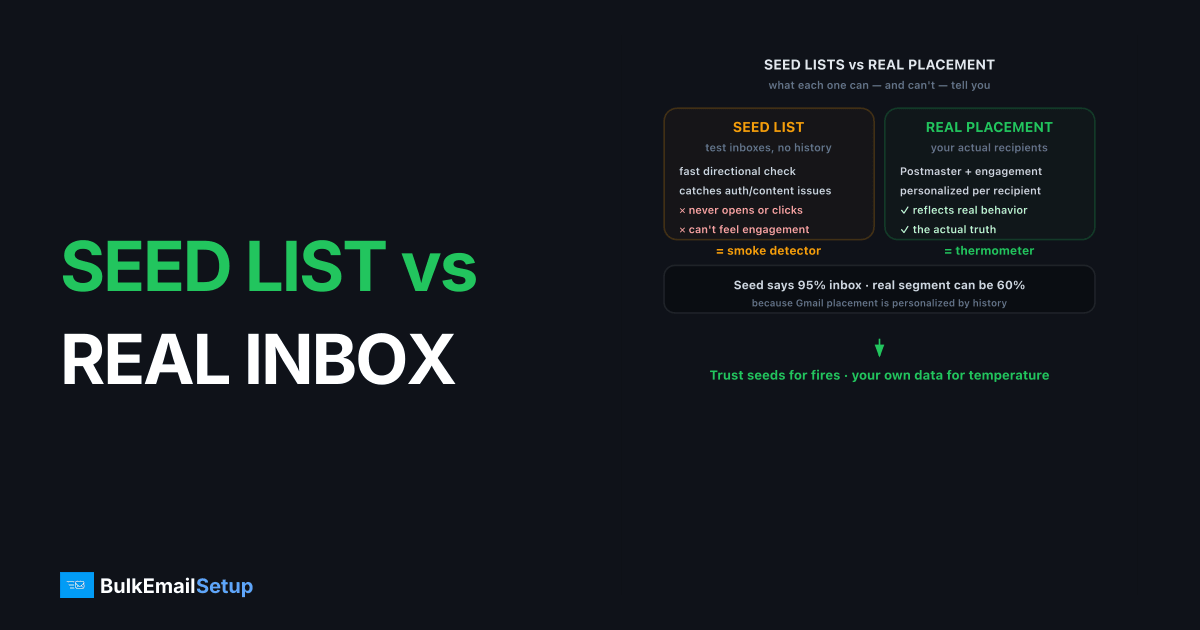
A seed list is a set of test inbox addresses across major providers that you send a campaign to in order to estimate where it lands (inbox, spam, or missing), while real inbox placement is measured from how your actual recipients receive your mail. The difference matters because seed addresses are inactive test accounts that never open or click, so they cannot reflect the engagement-based filtering that decides placement for real people. Trust seed lists for quick directional checks, and trust your own recipient-level data, like Google Postmaster Tools and engagement metrics, for the truth.
What does a seed list actually measure?
A seed list measures where a copy of your message lands across a fixed set of provider test accounts. You add the seed addresses to your send, the testing tool checks each mailbox, and it reports a placement breakdown by provider. It is fast, repeatable, and useful for catching obvious problems before a big send.
Its blind spot is engagement. Seed accounts do not open, click, reply, or move messages out of spam, so they miss the single biggest modern filtering factor: recipient behavior. The mechanics and limits of this approach are covered in inbox placement testing with seed lists. A seed list tells you whether your authentication and content pass a baseline, not whether real users will see you.
Why can seed list results mislead you?
Seed list results mislead when you treat a directional estimate as a precise verdict. The core problem is that placement at Gmail is heavily personalized. Two real users on the same campaign can get different placement based on their individual history with you, and a seed account has no history at all. So a seed result of "95% inbox" can sit next to a real-world result of 60% for a disengaged segment.
We have seen seed tests show clean inbox placement, 95 percent inbox or better, while a sender's real open rate slid from the low twenties into single digits over the same weeks, because the seeds could not feel the engagement decay the real audience was experiencing. Seed lists are a smoke detector, not a thermometer. They catch fires, they do not measure temperature.
What is panel data, and is it better?
Panel data measures placement across thousands of real, consenting mailboxes, capturing the engagement signals seed lists miss. Because panel mailboxes belong to actual users with real behavior, panel placement is closer to what your audience experiences. It is the middle ground between artificial seeds and your own data.
But panel data is still a sample of other people's mailboxes, not yours. It cannot see your specific recipient relationships. The comparison:
| Method | Measures | Strength | Weakness |
|---|---|---|---|
| Seed list | Test-account placement | Fast, cheap, repeatable | No engagement, not your audience |
| Panel data | Real-mailbox sample | Captures engagement | Still not your recipients |
| Your own data | Actual recipient outcomes | Ground truth | Slower, needs tooling |
What should you actually trust?
Trust your own recipient-level data above everything else, because it is the only source measuring your real audience. Google Postmaster Tools reports your domain and IP reputation, spam rate, and authentication results straight from Gmail. Your own engagement, bounce, and complaint metrics tell you how your list is really doing.
Use the tools in layers: seed lists for a fast pre-send sanity check, panel data for testing a content or infrastructure change, and your own metrics as the final word. The setup for the most important source is in Google Postmaster Tools guide, and the broader monitoring approach is in how to monitor email deliverability.
How should you use a seed list correctly?
Use a seed list as a pre-send check on authentication and content, not as a verdict on audience placement. Add the seed addresses to a test send (or a small slice of the real campaign), read the per-provider breakdown, and look for a binary signal: does anything land in spam at a provider where it should not?
The right questions for a seed test are narrow. Is SPF, DKIM, and DMARC passing at each provider? Did a content change suddenly tank placement versus the last run? Is one provider blocking outright while others accept? Those are real, actionable signals a seed list catches well.
The wrong question is "what percent of my audience reaches the inbox?" A seed list cannot answer that, because it has no engagement history. Treat a seed test like a compiler warning: a clean result does not prove your program works, but a failure definitely means something is broken. Use it to catch regressions, not to forecast revenue.
What are the common inbox-placement testing mistakes?
The most common mistake is trusting a high seed-list score while real engagement is sliding, then concluding deliverability is fine when it is not. Seed accounts cannot feel engagement decay, so they keep reporting inbox while your actual audience drifts to spam.
Watch for these traps:
- Over-reading the percentage. "94% inbox" on seeds is a pass/fail signal, not your audience's real rate.
- Stale seed lists. Old seed addresses can themselves get filtered or recycled, skewing results.
- Testing once. A single pre-launch test misses placement drift over a campaign's life.
- Ignoring your own data. Postmaster spam rate and your open and complaint trends override any seed result.
- No provider split. An aggregate "inbox" number hides a block at one specific mailbox provider.
The fix is sequencing. Seed-test to catch breakage, then trust your Postmaster and engagement data for the real picture. When the two disagree, believe your own recipients.
One concrete example shows why. A 50k newsletter send once tested at 96 percent inbox on seeds the morning of launch. By that afternoon, Gmail Postmaster showed the domain reputation had dropped from High to Medium and real open rate fell from 22 percent to 9 percent. The seeds never moved, because no seed account had ever opened, ignored, or complained about a prior send. The real audience had. That gap between a frozen seed score and live engagement data is the whole reason you sequence the two instead of trusting either alone.
How BulkEmailSetup helps
Seed tools cannot fix placement; clean infrastructure and clear data can. Our dedicated SMTP servers give you full logs and correct authentication, so the recipient-level signals you should actually trust are visible and reliable. You see real bounce and complaint data, not just a seed-list guess. See plans on our pricing page.
Frequently asked questions
What is a seed list in email?
A seed list is a set of test inbox addresses across providers like Gmail, Yahoo, and Outlook that you send to alongside a campaign. The tool reports where each test message landed, giving an estimate of inbox versus spam placement.
Are seed list results accurate?
Seed lists are directional, not exact. They use inactive test addresses that do not behave like real recipients, so they miss engagement-based filtering. Treat seed results as a sanity check, not a precise measure of where your real audience receives mail.
What is the difference between seed lists and panel data?
Seed lists use a small set of controlled test addresses. Panel data measures placement across thousands of real, consenting mailboxes, capturing engagement effects. Panel data is closer to reality but still a sample, not your own audience.
What should I actually trust for deliverability?
Trust your own recipient-level data first: Google Postmaster Tools, engagement rates, and bounce and complaint metrics from your real list. Seed lists and panels are useful for testing changes, but your actual audience signals matter most.