
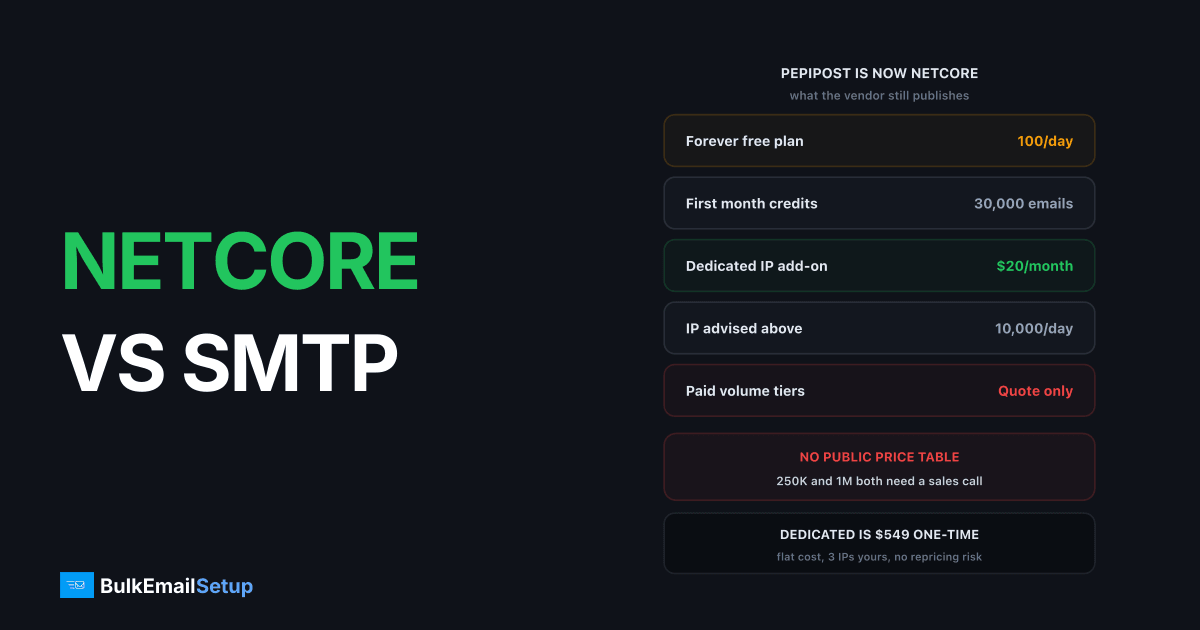
Pepipost no longer exists as a product. It was bought by Netcore Cloud around 2020, folded into Netcore Email API, and pepipost.com now redirects into Netcore's enterprise engagement suite. The practical result: the self-serve price table is gone, paid tiers are quote-only behind a demo call, and the only figures the vendor still publishes are a 100 emails/day free plan and a $20/month dedicated IP add-on. If you picked Pepipost because it was a cheap developer relay, the thing you bought is not the thing you are on now.
What actually happened to Pepipost
Pepipost was an independent transactional email service that competed on price, aimed squarely at developers in emerging markets who found SendGrid and Mailgun expensive. Netcore Cloud, an Indian marketing technology company, acquired it around 2020 and spent the following years absorbing it.
The absorption is now complete, and you can watch it in DNS. Here is what the old brand's endpoints do today.
| Endpoint | What it does now |
|---|---|
| pepipost.com | 301 redirects to Netcore's email API page |
| netcorecloud.com | 301 redirects to netcore.ai (a second rebrand) |
| smtp.pepipost.com | Resolves to 35.212.37.142 |
| smtp.netcorecloud.net | Resolves to the same 35.212.37.142 |
| Public email API price table | Gone, tiers are quote-only |
Both SMTP hostnames answer on one IP. The old name is a DNS alias kept alive so existing integrations do not break, not a surviving product. Netcore's current SMTP integration docs tell you to use smtp.netcorecloud.net on ports 25, 2525 or 587, and do not mention Pepipost at all.
Note the second rebrand in that table. netcorecloud.com now redirects to netcore.ai. That is two brand moves stacked on the same infrastructure inside a few years, which is the pattern this article is really about.
The pattern: cheap relay absorbed by an enterprise suite
This is the SparkPost shape. SparkPost was a focused high-volume email API, MessageBird (now Bird) acquired it, and the standalone product became a module inside a broader communications platform with repriced tiers. We covered the fallout in SparkPost alternatives.
Netcore ran the same play. The sequence is consistent enough to predict.
| Stage | What the sender sees |
|---|---|
| Independent relay | Public price table, self-serve signup, cheap per-email |
| Acquired | Nothing changes for 12 to 18 months, brand still up |
| Absorbed | Brand retired, docs move, endpoints renamed |
| Repositioned | Price table pulled, tiers become "Book a demo" |
| Bundled | Email is one module in a suite priced for enterprise |
The small self-serve sender is the segment that gets repriced first, because they are the least profitable to support and the least likely to sign an annual contract. Nobody sends an email telling you this happened. You find out when you go looking for the pricing page and it is a demo form.
I want to be fair here: Netcore did not break anything. Existing integrations keep working, the free plan still exists, and the deliverability team is real. The complaint is narrower and it is about predictability, which is a different thing from quality.
What Netcore Email API costs now
Netcore has retired the self-serve price table for the email API. The pricing route on the marketing site leads to the customer engagement platform, where the tiers are demo bookings rather than numbers. I am not going to print a per-month tier price for you, because the vendor does not publish one and any figure floating around on a review aggregator is a scrape of a table that no longer exists.
Two figures are still documented by the vendor and those I will use.
| Line item | Documented figure | Source |
|---|---|---|
| First month free credits | 30,000 emails, 1,000/day cap | Netcore docs |
| Forever free plan | 100 emails/day, about 3,000/month | Netcore docs |
| Dedicated IP add-on | $20/month | Netcore docs |
| Recommended volume for that IP | above 10,000/day | Netcore docs |
| Paid volume tiers | Quote-only, demo call | No public page |
The forever free plan doc is the source for the free figures. 100 emails a day is an integration test allowance, not a sending plan. At 3,000 a month you cannot run a newsletter for a mailing list of any size.
The $20 dedicated IP is genuinely cheap compared to most relays, where the same add-on runs $30 to $80. The catch is in their own recommendation: they advise it only above 10,000 emails a day. Below that the IP does not get enough volume to stay warm, which is true everywhere and honest of them to say.
Features compared
| Factor | Netcore Email API | Dedicated SMTP server |
|---|---|---|
| Pricing model | Quote-only, sales-led | Flat, published |
| Free tier | 100/day after month one | None |
| Dedicated IP | $20/month add-on | Included, yours |
| IPs you control | Zero, assigned to you | All of them |
| PTR record | Provider sets it | You set it |
| MTA tuning | Not available | Full access |
| Warm-up pace | Provider policy | Your schedule |
| Raw SMTP logs | Dashboard reports | Direct on the box |
| Setup time | Minutes | Hours, or managed |
| Contract | Annual likely at volume | One-time or monthly |
| Repricing risk | Vendor decides | None |
The rows that matter are the last two. Everything above them is the normal managed-relay trade, and it is a reasonable trade at low volume. The bottom two rows are what the repositioning changed.
Cost at 250K and 1M a month
Here is where I have to be careful. I can price the dedicated server column exactly, because our pricing is published. I cannot price the Netcore column, because Netcore does not publish it. Printing an invented number would be worse than leaving the cell honest.
| Monthly volume | Netcore Email API | Dedicated SMTP server |
|---|---|---|
| 3,000 | $0 (free plan) | Not worth it |
| 250,000 | Quote required | $549 one-time, then hosting |
| 250,000 + dedicated IP | Quote + $20/month | IPs included |
| 1,000,000 | Quote required | Same flat cost, no change |
| 1,000,000 + 3 IPs | Quote + $60/month | IPs included |
The shape of that table is the argument. The dedicated column does not move between 250K and 1M, because a flat cost is flat. The Netcore column requires a sales conversation at both volumes, and the number you get depends on what the account executive thinks you will pay.
For a like-for-like view against providers that do publish, see cost per 1,000 emails across every major provider. The useful benchmark from that comparison: once a relay bills you per message, 1M emails a month lands somewhere between $400 and $1,200 depending on the vendor. A one-time $549 server with unlimited sends inside its capacity does not have a per-message line at all.
Where the IPs sit, and whether it matters
Netcore is India-origin and its infrastructure history reflects that, which raises a fair question about deliverability to US and EU inboxes. The honest answer is that the country on the company registration is not the variable.
Gmail and Microsoft do not score you on where the vendor is headquartered. They score the sending IP's reputation, the domain's authentication, and the complaint rate. Google's sender guidelines set the bar the same way for everyone: SPF, DKIM and DMARC passing, TLS, valid reverse DNS, and a spam complaint rate under 0.3% with 0.1% as the real target.
What does matter is the shared pool. On a shared relay your mail leaves from IPs shared with other senders, and their behaviour affects your placement. A pool skewed toward one region's sending patterns can carry a different reputation profile at US receivers than at local ones. This is exactly why Netcore sells the dedicated IP add-on and recommends it above 10,000 a day.
So the question is not "is India a problem". It is "am I on an IP whose reputation I control". At $20/month you can buy your way out of the pool but not out of the platform, since the PTR record, the MTA config and the warm-up schedule stay Netcore's to set.
The migration risk of a repositioning vendor
Vendor repositioning is a slow risk, not a sudden one. Nothing breaks on any particular Tuesday. What happens is that your renewal quote arrives higher, the plan you were on is no longer sold, or the feature you depend on is now in a tier above yours.
The specific exposures worth naming:
- Price discovery is gone. You cannot budget next year without a sales call, and you cannot benchmark your quote against a public rate.
- Contract shape changes. Self-serve monthly becomes annual commit as an account moves upmarket.
- Feature bundling. The email API gets sold with engagement modules you do not need but end up paying for.
- Support tiers. Dedicated account management becomes the reason to be on a higher plan.
- A second rebrand. netcorecloud.com to netcore.ai means docs URLs, dashboard links and internal runbooks go stale.
Point five is not cosmetic. Every bookmark, integration guide and onboarding doc your team wrote against the old domain now depends on a redirect staying up. Redirects get retired.
If you do move, move properly. Domain reputation is portable, IP reputation is not, so a fresh dedicated IP needs a four to six week ramp regardless of your history. Our ESP migration plan covers running both paths in parallel so the cutover does not cost you placement.
Where Netcore is still the right call
I would stay on Netcore in a few real cases.
Under 50,000 emails a month with no email engineer on staff, the managed model earns its cost. You get the deliverability team, the dashboard and the authentication tooling without owning any of it, and $20 for a dedicated IP is cheaper than most competitors charge.
Spiky volume also favours the shared pool. If you send 200,000 one month and 8,000 the next, a dedicated IP goes cold between campaigns and a warm shared pool protects you. Dedicated infrastructure wants steady volume, roughly 50,000 a month as a floor.
And if you already have a signed Netcore contract at a rate you are happy with, the repositioning is somebody else's problem until renewal. Diarise the renewal date and get a competing quote before it.
Where a dedicated server wins
The dedicated case is strongest on three points, and only one of them is cost.
Price certainty. A flat published cost cannot be repositioned. No demo call, no annual commit, no tier that quietly stops being sold.
IP ownership. Not a $20 add-on inside someone else's platform. Your IPs, your PTR records, your warm-up pace, and separate IPs for transactional and marketing streams so a campaign mistake never delays a password reset.
Direct visibility. When placement dips you read the raw SMTP responses and per-destination throttling on your own box, instead of reading a dashboard summary and opening a ticket. That difference is worth most on the day something breaks.
The crossover sits around 250,000 to 500,000 emails a month sent consistently. Below it the managed relay is usually the better buy. Above it you are paying a per-message premium on infrastructure you do not control, and the vendor's roadmap is not aimed at you. The same maths runs against other cheap relays in Elastic Email vs a dedicated SMTP server.
Who should pick which
| Your situation | Better pick |
|---|---|
| Under 50K/month, no email engineer | Netcore Email API |
| Spiky, inconsistent volume | Netcore (pool stays warm) |
| Testing an integration | Netcore free plan, 100/day |
| Need a budget number without a sales call | Dedicated SMTP server |
| 250K+/month, steady | Dedicated SMTP server |
| Need multiple isolated IPs | Dedicated SMTP server |
| Want raw log and MTA access | Dedicated SMTP server |
| Burned by a repricing before | Dedicated SMTP server |
How BulkEmailSetup helps
We build dedicated SMTP infrastructure you own: your own server, your own IPs, full SPF, DKIM, DMARC and PTR setup, MTA tuning, bounce handling and a warm-up plan. No demo call to find out the price, no tier that gets retired, no email module bundled into an engagement suite you did not ask for.
Basic is $549 one-time, covering 1 SMTP server, 3 dedicated IPs, 25,000 emails/day and unlimited contacts. Higher tiers scale to 15 IPs and 200,000 emails/day. See pricing for the full table.
Frequently asked questions
Is Pepipost still available?
Not as a brand. Pepipost was acquired by Netcore Cloud around 2020 and folded into Netcore Email API, and pepipost.com now redirects to Netcore's own email API page. The old SMTP hostname smtp.pepipost.com still resolves, but Netcore's current docs tell you to use smtp.netcorecloud.net on ports 25, 2525 or 587 instead.
How much does Netcore Email API cost?
Netcore no longer publishes a self-serve price table for the email API, so paid volume tiers are quote-only and you go through a demo call to get a number. The two figures the vendor still documents publicly are the free plan and the dedicated IP add-on at $20 per month. Treat any tier price you find on a review aggregator as stale until sales confirms it.
Does Netcore Email API have a free tier?
Yes. Netcore's docs describe 30,000 email credits in the first month with a 1,000 per day cap, then 100 emails per day on the forever free plan after that. That is roughly 3,000 a month, which is fine for testing an integration and not enough for any real campaign.
Does Netcore give you a dedicated IP?
Yes, as a paid add-on at $20 per month, and their docs recommend it only above 10,000 emails a day. The IP is assigned to you but sits inside Netcore's infrastructure, so you do not control the MTA, the PTR record, or the warm-up pace the way you do on your own server.
Why does a vendor moving upmarket matter to my sending?
Because the cheap self-serve tier stops being the product. Pricing moves behind a sales call, contracts get annual, and the email API becomes one module in a suite priced for enterprise engagement. SparkPost went the same way after MessageBird bought it, and in both cases the small developer sender is the segment that gets repriced first.
When does a dedicated SMTP server beat Netcore?
Past roughly 250,000 to 500,000 emails a month sent consistently, and immediately if quote-only pricing is a problem for your budgeting. A flat one-time or flat monthly cost does not move when a vendor repositions, and the IPs are yours rather than a $20 add-on inside someone else's platform.
Is Netcore's India origin a deliverability problem for US inboxes?
Not by itself. Gmail and Microsoft score the sending IP and domain reputation, not the country the company is headquartered in. What matters is which pool your mail leaves from and who else is on it, which is why Netcore recommends a dedicated IP above 10,000 a day.


