
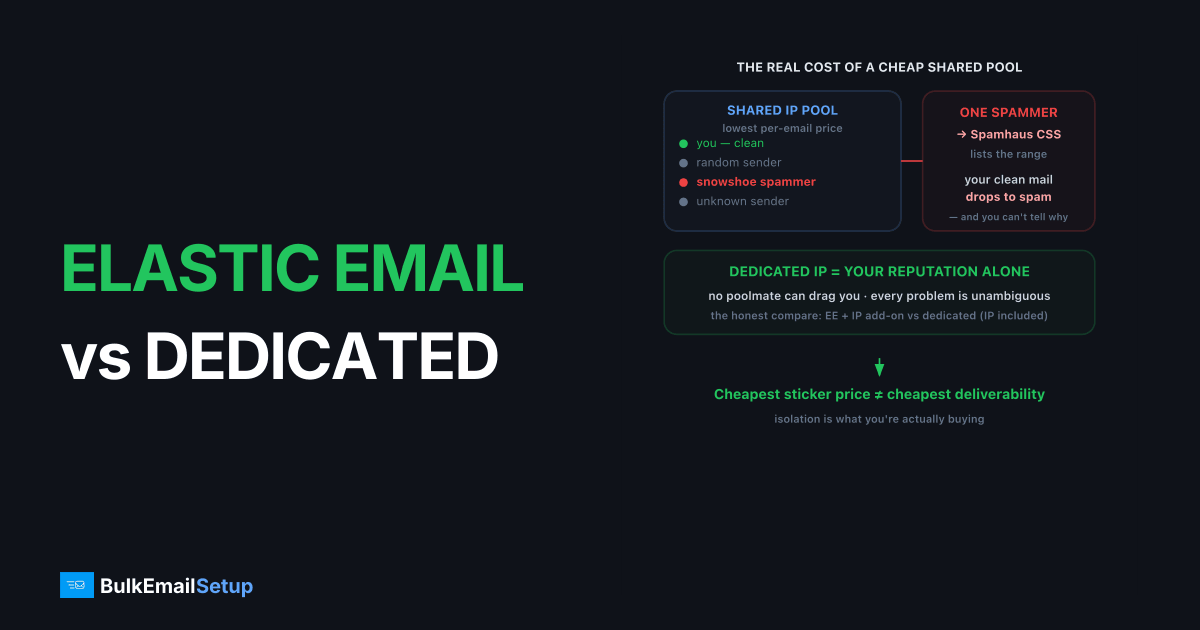
Elastic Email is the cheaper choice on raw per-email price at low to moderate volume; a dedicated SMTP server wins on control, IP isolation, and consistent deliverability once volume and reputation matter. Elastic Email is one of the lowest-cost relays, but its standard plans send from shared IP pools and manage everything for you. A dedicated SMTP server gives you your own IP, full SMTP and DNS access, and a flat monthly bill, so your reputation never depends on strangers in a shared pool.
What is Elastic Email and where does it fit?
Elastic Email is a low-cost email delivery platform with marketing and SMTP relay options, priced aggressively per email. It targets volume senders who want the cheapest possible per-message rate. As of early 2026, its standard sending runs through shared IP pools, with dedicated IPs offered as an add-on.
The low price is real, and so is the trade-off. Cheap relays attract mixed senders, so the shared pool you land in shapes your deliverability. That's the central risk to weigh.
How do Elastic Email and a dedicated SMTP server compare?
| Factor | Elastic Email | Dedicated SMTP server |
|---|---|---|
| Price model | Low per-email | Flat monthly |
| Default IP | Shared pool | Dedicated, you control it |
| Dedicated IP | Paid add-on | Included |
| Volume limits | Plan-based | Bound by IP capacity |
| Setup effort | Minutes | Hours to days (or managed) |
| Deliverability control | Provider-managed, shared | Full: IP, warm-up, DNS, MTA |
| Reputation risk | Inherited from pool | Only your own sending |
Figures are directional as of early 2026. Confirm current rates on the Elastic Email pricing page.
What's the real cost of shared-pool sending?
The hidden cost is reputation you don't control. On a shared IP you inherit the pool's standing, good and bad, so one snowshoe spammer can land the range on Spamhaus CSS and your mail suddenly drops to the spam folder. Diagnosing it is hard, since you can't tell if the problem is you or a poolmate.
A dedicated IP flips that. The reputation is yours alone, which is an advantage when your practices are clean and a liability when they aren't. We unpack the trade in dedicated IP vs shared IP for email.
In setups we have provisioned, the shared-pool failure mode looks the same every time: the sender's own metrics are clean, complaint rate under 0.1%, list freshly cleaned, and mail still drops to spam at one or two providers because a poolmate triggered a listing on the shared range. They open a delisting request and then wait, sometimes days, on a queue they do not control. On a dedicated IP the same sender fixes the cause in their own logs and requests delisting on an IP only they touched.
When does a dedicated SMTP server win?
It wins on control first, cost second. Once you send consistently past roughly 50K/month you can keep a dedicated IP warm, and past 200K-500K/month a flat plan starts rivaling even Elastic Email's low per-email rate. We compare relay rates in SMTP relay pricing comparison.
On a dedicated server you set SPF, DKIM, and DMARC, the PTR record, and run your own warm-up. That's more work, but your inbox placement stops being a lottery. Deliverability still depends on a clean list and a low complaint rate.
What does the cost look like at volume?
Elastic Email competes on raw per-email price, so it's genuinely cheap in its standard bands. The catch is that the cheap rate buys shared-pool sending; a dedicated IP add-on changes the math. Here's a directional comparison as of early 2026.
| Monthly volume | Elastic Email (shared, per-email) | Dedicated SMTP server (flat) |
|---|---|---|
| 50K | Very cheap, shared pool | Flat plan, likely more per email |
| 200K | Cheap, shared reputation risk | Roughly break-even territory |
| 500K | Add dedicated IP cost to compare | Flat plan often cheaper, isolated |
| 1M+ | Per-email plus IP add-on stacks | Flat plan, cheaper and isolated |
The honest comparison isn't bare per-email rate against flat rate. It's Elastic Email plus a dedicated IP add-on against a dedicated server that includes the IP. Once you add the IP you actually need for stable deliverability, the price gap narrows fast. We compare relay rates in SMTP relay pricing comparison and the broader curve in cost per email: SMTP vs ESP.
Where is Elastic Email the better choice?
Elastic Email wins when raw price is the priority and your volume is low enough that shared-pool risk is acceptable. For low-stakes sending, internal notifications, or budget-constrained projects under 200K a month, it's hard to beat on cost. The platform is functional and the rate is real.
It's also reasonable when your volume is spiky. A dedicated IP needs consistent volume to stay warm, and an idle dedicated IP is a deliverability liability. If your sends swing wildly month to month, Elastic Email's shared pool, kept warm by other senders, can deliver more reliably than a half-warmed IP of your own. That's a real, if counterintuitive, advantage of shared infrastructure.
Where does a dedicated SMTP server win?
A dedicated SMTP server wins the moment deliverability consistency matters more than the lowest sticker price. On a dedicated IP your reputation is yours alone, so a snowshoe spammer sharing your pool can't drag your inbox placement into the spam folder. That isolation is the core reason to leave a cheap shared relay. We unpack it in dedicated IP vs shared IP for email.
Control comes with it. You run your own warm-up, set authentication yourself, and diagnose problems from your own logs instead of guessing whether a poolmate caused them. When mail starts landing in spam on a shared pool, you often can't tell if the fault is yours. On a dedicated IP the answer is unambiguous, which makes every deliverability problem faster to fix.
How do you migrate from Elastic Email to a dedicated server?
Migration is DNS plus warm-up, not a rewrite. Both speak standard SMTP on ports 587 or 465, so the app change is host, port, and credentials. The slow part is reputation: a fresh dedicated IP starts cold and warms over four to six weeks.
Stage it. Stand up the server with SPF, DKIM, DMARC, and PTR verified. Route a small slice through the new IP while Elastic Email carries the bulk, ramping on a warm-up schedule. Watch placement at each step, then shift the rest once the IP holds steady. Moving off a shared pool means you give up borrowed warmth, so don't rush the ramp.
Who should pick which?
| Your situation | Better pick |
|---|---|
| Lowest price, low stakes | Elastic Email |
| Under 200K/month, budget-bound | Elastic Email |
| Spiky, inconsistent volume | Elastic Email (shared pool stays warm) |
| Deliverability consistency matters | Dedicated SMTP server |
| Want reputation isolation | Dedicated SMTP server |
| Steady 200K+/month | Dedicated SMTP server |
| Need your own warm-up control | Dedicated SMTP server |
What deliverability rules carry over no matter which you pick?
Leaving Elastic Email doesn't change what receivers demand. Gmail and Yahoo's bulk sender rules (5,000+ recipients a day) require SPF, DKIM, and DMARC all passing, one-click unsubscribe per RFC 8058, TLS, valid PTR or reverse DNS, and a spam complaint rate under 0.3%, ideally under 0.1%. On a shared pool you depend on poolmates meeting these too; on a dedicated IP you own every record and every metric. Neither path lets you skip the thresholds.
The records carry technical floors worth knowing. Your DKIM key should be 2048-bit, with 1024 the weak minimum. Your SPF must resolve in 10 DNS lookups or fewer, or receivers return a PermError and fail the check. DMARC steps through none, quarantine, then reject as your authentication proves stable. On a dedicated IP these are fully in your hands, which is the whole point of leaving a shared pool.
What goes wrong when senders switch badly?
The classic mistake is cutting all volume to a cold IP at once. A new dedicated IP that suddenly pushes 200K in a day looks like a spam cannon to Gmail, which replies with a 421 4.7.28 rate limit or a soft block to the spam folder. Moving off a shared pool means you lose its borrowed warmth, so the ramp matters even more. Start near 50 to 100 a day and double every few days while watching placement.
The second mistake is moving a dirty list to fresh infrastructure, then blaming the server. A new IP with a 5% bounce rate and rising complaints burns reputation faster than a shared pool would, because all the damage lands on an IP that's entirely yours. Clean the list, suppress hard bounces, and let your most engaged contacts lead the warm-up. A switch is the worst moment to skip list hygiene.
How much volume justifies a dedicated IP?
The threshold is consistency, not just a number. A dedicated IP needs steady volume to stay warm, with a rough floor near 50K sends a month sent regularly. Below that, Elastic Email's shared pool usually delivers better because other senders keep it warm. Above it, a dedicated IP starts to pay off, and the consistency case strengthens as volume climbs.
Cost is the secondary trigger here, because the real driver is reputation control. Once you add Elastic Email's dedicated IP add-on to get stable deliverability, the price gap to a dedicated server that includes the IP narrows sharply. There's a staffing factor too: a dedicated server's controls only help if someone will read logs, tune warm-up, and manage DNS. If nobody will, a cheap shared relay keeps appeal despite the reputation risk. If you have the capacity and your sending is steady, owning the IP ends the deliverability lottery. How many emails before you need dedicated infrastructure covers the signals.
How BulkEmailSetup helps
If Elastic Email's shared pools have made your deliverability unpredictable, a dedicated SMTP server gives you an IP nobody else can wreck. We provision clean dedicated IPs, configure authentication correctly, and run the warm-up so your reputation is yours alone, at a flat monthly cost. See plans on our pricing page.
Frequently asked questions
Is Elastic Email cheaper than a dedicated SMTP server?
Elastic Email is among the lowest per-email relays, so at low to moderate volume it's hard to beat on raw price. At consistent high volume, a flat-rate dedicated SMTP server can match or beat it per email while giving you a dedicated IP and full control.
Does Elastic Email use shared or dedicated IPs?
Elastic Email's standard plans send from shared IP pools, with dedicated IPs available as a paid add-on. A dedicated SMTP server gives you your own IP by default, plus the warm-up, PTR, and reputation control that comes with it.
Is Elastic Email good for deliverability?
Elastic Email's deliverability depends heavily on the shared pool you land in, since cheap relays attract mixed senders. A dedicated SMTP server isolates your reputation so a poolmate's bad behavior can't drag your inbox placement down.
When should I move from Elastic Email to a dedicated server?
Move when shared-pool deliverability becomes inconsistent, when you need a dedicated IP you control, or when per-email cost at high volume rivals a flat plan. That usually happens once you send consistently above roughly 200K-500K emails per month.


