
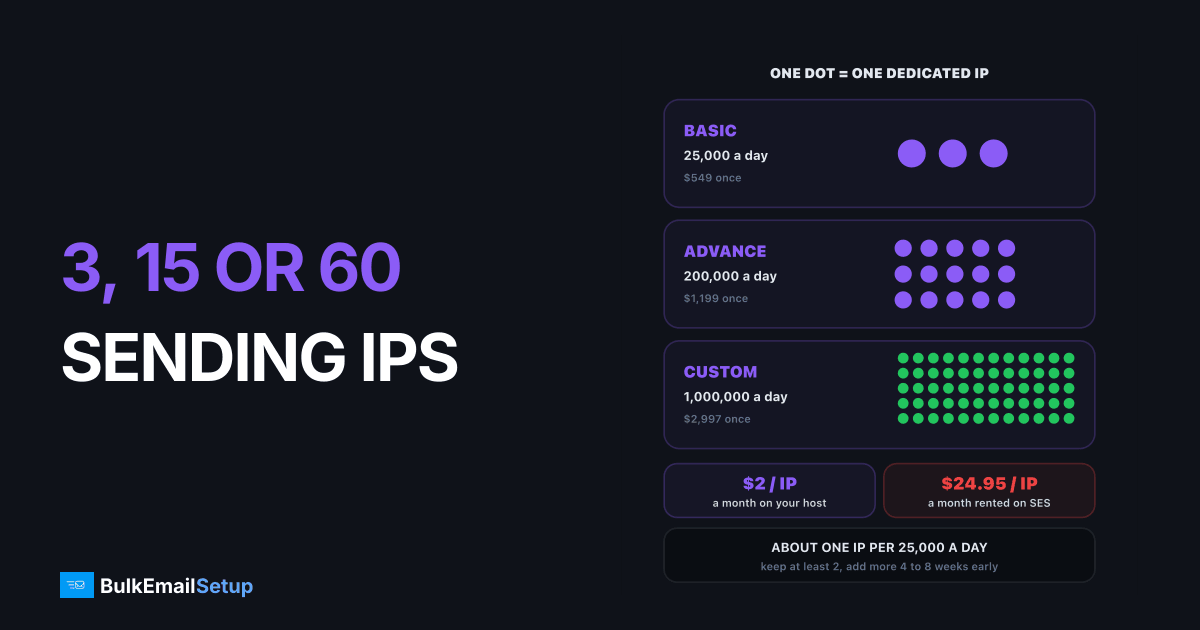
Plan for roughly one IP per 25,000 emails a day, with a floor of 2. That is the comfortable ceiling per IP before Microsoft and Yahoo start throttling. Our plans sit well under it: 3 IPs carry 25,000 a day (about 8,300 each), 15 carry 200,000 (about 13,300 each) and 60 carry a million (about 16,700 each). On your own server each IP costs about $2 a month from your host, so 15 IPs come to roughly $30 a month, against about $374 a month to rent 15 dedicated IPs from Amazon SES.
How many IPs does an SMTP plan need?
The rule from our IP count guide: divide daily volume by 25,000, round up, keep at least 2. The floor matters as much as the ceiling, because an IP needs 1,000 to 2,000 emails a day just to keep a reputation.
| Daily volume | IPs to run | Per IP per day |
|---|---|---|
| Under 10,000 | 2 to 3 | under 5,000 |
| 25,000 | 3 | about 8,300 |
| 100,000 | 4 | about 25,000 |
| 200,000 | 8 to 15 | 13,300 to 25,000 |
| 1,000,000 | 40 to 60 | 16,700 to 25,000 |
Each rung adds IPs and daily capacity
Gmail's sender guidelines also require every sending IP to have valid forward and reverse DNS. With a pool of 15 or 60 IPs, that means 15 or 60 PTR records that match, which is the kind of detail that gets skipped in a DIY build.
What is IP rotation and does it help?
Rotation spreads one send across the whole pool. On our Advance plan, 3 SMTP servers each hold 5 IPs, and sending rotates across all 15 IPs.
One platform, 3 servers, 15 IPs
| What rotation does | What it does not do |
|---|---|
| keeps each IP under hourly limits at Gmail and Microsoft | fix a list with old or bought addresses |
| leaves 14 working IPs if 1 gets listed | hide complaints, which every IP carries |
| lets new IPs warm up beside warm ones | replace SPF, DKIM and DMARC |
The line to stay on the right side of is snowshoeing: spreading spam thinly across many IPs and domains to dodge filters. Legitimate rotation is a fixed, authenticated pool with matching reverse DNS and steady volume. Our page on IP rotation for cold email covers the patterns in more depth.
How much do 15 dedicated IPs cost?
On your own server, IPs are a small line item. On a relay, they are the biggest one.
Same 15 IPs, very different monthly bills
| Line item | Own server, Advance | Amazon SES, 15 dedicated IPs |
|---|---|---|
| Setup | $1,199 once | none |
| Server | $19 a month VPS | included |
| 15 IPs | $30 a month | $374.25 a month |
| Sending fees | none | $0.10 per 1,000 emails |
| Domains | 4 at about $10 a year | yours |
At 200,000 emails a day, SES sending fees add about $600 a month on top of the IPs. The own-server bill stays at about $49. The cost of 1 million emails a day runs the same math at the next tier.
Can I add IPs to my plan later?
Yes, and most senders should grow in steps rather than buy the biggest pool on day one.
| Change | How | Cost | Lead time |
|---|---|---|---|
| More IPs on the same server | your host assigns them, we add them to rotation | about $2 per IP a month | 4 to 8 weeks of warm-up |
| Another SMTP server | added to the same platform | small setup fee each | days to build, weeks to warm |
| Move up a plan | Basic to Advance upgrade | see pricing | warm-up on the new IPs |
New IPs start cold no matter how warm the rest of the pool is. Add them 4 to 8 weeks before you need the capacity, and stagger them. Our warm-up schedule has the week-by-week numbers.
Signs you need more IPs
You rarely need more IPs on day one. These are the signals that the pool is too small for your volume.
| Signal | Where you see it | What to do |
|---|---|---|
| Deferrals (4xx) at Microsoft or Yahoo rise during sends | server logs, bounce reports | add IPs or slow the hourly rate |
| A campaign takes longer than your send window | campaign stats | add an SMTP server, not just IPs |
| One IP listed takes out a large share of capacity | blocklist alerts | grow the pool so each IP carries less |
| Daily volume passes 25,000 per IP | campaign stats | add IPs 4 to 8 weeks before the next jump |
The reverse also applies: if most IPs sit under 1,000 emails a day, you have too many, and some will lose their reputation from lack of traffic.
Which plan fits
| Plan | Servers | Dedicated IPs | Emails a day | Emails an hour | Domains | One-time fee | Hosting a month |
|---|---|---|---|---|---|---|---|
| Basic | 1 | 3 | 25,000 | 1,050 | 1 | $549 | about $11 |
| Advance | 3 | 15 | 200,000 | 8,500 | 4 | $1,199 | about $49 |
| Custom | 12 | 60 | 1,000,000 | 41,700 | 13 | $2,997 | about $170 |
If your daily peak is under 20,000, Basic is enough and leaves room. Between 25,000 and 200,000, Advance. Above that, Custom, which runs on one dedicated server with 5 IPs per SMTP instance.
How BulkEmailSetup helps
We build the whole pool: servers, dedicated IPs with matching PTR records, SPF, DKIM and DMARC, rotation across every IP, bounce handling, a campaign platform and a warm-up plan. You own the server and the IPs, and pay your host directly.
There is no monthly fee to us and no contact limit. Every plan has a 15-day money-back guarantee, which applies until server access is handed over. See the Advance plan for 15 IPs, or compare all pricing.
Frequently asked questions
How many IPs does an SMTP plan need?
Divide your daily volume by 25,000, round up, and keep at least 2. Under 10,000 a day, 2 to 3 IPs is plenty; 100,000 a day needs about 4; a million needs 40 to 60. More IPs than your volume can keep warm is a mistake too, because an IP sending a few hundred emails a day never builds a reputation.
What is IP rotation and does it help?
Rotation spreads each send across a pool of IPs, so no single IP sends too much to Gmail or Microsoft in an hour. It helps with capacity and gives you a working fallback if one IP gets listed. It does not fix a bad list: every IP in the pool carries the same complaints, just in smaller slices.
How much do 15 dedicated IPs cost?
On your own server, about $2 per IP a month, so roughly $30 for 15, plus the VPS. BulkEmailSetup's Advance plan runs 15 IPs and 3 SMTP servers for about $49 a month in hosting after a $1,199 one-time setup. Renting 15 dedicated IPs from Amazon SES at $24.95 each is about $374 a month before sending fees.
Can I add IPs to my plan later?
Yes. Extra IPs on the same server cost about $2 each a month from your host, and extra SMTP servers can be added for a small setup fee each. Add them 4 to 8 weeks before you need the capacity, because each new IP has to warm up, and stagger them rather than warming several at once.
Do more IPs improve deliverability?
Only up to the number your volume can keep busy. Inbox providers score each IP on the mail it carries, so an IP needs steady traffic, at least 1,000 to 2,000 a day, to keep a reputation. Past that, extra IPs add capacity and resilience, not inbox placement. List quality and authentication decide placement.
What happens if one IP gets blacklisted?
With a pool, you pull that IP out of rotation and keep sending on the rest while you delist it. On Advance, losing 1 of 15 IPs removes under 7% of capacity. On a single-IP setup, one listing stops everything. BulkEmailSetup's delisting guide covers the steps for each major list.
Is IP rotation the same as snowshoeing?
No. Snowshoeing is spreading spam thinly across many IPs and domains to dodge filters, and blocklists treat it harshly. Legitimate rotation uses a fixed pool of IPs that all have matching reverse DNS, the same authenticated domain and consistent volume. If rotation is being used to hide a list problem, it is the bad kind.


