
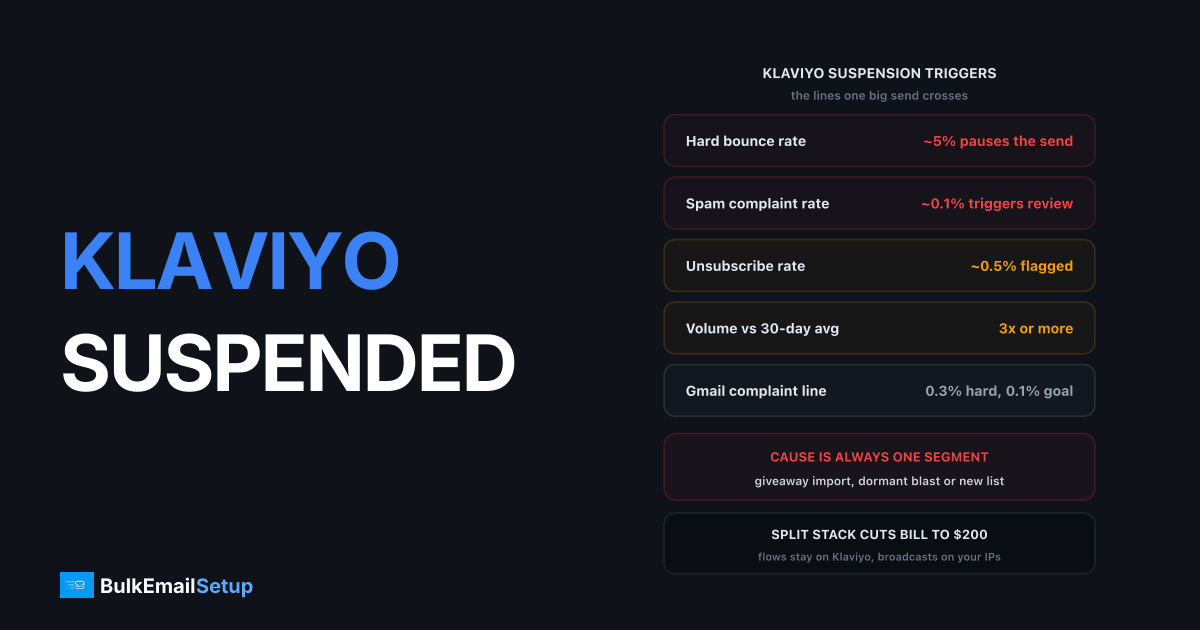
Klaviyo pauses a campaign or puts an account under review when one large send produces a hard bounce rate over roughly 5% or a spam complaint rate over roughly 0.1%, or when its compliance team decides the list source or the product category is not allowed on its shared infrastructure. In practice the send that trips it is nearly always a giveaway list, a re-engagement blast to dormant profiles, or an import from another platform. The account was fine for two years and then one campaign to 300,000 profiles broke it. Before you write to support, pull the 7-day numbers below, because the reply that works is different for each cause.
Which notice did you get
Klaviyo has three states that people describe as "suspended". Only the first one is automated, and only the first one clears itself.
| Notice type | Typical wording | What triggered it | Realistic outcome |
|---|---|---|---|
| Campaign paused | "This campaign was paused due to high bounce rate" | Bounces or complaints crossed the line mid-send | Resume within hours once the bad segment is dropped |
| Account under review | "Your account is under review", "sending has been temporarily disabled" | A bad send plus a compliance look at list source | Restored in 2 to 5 business days if you show cause |
| Account suspended | "Your account has been suspended for violating our Acceptable Use Policy" | Purchased list, restricted category, or a repeat | Usually permanent |
A paused campaign is Klaviyo protecting its own IPs mid-send. It stopped at, say, 40,000 of 300,000 recipients because the first batches bounced at 8%. Nobody has looked at your account yet. An account under review means someone has, and they want an explanation. A suspension is a decision already made, and writing the same ticket for all three is how a fixable case becomes a permanent one.
How the deliverability hub maps to the trigger
Klaviyo's deliverability hub shows the same numbers its automated checks use, so you can see exactly what tripped. The colours matter less than the raw rates.
| Metric | Klaviyo's practical line | Gmail's line | What it points to |
|---|---|---|---|
| Hard bounce rate | ~5% pauses a send | ~2% draws throttling | list provenance, dormant addresses |
| Spam complaint rate | ~0.1% triggers review | 0.3% hard, 0.1% target | consent or relevance |
| Unsubscribe rate | ~0.5% flagged | none published | frequency or targeting |
| Open rate on the send | under 10% flagged alongside the others | none | dormant segment |
| Volume vs 30-day average | 3x or more | none | what drew the automated look |
Gmail's bulk sender guidelines are the ones that matter for the long term, because Gmail is 50 to 70% of most consumer lists. Klaviyo's own thresholds sit slightly below Gmail's on purpose. It wants to stop you before Gmail notices, and it did not manage to this time.
The 7-day numbers to pull now
You still have dashboard access under review, and usually for a window after suspension. Export these before anything else.
- Per-campaign bounce, complaint, unsubscribe and open rates for the last 7 days, from the campaign reports.
- The bounce list for the offending campaign, sorted by recipient domain. If Gmail bounced at 2% and a long tail of corporate domains bounced at 20%, that is a scraped or ancient segment.
- The segment definition you sent to. "Profiles with no activity in 180 days" is a different story from "imported from giveaway CSV on the 12th".
- The import history for the last 30 days, with source and row counts.
- Your suppression list, complete. You need it wherever you send next, legally.
- Google Postmaster Tools domain reputation and spam rate for the same 7 days. If it dropped from High to Medium or Low, the damage is already recorded.
One more thing to note: the profiles that bounced or complained. In a typical case I've seen, 250,000 profiles were mailed, 18,000 hard bounced (7.2%), 410 complained (0.16%), and 84% of both came from a single 60,000-row giveaway import.
What to send support
Klaviyo's compliance team reads hundreds of these. The ones that get restored share a shape: they name the segment, own the numbers, and describe a change that prevents a repeat. The ones that get closed argue.
| Line | Include | Leave out |
|---|---|---|
| Cause | "The 60K giveaway import from 12 March bounced at 11% and generated 84% of complaints" | "We have no idea what happened" |
| Evidence | Bounce breakdown by segment, import source, signup form URL | Screenshots of your open rate from last year |
| Fix already done | Segment deleted, hard bounces suppressed, imports now go through validation | "We will be more careful" |
| Process change | Re-engagement limited to 180-day profiles, 10K per day, giveaway leads double opt-in | Promises with no number attached |
| Ask | Restore sending to the engaged segment only, at reduced volume for 14 days | Restore everything immediately |
Send it once. Follow up after 3 business days, not 3 hours. Do not attach the list.
What it did to your domain
Nothing new. That sounds like good news and is not. Gmail, Yahoo and Microsoft scored your sending domain on that campaign the moment it landed, and the score does not care that Klaviyo carried it. A 0.16% complaint rate at Gmail on a 250K send is recorded against your domain for a rolling window that runs weeks, and it follows you to Klaviyo's replacement, to Amazon SES, to a dedicated server, to anything.
So the suspension is not the reputation event. The send was. Check Postmaster Tools. If domain reputation is still High, you got away with it and the fix is list hygiene. If it is Low, every route below starts with 2 to 4 weeks of sending only to your most engaged 20% to pull it back, on Klaviyo or anywhere else.
The route decision
There are three routes and the cause decides it.
Route 1: list quality. The list is legitimate but part of it is dead. This is a paused campaign or an under-review case, and it is the most common. Fix the list, get restored, stay on Klaviyo if the bill makes sense. Every provider suspends for the same numbers, so moving without cleaning just repeats the suspension elsewhere in two weeks. Method in email list cleaning.
Route 2: policy. Klaviyo has decided the list source (co-registration, purchased, giveaway leads without a clear opt-in) or the category (supplements with health claims, CBD, adult, several others) is not welcome on shared IPs. No number in your reply changes this. The same call comes from Mailchimp and Brevo, and Mailchimp's closures are harder to reverse still. Legitimate senders in this position move to infrastructure where the only reputation at risk is their own.
Route 3: Klaviyo is the wrong tool for the job. You have 300,000 profiles, you send a weekly broadcast to most of them, and Klaviyo's automated checks are tuned for flows to engaged buyers at a few thousand a day. Broadcasts to a big list will keep tripping the checks even when the list is reasonable, because a 3x volume spike on a shared pool is exactly what the check looks for. This is a fit problem, and Klaviyo vs a dedicated SMTP server covers it in full.
| Route | Signal | Fix | Time to sending again |
|---|---|---|---|
| List quality | Bad numbers isolated to one segment | Clean, suppress, appeal | 3 to 7 days |
| Policy | Notice cites list source or category | Move broadcasts to own IPs | 2 to 3 weeks incl. warm-up |
| Wrong tool | Repeat pauses on normal broadcasts | Split stack | 4 to 6 weeks to full volume |
What the outage costs
Klaviyo bills on active profiles, not emails sent, and the pricing page makes no allowance for a week you could not send. The invoice runs regardless.
| Line item | 100K-profile store, 7-day outage | 250K-profile store, 14-day outage |
|---|---|---|
| Klaviyo bill continuing | ~$250 to $330 of a $1,000 to $1,400 month | ~$1,250 of a $2,500+ month |
| Broadcast revenue lost | one weekly send, typically $2,000 to $8,000 | two sends, $10,000 to $40,000 |
| Flow revenue lost if flows paused | abandoned cart is 20 to 30% of email revenue | same, doubled |
| Cleanup and appeal time | 10 to 20 hours | 20 to 40 hours |
| Re-warm if you move | 4 to 6 weeks at reduced volume | 4 to 6 weeks |
The two clocks run in sequence. A one-week review followed by a four-week warm-up elsewhere is five weeks, not four.
The split-stack option
The move that fixes both the fit problem and the bill is not "leave Klaviyo". It is split the two jobs Klaviyo was doing.
| Job | Where it goes | Why |
|---|---|---|
| Flows: welcome, abandoned cart, post-purchase, winback | Stays on Klaviyo, 10K to 20K profile plan | Engaged buyers, low volume, never the cause of a suspension |
| Weekly broadcasts to the full list | Sendy ($69 once) or MailWizz ($79 once) on a dedicated SMTP server | Your IPs, your thresholds, no shared pool to protect |
| Suppression sync | Export from Klaviyo weekly, import to the broadcast tool | Keeps opt-outs honoured on both sides |
| Klaviyo bill at 100K | ~$1,200 becomes ~$200 | Only profiles kept in Klaviyo are billed |
At 100K profiles the whole email line drops from around $1,200 a month to $200 to $300 including a $40 VPS, and the broadcast side can never pause Klaviyo again because it is not on Klaviyo. The arithmetic is in Klaviyo bill too high. The cost is that you own deliverability on the broadcast side: warm-up, bounce handling, Postmaster Tools every week. Some stores do not want that job. Most stores at 250K profiles already have someone who can.
The 30-day plan
Assume the review fails and work this anyway. If it succeeds you are ahead.
Days 1 to 3. Export suppression list, campaign reports, bounce logs, segment definitions. Identify the segment. Set up Postmaster Tools if it is not running. Send the one support message.
Days 4 to 7. Suppress every hard bounce permanently. Suppress anything with no open or click in 12 months, which on a store list is typically 25 to 40% of profiles. Re-tag giveaway and imported leads so they never go into a broadcast unconfirmed again.
Days 8 to 14. If staying: resume to the engaged 20% only, at half your normal volume, for two weeks. If splitting: set up the broadcast stack on a subdomain, publish SPF, DKIM and DMARC at p=none, confirm PTR, install Sendy or MailWizz, import only the cleaned list.
Days 15 to 30. Warm the new IPs from a few hundred a day to your engaged segment, ramping about 30% every two days. Watch 4xx deferrals, not opens. Keep flows running on Klaviyo throughout.
Every week after. Complaint rate and bounce rate per campaign, Postmaster reputation. Fifteen minutes.
What not to do
- Do not resume the same campaign to the rest of the list when the pause lifts. That is the send Klaviyo stopped for a reason.
- Do not open a second Klaviyo account. Matched by store URL, domain, card and profile overlap within days, and it converts a review into a closure.
- Do not move the uncleaned list to Mailchimp or Brevo. Same thresholds, same suspension, two weeks later, and now two providers have your domain on record.
- Do not send at your old volume from new IPs. Cold IPs at 50,000 a day get deferred by Gmail on day one.
- Do not delete the suppression list to shrink the profile bill. Suppressed profiles are not billed anyway, and you need them.
How BulkEmailSetup helps
We build the broadcast side of the split stack: a dedicated SMTP server you own, your own IPs, SPF, DKIM, DMARC and PTR configured, MTA tuned, bounce handling wired in, and a warm-up plan for your list size. Your flows stay on Klaviyo. Your 300K-profile broadcasts run on infrastructure with no shared pool to protect and no automated pause tuned for someone else's sending pattern.
Basic is $549 one-time, covering 1 SMTP server, 3 dedicated IPs, 25,000 emails/day and unlimited contacts. Higher tiers scale to 15 IPs and 200,000 emails/day. See pricing, or read Klaviyo vs a dedicated SMTP server for the direct comparison.
Frequently asked questions
Why did Klaviyo suspend my account after one campaign?
Almost always because that campaign went to a list segment Klaviyo had never seen you mail before: a giveaway import, a re-engagement blast to dormant profiles, or a list from another platform. Those segments bounce at 5 to 15% and complain at 0.2 to 0.5%, against Klaviyo's practical lines of roughly 5% and 0.1%. The automated check pauses the campaign, and if the numbers are bad enough the compliance team puts the whole account under review.
How long does a Klaviyo account review take?
A paused campaign is instant and you can usually resume once you drop the bad segment. An account under review typically takes 2 to 5 business days after you reply with a clear list source and a cleanup plan. A full suspension for a policy reason, such as a purchased list or a restricted category, is usually final. Plan for a week of no broadcasts in every case.
Does Klaviyo keep billing while my account is suspended?
Yes. Klaviyo bills on active profiles, not on emails sent, so a 100K-profile plan at roughly $1,000 to $1,400 a month costs the same during a week you send nothing. Flows are usually paused too, so the abandoned-cart revenue stops while the invoice continues. That is the part of the outage most stores forget to count.
Did the suspension damage my domain reputation?
The suspension did not, but the send that caused it already did. Gmail records your domain's complaint rate the moment the mail lands, independent of Klaviyo, and its bulk sender rules want that under 0.3% with 0.1% as the target. Check Google Postmaster Tools before assuming a clean start anywhere else.
Can I open a second Klaviyo account and keep sending?
No. Klaviyo matches on store URL, sending domain, payment method and profile overlap, and closes duplicates within days. It also turns a review that might have reopened into a permanent closure, because the second account is a clear terms breach. Fix the list or move the broadcasts to separate infrastructure instead.
Should I move off Klaviyo entirely after a suspension?
Usually not. Klaviyo's flows on engaged buyers are where its value is, and they rarely cause suspensions. Most stores keep flows there on a 10K to 20K profile plan and move the weekly broadcasts to Sendy or MailWizz on a dedicated SMTP server, which cuts the Klaviyo bill from about $1,200 to about $200 a month at a 100K list.


