
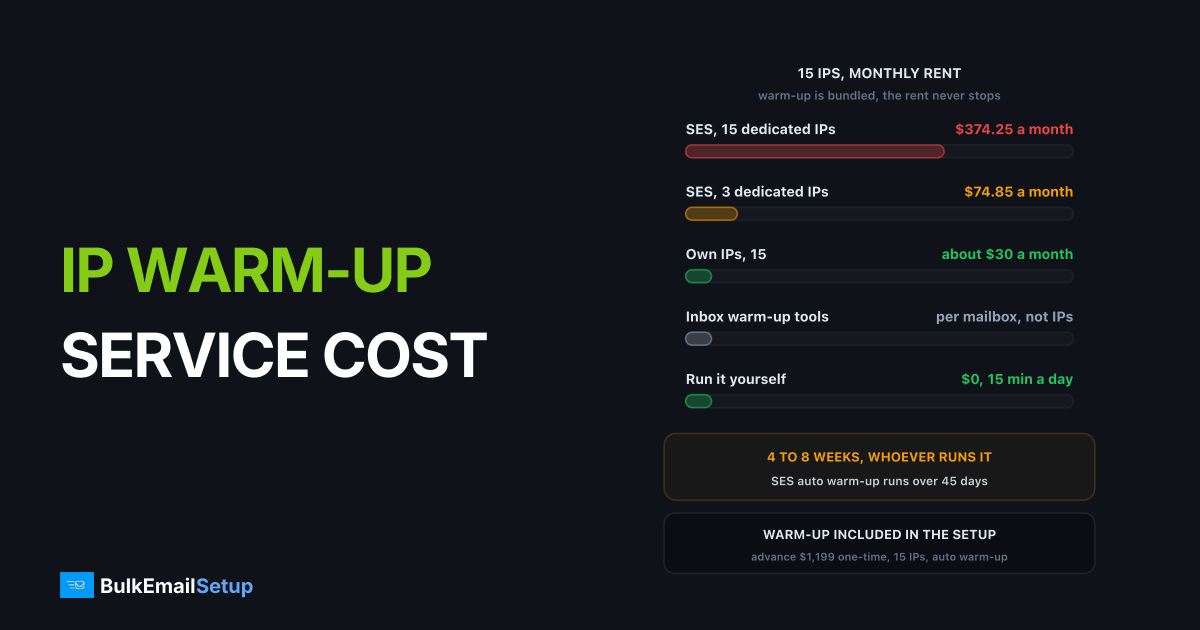
You rarely need to buy IP warm-up as its own service. Amazon SES warms each standard dedicated IP automatically for $24.95 a month, warm-up is part of most managed setups, and the schedule itself is free to run yourself. Inbox warm-up tools are a different product and do not warm bulk sending IPs at all. Whatever you pay, the timeline is set by Gmail and Microsoft: plan on 4 to 8 weeks to full volume.
What you are actually paying for
An IP warm-up has two parts, and only one of them can be sold to you.
| Part | What it is | Can a service do it? |
|---|---|---|
| Pacing | raising daily volume per IP on a schedule | yes, software does this well |
| Watching | reading bounces, deferrals and complaints, slowing down when they rise | partly, needs a human for edge cases |
| List quality | sending warm-up traffic only to engaged, real subscribers | no, that is your list |
| Content | mail people actually open | no |
Every paid option sells the first part and some of the second. None of them can fix the third, which is the part that decides whether the warm-up works.
The real options and what they cost
| Option | Cost | Warms bulk IPs? | Best for |
|---|---|---|---|
| Run the schedule yourself | $0, about 15 min a day for 4 to 8 weeks | yes | anyone with a clean list |
| Amazon SES automatic warm-up | included in $24.95 per dedicated IP a month | yes, over 45 days | SES users |
| Warm-up bundled with a managed setup | included in the setup fee | yes | new dedicated servers |
| Deliverability consultant | project quote, varies widely | yes, with hands-on monitoring | big volume, past problems |
| Inbox warm-up tools | per mailbox, per month | no | one outreach inbox at a time |
The SES line is the clearest public benchmark. AWS documents that automatic warm-up is on by default for standard dedicated IPs and ramps the share of mail sent from the new IP over 45 days, independent of your volume. You can read the details in the SES warm-up documentation.
The hidden cost is the IP rent, not the warm-up
Warm-up bundled into a per-IP rental looks free, but you keep paying for it every month the IP exists.
| IPs | SES at $24.95 per IP a month | Your own IPs at about $2 per IP a month |
|---|---|---|
| 3 | $74.85 | about $6 |
| 15 | $374.25 | about $30 |
| 60 | $1,497 | about $120 |
The warm-up is the tip. The monthly IP rent is the rest
The warm-up runs once. The rent runs forever. On 15 IPs the gap is about $344 a month, which pays for any warm-up service many times over within a year.
What a warm-up schedule looks like
Here is the shape every service follows, with numbers for our two most common setups.
| Setup | Target per IP per day | Start per IP | Growth | Days to target |
|---|---|---|---|---|
| 3 IPs, 25,000 a day | about 8,300 | 200 | about 30% every 2 days | about 28 |
| 15 IPs, 200,000 a day | about 13,300 | 200 | about 30% every 2 days | about 32 |
The math is simple: 200 a day growing 30% every second day reaches 8,300 in about 14 steps, so about four weeks. After the numbers say you are done, give it another week or two at steady volume before big sends. Our IP warm-up schedule has the full week-by-week table.
One IP, four weeks: 200 a day to about 8,300 a day
The pace is not a vendor choice. AWS notes that reputation can build in about two weeks at some inbox providers and take up to six at others. That is why how long IP warm-up takes has the same answer whoever you pay.
Why inbox warm-up tools are the wrong purchase
This is the most common mix-up we see. Inbox warm-up tools connect one Gmail or Outlook mailbox to a network of other mailboxes. They send messages back and forth, open them, and pull them out of spam. That builds the reputation of one mailbox used for cold outreach.
A dedicated SMTP IP is different:
- It sends to your real subscribers, not a warm-up network.
- Its reputation is built from real opens, real complaints and real bounces at Gmail, Microsoft and Yahoo.
- Fake engagement from a seed network does not count the same, and patterns that look manufactured can hurt.
Listings in October 2026 put these tools at roughly $10 to $50 per mailbox per month. That is fine value for a sales inbox. It is wasted money for a bulk server.
What automatic warm-up can and cannot do
Software handles the pacing. Your list decides the result
Pacing is the easy half. The hard half is what you send during those four weeks:
- Engaged first. Week one goes only to people who opened or clicked in the last 30 to 90 days.
- No old segments. Anyone silent for 12 months waits until the end, or goes.
- Watch deferrals daily. A rising 421 rate at one provider means slow down for that provider.
- Keep complaints under 0.1%. Gmail's hard line is 0.3%. During warm-up there is no buffer.
Our email list cleaning guide covers how to get the list ready before day one.
When paying a consultant does make sense
A consultant earns the fee in three cases:
- You are moving a big program. Millions a month from an ESP to new IPs, where a bad week costs real revenue.
- You burned IPs before. Someone needs to find the cause, not just rerun the schedule.
- You have no one to watch it. Warm-up needs a daily look for a month. If nobody on the team has that time, buy it.
Ask for three things in writing: the per-IP daily schedule, who watches it and how often, and what happens if an IP gets listed. If the quote cannot answer the third, keep looking. Our setup service cost guide has the same checklist for the build itself.
How BulkEmailSetup helps
Warm-up comes with the setup, not as a monthly add-on, and the IPs are yours, so there is no per-IP rent to the ESP.
| Plan | One-time fee | IPs | Emails per day | Warm-up |
|---|---|---|---|---|
| Basic | $549 | 3 | 25,000 | written warm-up plan |
| Advance | $1,199 | 15 | 200,000 | automatic, watched with you |
| Custom | $2,997 | 60 | 1,000,000 | automatic, priority support |
Extra IPs cost about $2 a month each from your host. See the Advance plan for the automatic warm-up details, or compare all pricing.
Frequently asked questions
How much does an IP warm-up service cost?
It depends on who does it. Amazon SES includes automatic warm-up with each standard dedicated IP at $24.95 a month. Inbox warm-up tools charge per mailbox per month and do not warm bulk IPs at all. Consultants price by project and vary widely. On BulkEmailSetup's Advance and Custom plans automatic warm-up is included in the one-time setup fee, and Basic comes with a written warm-up plan.
Can warm-up be fully automatic?
The pacing can be. Software can raise volume per IP on a schedule, the way Amazon SES ramps a new dedicated IP over 45 days. What software cannot automate is list quality. If the warm-up traffic goes to old or bought addresses, bounces and complaints rise and the automatic schedule just delivers bad mail more slowly.
How long does a paid warm-up take?
About as long as a free one, because inbox providers set the pace, not the vendor. Amazon SES says a good reputation takes about two weeks at some providers and up to six at others, and its automatic warm-up runs over 45 days. Plan for 4 to 8 weeks to full volume whoever runs it.
Do warm-up tools work for bulk IPs?
No. Inbox warm-up tools send and reply between real mailboxes to build the reputation of one Gmail or Outlook inbox used for outreach. A bulk sending IP needs real mail to real subscribers at a rising daily volume. Tools that promise to warm a dedicated IP with fake engagement risk getting that IP flagged instead.
Is a warm-up service worth it for a small sender?
Usually not as a separate purchase. Below a few hundred thousand emails a month, a written schedule and 15 minutes a day of watching bounces and deferrals does the job. Pay for warm-up when it comes bundled with the IPs or the setup, so you are not buying the same schedule twice.
What happens if I skip IP warm-up?
Gmail, Microsoft and Yahoo see a new IP sending at full volume with no history and start deferring or junking the mail. A typical result is a wave of 421 deferrals on day one, mail landing in spam, and sometimes a blocklist entry. Fixing a burned IP takes longer than warming it properly in the first place.


