
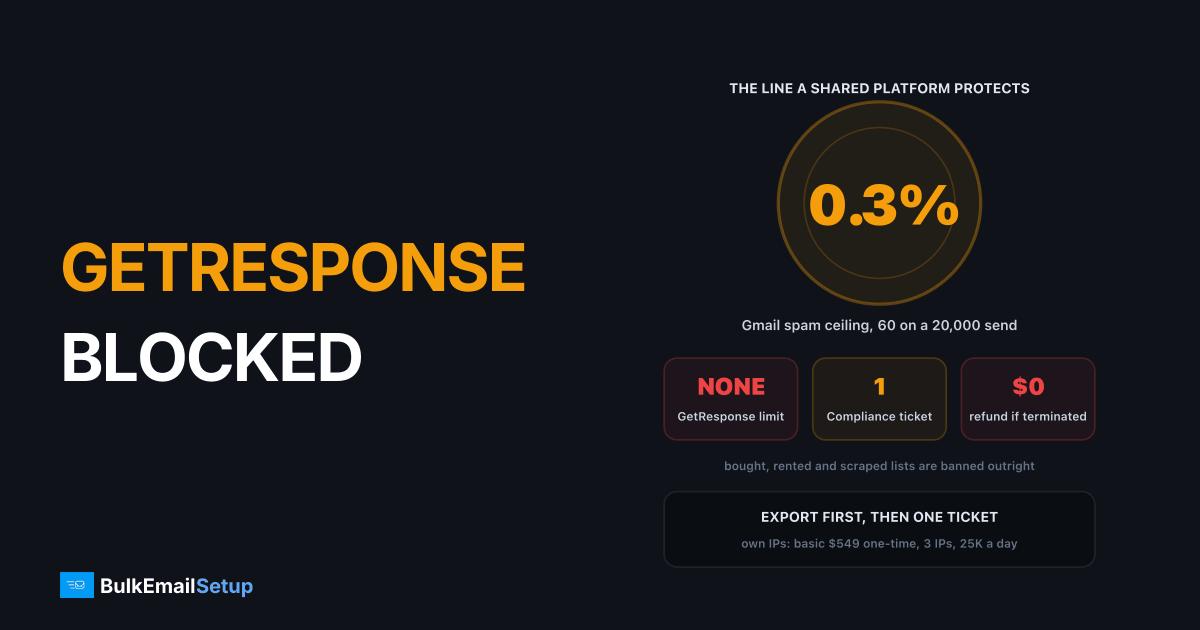
GetResponse blocks accounts for three things: a list source its anti-spam policy bans, spam traps it finds when checking an import, and complaint spikes after a send. It publishes no complaint threshold, so you will not find a number in the notice. The way back is a Compliance ticket that shows where the list came from and what you removed. If the list was bought, rented or scraped, plan to move, because the policy bans those sources outright.
What GetResponse's policy actually says
Most people read the block email and guess. The GetResponse anti-spam policy is short and specific, and it explains almost every block we see.
| Policy line | What it means for you |
|---|---|
| Bans renting, leasing or buying addresses | a bought list is a block, not a warning |
| Bans scraping or harvesting | public-web lists count as scraped |
| Consent "may not be presumed" | "they are in our industry" is not consent |
| Recommends confirmed opt-in | double opt-in is the safe default |
| May verify imported lists, incl. spam traps | big imports get checked before they send |
| May require a test send on large imports | a sample goes out first, results decide |
| May terminate without notice or refund | the worst case skips the warning |
Read the last row twice. A block can arrive with no warning and no money back, so the moment you see any compliance message, export your data.
How an import gets rejected before it sends
A lot of "blocks" are really a failed import check. GetResponse reserves the right to review an uploaded list for quality, look for spam traps and misspellings, ask for a test send on a large import, and reject the list if it fails.
A big import passes three gates before it can send
The middle step is where old lists die. A list that has not been mailed in a year carries dead addresses and recycled spam traps, and one trap hit is enough to fail the check. If the test send also bounces hard, the list is rejected and the account is flagged.
The complaint line you are judged against
GetResponse's help page on complaints gives no acceptable rate. It tells you to open a Compliance ticket if your rate climbs. So the useful benchmark is the inbox providers' line, because that is what shared platforms protect.
| Signal | Where the line sits | Source |
|---|---|---|
| Gmail spam rate target | under 0.1% | Google sender guidelines |
| Gmail hard ceiling | 0.3% | same |
| GetResponse published limit | none | help center, complaints page |
| On a 20,000 send | 20 reports = 0.1%, 60 = 0.3% | simple math |
On a 20,000 send, 20 spam reports already sit at the line
One reported case on a marketing forum describes a 72-hour warning at a 2.3% complaint ratio, quoting the 0.1% ISP guideline. Treat that as one person's story, not policy. It does show the pattern: shared platforms act well before Gmail's ceiling, because your complaints land on IPs shared with other customers.
Can you get it unblocked?
GetResponse points you to one channel: My tickets, Send new email, category Compliance. Make that one message count.
- Name the list source. "Webinar signups, March to June" beats "our contacts".
- Show what you removed. The segment that complained or bounced, with a count.
- Show proof of consent. Signup dates, form names, double opt-in records if you have them.
- Say what changes. Confirmed opt-in, a 12-month sunset rule, a cleaning schedule.
- Send once. Then wait. Extra tickets do not move it faster.
Whether to appeal depends on where the list came from
Do not appeal a bought or scraped list. The policy bans it by name, so the appeal costs a week and ends the same way.
What a block costs, in time
| Stage | Typical time |
|---|---|
| Waiting on Compliance | days, no fixed clock |
| Cleaning the list | 2 to 4 days |
| Setting up a new sending path | 3 to 7 days |
| Warming new IPs to full volume | 4 to 8 weeks |
The clocks run one after another. A one-week wait plus a six-week warm-up is seven weeks before you are back to normal volume, so start the fallback on day one instead of waiting on the ticket.
Where to send if the block sticks
If the cause was list quality, fix that before moving anywhere. Every shared platform runs the same checks, so the same list gets you blocked again. Our email list cleaning guide covers removing hard bounces, traps and 12-month inactives, which usually takes 20% to 30% of a tired list out.
If the cause was policy fit, meaning your list is opt-in but your volume or sending pattern makes a shared pool nervous, your own IPs remove that conflict. Nobody else's sending affects your reputation, and nobody else's complaints affect yours.
Either way, export first. Our guide to exporting your list before an ESP ban lists exactly which files to pull. For a side-by-side of the platform against your own server, see GetResponse vs a dedicated SMTP server, and for how another platform handles the same situation, Mailchimp shut down my account.
What not to do
- Do not re-import the same list elsewhere. Same traps, same bounces, same result.
- Do not open a second GetResponse account. It tends to be found and closed.
- Do not send at full volume on new IPs. Cold IPs get throttled at Gmail and Microsoft.
- Do not skip the post-mortem. If you never find the segment, it happens again.
How BulkEmailSetup helps
We build a dedicated SMTP server you own: your server, your IPs, SPF, DKIM, DMARC and PTR set up, bounce handling, a campaign platform and a warm-up plan. We hold the same line on list source as GetResponse does. Our anti-spam policy bans purchased, rented and scraped lists too, so this is for senders whose list is theirs.
| Plan | One-time fee | Emails a day | Dedicated IPs | Hosting you pay |
|---|---|---|---|---|
| Basic | $549 | 25,000 | 3 | about $11 a month |
| Advance | $1,199 | 200,000 | 15 | about $49 a month |
No monthly fee to us and no contact limit. The 15-day money-back guarantee applies until server access is handed over. See Basic plan details or all pricing.
Frequently asked questions
Why did GetResponse block my account?
The usual causes are a list GetResponse will not accept, spam traps found when it checks an import, or a complaint spike after a send. Its anti-spam policy bans bought, rented, leased and scraped addresses and says consent cannot be assumed. It reserves the right to verify imports, reject a list that fails and terminate an account without notice or refund.
What complaint rate gets a GetResponse block?
GetResponse does not publish a number. Its help page tells you to open a Compliance ticket if your complaint rate rises. The practical line is the one inbox providers use: Gmail asks bulk senders to stay under 0.1% and treats 0.3% as a hard ceiling. One complaint per 1,000 emails is the budget, so 20 reports on a 20,000 send is already at the edge.
Can I unblock a GetResponse account?
Sometimes. Open a ticket under My tickets, pick the Compliance category and explain where the list came from, what you removed and what changes. Blocks tied to one bad segment you can prove you deleted have a chance. Blocks tied to a bought or scraped list rarely come back, because the policy bans that source outright.
What should I use instead of GetResponse?
First fix the cause, because any shared platform judges the same numbers. If the list is opt-in and the volume is steady, a dedicated SMTP server takes the shared-pool policy out of the picture. BulkEmailSetup's Basic plan is $549 one-time for 3 dedicated IPs and 25,000 emails a day, with hosting around $11 a month paid to your host.
Can I export my contacts from a blocked GetResponse account?
Export as soon as you see a warning, not after. Whether exports stay open after a block depends on the account state and is not promised anywhere in GetResponse's policy. Download contacts, unsubscribes and any signup data you have, so you keep proof of consent for whatever you move to next.
Will opening a new GetResponse account work?
It is a poor bet. The same list will trip the same import checks, and a second account for a blocked sender tends to be closed fast. It also puts your domain on record twice. Clean the list, document consent, and either win the appeal or move to infrastructure where only your own reputation counts.


