
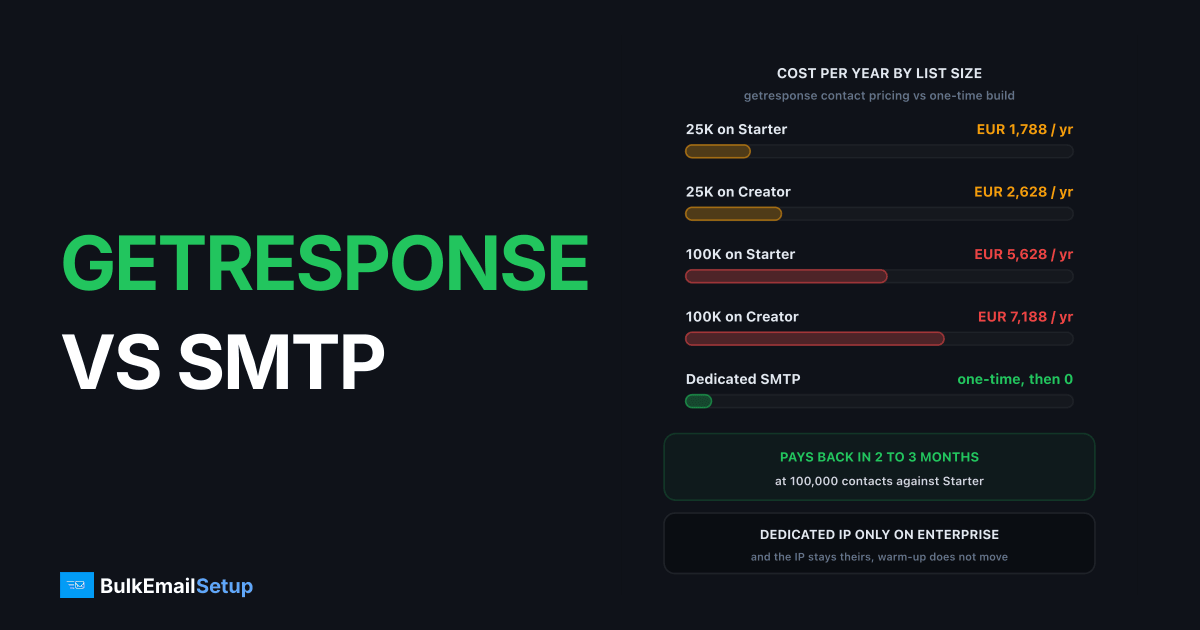
GetResponse charges by stored contacts and bundles webinars, funnels, landing pages and ecommerce tools into the price, with a dedicated IP appearing only at the Enterprise tier. At 100,000 contacts the published price is EUR 469 a month on Starter and EUR 599 on Creator, which is roughly EUR 5,600 to EUR 7,200 a year, forever. A dedicated SMTP server is a one-time build with no per-contact fee, and the IPs are yours rather than rented.
The real question is not which is cheaper. It is whether you use the bundle, and whether you care about owning the IP reputation you spend eight weeks building.
The pricing, from their own page
These are the published monthly figures from GetResponse's pricing page, billed monthly. Yearly billing takes about 18% off.
| Contacts | Starter | Marketer | Creator |
|---|---|---|---|
| 1,000 | EUR 16 | EUR 54 | EUR 62 |
| 25,000 | EUR 149 | EUR 189 | EUR 219 |
| 100,000 | EUR 469 | EUR 519 | EUR 599 |
Two things stand out. The gap between tiers narrows as the list grows, so at 100,000 contacts the fully loaded Creator plan is only 28% more than bare Starter. And the curve from 25,000 to 100,000 is roughly 3.1x for a 4x list, which is gentler than most contact-priced platforms.
The catch is what is not on that table. A dedicated IP is not a checkbox you can add to Creator. It sits on Enterprise, which is quote-only.
What the bundle actually contains
This is where GetResponse differs from MailerLite or Mailchimp. You are buying four products, not one.
| Bundled tool | Available from | What you would pay to replace it |
|---|---|---|
| Email + automation | Starter | MailWizz one-time, or Sendy $69 one-time |
| Landing pages | Starter | included in most self-hosted mailers |
| Sales funnels | Marketer | funnel software, $30 to $100/mo |
| Ecommerce tools | Marketer | store plugin, usually free to $50/mo |
| Webinars, 100 attendees | Creator | Zoom Webinars, roughly $79/mo |
| Webinars, 1,000 attendees | Enterprise | Zoom or similar, $300+/mo |
If you run weekly webinars to 100 people and use the funnel builder, Creator at EUR 219 for 25,000 contacts is genuinely good value. Replacing that stack separately costs more.
If you send campaigns and nothing else, you are paying Creator money for Starter usage. That is the single most common GetResponse overspend I see, and it is worth checking before any migration maths.
Cost at three list sizes
Comparison at monthly billing, using Starter as the floor and Creator as the loaded case. The dedicated column is the one-time build with no recurring per-contact charge.
| List size | GetResponse Starter/yr | GetResponse Creator/yr | Dedicated SMTP |
|---|---|---|---|
| 25,000 | EUR 1,788 | EUR 2,628 | one-time build, then $0 |
| 100,000 | EUR 5,628 | EUR 7,188 | one-time build, then $0 |
| 250,000 | quote territory | quote territory | one-time build, then $0 |
At 250,000 contacts GetResponse's public table stops and you are into a sales conversation, which in practice lands somewhere north of EUR 1,000 a month. That is also the point where Enterprise, and therefore the dedicated IP, becomes reachable. So the tier that finally gives you a dedicated IP is the tier where the recurring bill is largest.
A dedicated build recovers its cost against Starter at 100,000 contacts in about two to three months. After that the delta is the whole subscription. Run your own numbers in the SMTP cost calculator by list size.
The rented IP problem
Here is the part that matters more than the price difference.
On GetResponse Enterprise you get a dedicated IP. You do not get to keep it. It is assigned to your account, it stays on GetResponse's network, and the reputation you build on it over eight to twelve weeks belongs to that IP, not to you.
| Question | Rented IP | Your own IP |
|---|---|---|
| Who owns the address | the provider | you |
| Reputation portable on exit | no | yes, IP moves with you |
| Warm-up repeated if you leave | yes, from zero | no |
| Can the provider reassign it | yes | no |
| Cost model | bundled into a monthly tier | one-time, part of the build |
| Who decides acceptable use | provider policy | you, within receiver rules |
Warm-up is the expensive part. Eight weeks of restricted sending, careful segmentation and daily monitoring is real work with a real revenue cost. Doing it on a rented IP means you do that work once, and then do it again from zero the day you move.
That is not an argument against ever renting. It is an argument against renting for years. If you plan to be on GetResponse Enterprise for a decade, the point is moot. If you expect to outgrow it, every month of warm-up you invest is a month you will repeat.
More on the trade in is a dedicated IP worth it and do I need a dedicated IP or shared.
Keeping a dedicated IP warm
A dedicated IP is not automatically better than a shared pool. It is better only if you feed it.
| Monthly volume per IP | What happens |
|---|---|
| Under 20,000 | too little signal, receivers treat it as near-new |
| 20,000 to 100,000 | workable but reputation swings on single bad sends |
| 100,000 plus | stable score, one bad campaign does not sink it |
| 500,000 plus | strong signal, split across multiple IPs |
Roughly 100,000 messages a month per IP is the practical floor. Below that a shared pool genuinely serves you better, because you are borrowing volume signal from everyone else on the address.
This applies identically to a rented GetResponse IP and to one on your own box. If you have 40,000 contacts you mail twice a month, that is 80,000 sends and one dedicated IP is marginal. Two dedicated IPs would be worse than one.
Deliverability, honestly
Below Enterprise you are on GetResponse's shared pools. Their abuse team polices complaint rates hard, because one bad sender damages everyone on the address. That protection is real and worth something.
| Factor | GetResponse shared | GetResponse Enterprise IP | Your own IPs |
|---|---|---|---|
| Reputation source | pool average | your sending, their address | your sending, your address |
| Damaged by other senders | yes | no | no |
| Suspension risk | real, policy driven | lower, still policy bound | none, you set policy |
| Warm-up owner | provider | you | you |
| Portable if you leave | nothing to port | nothing to port | yes |
| Time to full volume | immediate | 8 to 12 weeks | 8 to 12 weeks |
The receiver requirements do not change between these columns. Google's bulk sender guidelines apply to anyone sending over 5,000 messages a day to Gmail:
- SPF and DKIM aligned on the sending domain
- A DMARC record, even at
p=none - One-click unsubscribe in the header
- Spam complaint rate under 0.3%, ideally under 0.1%
- Valid forward and reverse DNS on the sending IP
GetResponse handles the DNS and IP plumbing on shared plans. The complaint rate is yours in every model, and it is the number that actually kills campaigns.
Where the crossover sits
| List size | Which wins | Why |
|---|---|---|
| Under 25,000 | GetResponse clearly | EUR 149/mo buys more than you could build |
| 25,000 to 50,000 | GetResponse, if you use the bundle | webinars and funnels justify it |
| 50,000 to 100,000 | close, depends on bundle usage | EUR 5,600/yr against a one-time build |
| Over 100,000 | dedicated wins, gap widens | subscription is pure recurring cost |
| Over 250,000 | dedicated, no argument | Enterprise quotes exceed a build in months |
The bundle is the swing factor, not the contact count. A 120,000-contact list that runs weekly webinars and three funnels may still be better off on Creator. A 60,000-contact list that only sends newsletters is overpaying today.
The same shape shows up against other platforms, see MailerLite vs a dedicated SMTP server for the contact-pricing version of this argument without the bundle complication.
Who should stay on GetResponse
Stay if you are under 25,000 contacts, or if you actually use webinars and funnels rather than just having access to them. Audit that honestly. Log in and check last quarter's usage before you decide.
Stay if nobody on the team can own an eight-week warm-up. That is the single most common reason self-managed sending fails, and it is not fixable with a better server.
Move if you are past 100,000 contacts, send mostly email campaigns, have a clean list, and want the IP reputation to be an asset you own rather than something you rent.
Run both is common and sensible. GetResponse for lifecycle automation and webinar signups to engaged contacts, your own infrastructure for the large campaign sends where per-contact pricing hurts most.
What the migration looks like
Week 1. Server, IPs, authentication on a sending subdomain. SPF, DKIM, DMARC at p=none. Confirm PTR matches the HELO hostname.
Week 2. Install campaign software and import the list. Export GetResponse's suppression list first and load it, because those opt-outs remain legally binding.
Weeks 3 to 12. Warm up. A few hundred a day per IP to your most engaged segment, ramp roughly 30% every two days, watch deferral rates rather than opens.
Ongoing. Weekly checks on complaint rate, bounce rate and Google Postmaster Tools.
Keep GetResponse running through warm-up. You cannot run normal campaign volume during weeks 3 to 12, and cancelling early is how people end up with a half-warm IP and a backlog.
How BulkEmailSetup helps
We build the sending half: your own server, your own IPs, full SPF, DKIM, DMARC and PTR configuration, MTA tuning, bounce handling and a warm-up plan. You keep whatever campaign software you prefer on top, and the IP reputation you build stays with you.
Basic starts at $549 one-time, covering 1 SMTP server, 3 dedicated IPs, 25,000 emails/day and unlimited contacts. Higher tiers run to 15 dedicated IPs and 200,000 emails/day. See pricing, or is a dedicated IP worth it if you are still weighing the move.
Frequently asked questions
How much does GetResponse cost at 100,000 contacts?
On the published pricing page it is EUR 469 a month on Starter, EUR 519 on Marketer and EUR 599 on Creator, billed monthly. That is charged on stored contacts, not emails sent, so a month with no campaigns costs the same as a month with four. Yearly billing takes about 18% off those figures.
Does GetResponse give you a dedicated IP?
Only on the Enterprise tier, where a dedicated IP and dedicated sending domain are listed as included features. Everything below Enterprise sends from shared IP pools. The IP stays GetResponse property, so any reputation you build on it ends when your contract does.
How much volume do you need to keep a dedicated IP warm?
Roughly 100,000 messages a month to a single IP, and ideally consistent week to week. Below that the receiving networks see too little traffic to hold a stable reputation score and treat the IP as semi-new each time you send. That threshold applies whether the IP is rented from GetResponse or sits on your own server.
Is a dedicated SMTP server cheaper than GetResponse?
Past about 50,000 contacts, yes. At 100,000 contacts GetResponse Starter is EUR 469 a month, which is roughly EUR 5,600 a year, every year. A dedicated build is a one-time cost with no per-contact fee, so it pays back in two to three months at that list size and costs nothing further after.
What do you lose moving off GetResponse?
The webinar platform, the funnel builder, landing pages, the ecommerce integrations, the automation editor and the support team. A dedicated SMTP server is sending infrastructure only. Most people who move replace the campaign layer with MailWizz, Sendy, Mautic or Listmonk and keep a separate tool for webinars if they actually run them.
Who should stay on GetResponse?
Anyone under about 25,000 contacts, anyone genuinely using the webinar and funnel features, and any team without a person who can own an eight-week IP warm-up. At 25,000 contacts the Starter plan is EUR 149 a month and replacing the whole bundle piece by piece would cost more than that in tools alone.


