
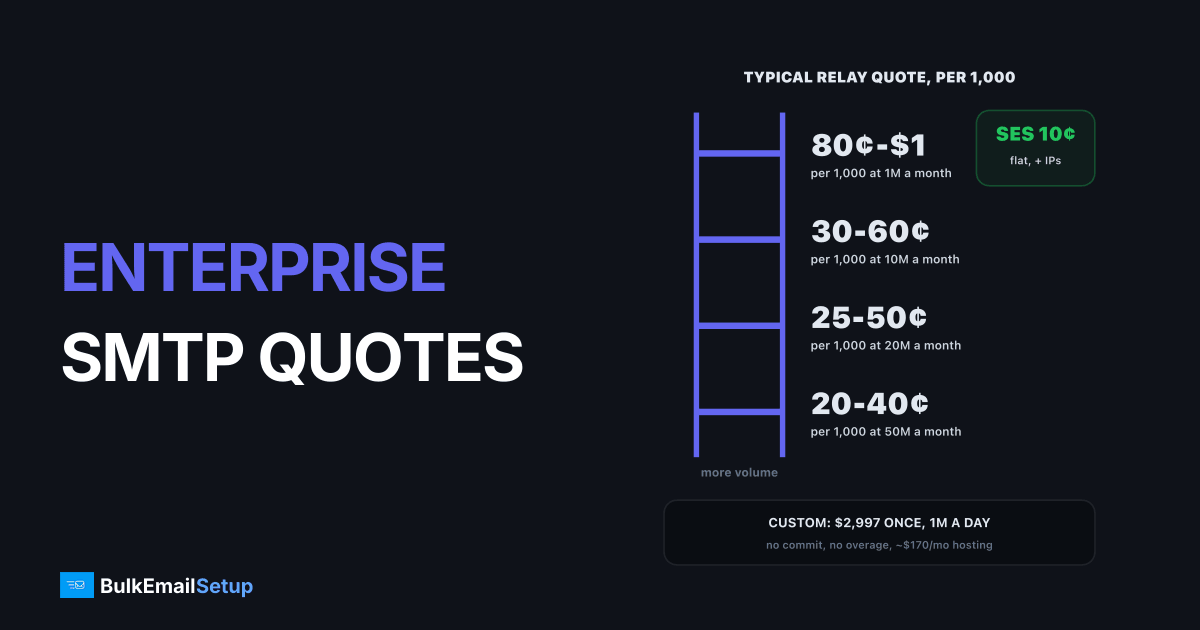
At 10 million emails a month and up, enterprise relay quotes usually land between $0.30 and $0.60 per 1,000 emails, on a 12-month commit with a higher overage rate above it. That is roughly $3,000 to $6,000 a month at 10M. Amazon SES stays at its published $0.10 per 1,000, and owning the servers turns the per-email price into a fixed hosting bill. The relay ranges here are what quotes typically look like, not prices any vendor publishes.
Why there is no price on the page
SendGrid's top tier is "Premier, contact sales." Mailgun and SparkPost do the same at volume. The quote depends on things a pricing page cannot know:
| Input | Why it moves the price |
|---|---|
| Monthly volume | the rate drops as volume grows |
| Commit length | 12 months is standard, longer buys a lower rate |
| Dedicated IPs | a block is usually bundled, extras cost more |
| List quality and use case | risky senders pay more or get declined |
| Support level | named account manager, deliverability reviews |
Amazon SES is the exception. Its pricing page lists $0.10 per 1,000 emails and $24.95 a month per dedicated IP at any volume, with no contract.
What the rate looks like at each volume
Typical enterprise rates fall as volume climbs, but never reach SES
| Monthly volume | Typical relay rate per 1,000 | Monthly relay cost | Amazon SES sends only |
|---|---|---|---|
| 1 million | about $0.80 to $1.00 | $800 to $1,000 | $100 |
| 10 million | about $0.30 to $0.60 | $3,000 to $6,000 | $1,000 |
| 20 million | about $0.25 to $0.50, estimate | $5,000 to $10,000 | $2,000 |
| 50 million | about $0.20 to $0.40, estimate | $10,000 to $20,000 | $5,000 |
SES looks far cheaper because the sends are cheap. You still add dedicated IPs (12 to 16 of them at 10M, about $300 to $400 a month) and the engineering time to run bounces, complaints and warm-up yourself. We broke that down in what 10 million emails a month costs and the 20 million a month breakdown.
How a quote turns into a bill
The rate is only half the story. The other half is the commit and the overage. Here is a worked example for a sender forecasting 100 million emails over a year who actually sends 120 million:
Growth you did not forecast is billed at the overage rate
| Line | Volume | Rate | Cost |
|---|---|---|---|
| Annual commit | 100 million | $0.40 per 1,000 | $40,000 |
| Overage | 20 million | $0.75 per 1,000 | $15,000 |
| Year total | 120 million | about $0.46 blended | $55,000 |
Two lessons from that table. First, under-forecasting is expensive: the extra 20 million cost nearly twice the committed rate. Second, the commit is owed even in a slow month, so a quiet quarter does not lower the bill. Hidden fees in ESP contracts lists the other clauses to read before you sign.
What to negotiate
Ask for these in writing, in this order:
- The overage rate. Get it as close to the committed rate as you can.
- Rollover. Unused commit carrying into the next month or quarter.
- Commit size. Commit to your realistic low month, not your forecast.
- IP count. How many dedicated IPs are included, and the price of each extra one.
- Term and notice. A 12-month term with a short notice period beats a cheap 36-month lock-in if you may move.
- Ramp. A lower commit for the first quarter while volume grows.
If you are unsure whether a commit makes sense at all, contracts vs pay-as-you-go walks through the break-even.
Relay, SES or your own servers
Each route wins on a different side
| Route | Year one at 10M a month | Best for | Trade-off |
|---|---|---|---|
| Enterprise relay | roughly $36,000 to $72,000 | teams that want support and warmed IPs | contract, overage, IPs are not yours |
| Amazon SES | about $12,000 sends + $3,600 to $4,800 IPs | engineering teams | you build bounce, complaint and warm-up handling |
| Own servers, Custom | $2,997 once + about $2,040 hosting | steady volume, wants control | you run list hygiene and warm-up |
The own-server row uses our Custom plan: 12 SMTP servers and 60 IPs on one dedicated host, up to 1 million emails a day, with about $170 a month of hosting paid to your provider. At 50 million a month you would need two of those; ask us for a quote rather than doubling the list price.
How BulkEmailSetup helps
At enterprise volume the per-email price is the whole bill on a relay. On your own servers it disappears. We build the stack on hosting you own: dedicated IPs, SPF, DKIM, DMARC and PTR on every domain, MTA tuning, bounce handling, a campaign platform and automatic warm-up across the pool.
| Plan | One-time fee | Emails per day | Servers | Dedicated IPs | Hosting you pay your host |
|---|---|---|---|---|---|
| Advance | $1,199 | 200,000 | 3 | 15 | about $49 a month |
| Custom | $2,997 | 1,000,000 | 12 | 60 | about $170 a month |
No monthly fee to us, no commit, no overage. There is a 15-day money-back guarantee, which applies until server access is handed over. See the Custom plan or all pricing.
Frequently asked questions
What does enterprise email cost at 10 million a month?
Quotes from enterprise relays such as SendGrid Premier, Mailgun and SparkPost usually land around $0.30 to $0.60 per 1,000 at that volume, so roughly $3,000 to $6,000 a month on a 12-month commit. Amazon SES stays at its published $0.10 per 1,000, about $1,000 a month plus dedicated IPs. These relay figures are typical ranges, not published prices.
Why do ESPs hide enterprise pricing?
Because the price depends on your volume, your list quality, how many dedicated IPs you need, the support level and how long you commit. A published number would either be too high for good senders or too low for risky ones. The quote also lets the sales team trade rate for term: a lower per-1,000 price in exchange for a longer, larger commit.
What can you negotiate in an enterprise quote?
The per-1,000 rate, the size of the annual commit, the overage rate above it, how many dedicated IPs are included, whether unused volume rolls over, and the notice period to leave. The overage rate is the one most buyers forget. It can be roughly double the committed rate, so under-forecasting growth costs more than over-committing slightly.
Is owning infrastructure cheaper at enterprise volume?
Usually, yes. At 10 to 30 million emails a month, BulkEmailSetup's Custom setup is $2,997 one-time for 12 SMTP servers and 60 IPs, up to 1 million emails a day, plus about $170 a month of hosting you pay your provider. That compares with tens of thousands a year on a relay contract. You do take on warm-up and list hygiene yourself.
How big is a typical annual commit?
It is sized to your forecast, so a sender at 10 million a month is usually asked to commit to roughly 100 to 120 million emails over 12 months, billed monthly. You pay the commit whether or not you send it. Above it, overage applies at a higher rate, so check both numbers against a slow month and a busy one.
Do enterprise plans include dedicated IPs?
Usually yes: a block of dedicated IPs, often already warmed by the vendor, is one of the main things the enterprise tier pays for. Ask how many are included, whether they stay yours if you leave (they do not), and the price of extra IPs. Amazon SES charges $24.95 a month per dedicated IP on its pricing page.
How long do enterprise email contracts run?
Twelve months is the common term, and some vendors push for 24 or 36 months in exchange for a lower rate. Read the renewal clause: many renew automatically unless you give notice inside a set window before the end date. If you might move to your own infrastructure within a year, a shorter term at a slightly higher rate is often the cheaper choice.


