
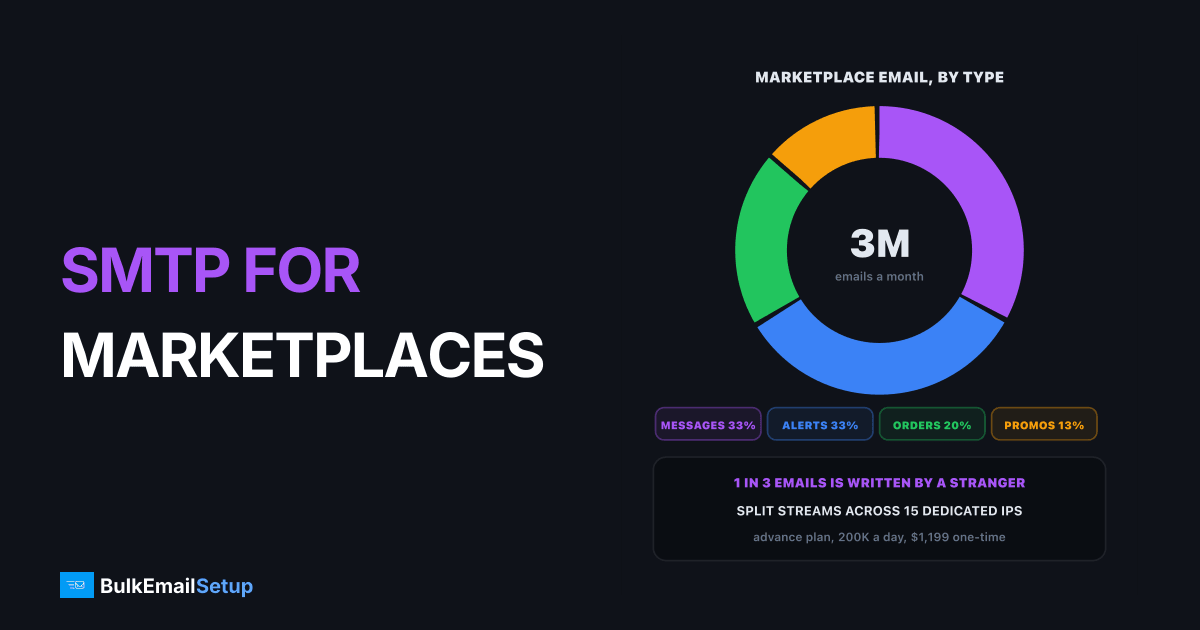
Email for marketplaces adds up fast: a marketplace sends far more than its user count suggests, and around a third of it is written by strangers. Every message, offer, saved-search hit and order update triggers mail. A site with 200,000 active users can easily reach 3 million emails a month, about 100,000 a day. The email setup that survives this splits mail into separate streams (account mail, user messages, alerts, marketing), relays user messages through masked addresses with rate limits, and runs on IPs that only your platform's behaviour can damage.
How much email does a marketplace send?
Count actions, not users. This is a planning example for a mid-size buyer-seller site.
| Trigger | Per active user a month | At 200,000 users |
|---|---|---|
| User-to-user messages and offers | 5 | 1,000,000 |
| Saved-search and price alerts | 5 | 1,000,000 |
| Account, order and listing updates | 3 | 600,000 |
| Marketing digests and promotions | 2 | 400,000 |
| Total | 15 | 3,000,000 |
Your mix will differ, but the shape is common. Marketing is the smallest slice. The mail you depend on most, logins and orders, is a fifth of the total, and the riskiest mail, user messages, is the biggest.
Example mix for 200,000 active users. Marketing is the smallest slice
Why user messages are the risk
When a buyer writes to a seller, your server sends text you did not write to an address you did not choose. Scammers know this. Classifieds sites are a favourite target because the relay carries your domain's reputation.
A third of the mail carries text you did not write
What that means in practice:
| Abuse pattern | What it does to you | Defence |
|---|---|---|
| Fake seller blasting buyers with a phishing link | spam traps, blocklisting | hold first messages from new accounts |
| Scraped addresses fed into your contact form | complaints from people who never used the site | require login before contacting |
| Off-platform payment scams | user reports, lost trust | scan for payment and wire keywords |
| Mass messaging from one account | rate-limit breach, deferrals | per-account hourly caps |
How classifieds sites stop spam abuse of their mail
- Mask every address. Each conversation gets a unique reply address on your domain. Real addresses never leave your database.
- Rate-limit by account age. A one-day-old account sending 40 messages an hour is a scammer. Start new accounts at a handful per hour.
- Scan the body. Links, phone numbers in odd places and phrases like "pay by gift card" go to review.
- Honour reports instantly. A "report this message" button that suppresses the sender beats any filter.
- Process bounces and complaints. Feedback loops tell you which streams draw complaints. Our feedback loop guide covers setup, and bounce handling best practices covers the rest.
Should seller and buyer emails use separate streams?
Yes, and this is the single biggest decision in a marketplace's email setup.
Split the streams and a scam wave stays in its own lane
| Stream | Subdomain example | Why separate |
|---|---|---|
| Account and order | mail.yoursite.com | must always arrive, lowest risk |
| User messages | relay.yoursite.com | highest risk, written by strangers |
| Alerts | alerts.yoursite.com | high volume, moderate engagement |
| Marketing | news.yoursite.com | needs consent and one-click unsubscribe |
On shared ESP infrastructure you rarely get to split by IP, and the user-message stream is exactly the kind of traffic that gets an ESP account reviewed. On your own server, each stream gets its own IPs and its own reputation. The trade-offs are the same ones we cover in dedicated IP vs shared IP.
What inbox providers expect from email for marketplaces
Gmail's sender guidelines apply to anyone sending more than 5,000 messages a day to Gmail addresses, which almost every marketplace does.
| Requirement | Applies to |
|---|---|
| SPF, DKIM and DMARC aligned | every stream |
| Spam complaint rate under 0.3% | measured per sending domain |
| One-click unsubscribe | marketing and digests |
| Valid PTR record | every sending IP |
The complaint rate is where user messages hurt. If scam messages draw reports on the same domain as your order mail, the order mail pays for it. Separate subdomains give each stream its own measurement.
What email costs for a marketplace
At 3 million emails a month, about 100,000 a day:
| Option | Monthly cost | Stream splitting |
|---|---|---|
| Amazon SES send fees | about $300, plus $24.95 per dedicated IP | possible with configuration sets |
| List-price API plans (Mailgun, SMTP2GO) | thousands a month at list rates | limited by plan |
| Own server, Advance plan | about $49 hosting, after $1,199 one-time | 15 IPs to split as you like |
The full breakdown at this volume is in what it costs to send 100,000 emails a day. For the transactional side of the stack, see SMTP for SaaS transactional email.
How BulkEmailSetup helps
We build the sending side of a marketplace on infrastructure you own. On the Advance plan that is 3 SMTP servers and 15 dedicated IPs, which is enough to give account mail, user messages, alerts and marketing their own IPs and subdomains. We set up SPF, DKIM, DMARC and PTR on each, bounce handling and a campaign panel, and the IPs warm up automatically.
| Plan | One-time fee | Emails per day | Dedicated IPs | Hosting you pay your host |
|---|---|---|---|---|
| Advance | $1,199 | 200,000 | 15 | about $49 a month |
| Custom | $2,997 | 1,000,000 | 60 | about $170 a month |
There is no monthly fee to us and no contact limit. See Advance plan details or compare all pricing.
Frequently asked questions
How much email does a marketplace send?
Far more than the user count suggests, because every action triggers mail: new message, offer, saved-search alert, listing expiry, order update. As a planning example, 200,000 active users at about 15 emails each a month is 3 million emails, or roughly 100,000 a day. Alerts and user-to-user messages usually make up most of it, with marketing a small share.
How do classifieds sites stop spam abuse of their mail?
Never let a user's text go out as if you wrote it without checks. Relay messages through masked addresses, rate-limit new accounts, scan message bodies for links and known scam phrases, hold first messages from brand-new sellers for review, and stop sending to anyone who reports spam. One scam campaign through your relay can put your main IPs on a blocklist within hours.
Should seller and buyer emails use separate streams?
Yes. Put account and order mail, user-to-user messages and marketing on separate subdomains and, at volume, separate IPs. User messages carry the most risk because strangers write them. If they share an IP with password resets, one wave of scam messages can delay every login email on the site. Splitting keeps damage inside the stream that caused it.
What does email cost for a marketplace?
At 3 million emails a month, Amazon SES send fees are about $300 a month before dedicated IPs, while list-price plans at Mailgun or SMTP2GO run into thousands. A dedicated setup like BulkEmailSetup's Advance plan handles 200,000 a day for $1,199 one-time plus about $49 a month hosting, with 15 IPs you can split between streams.
Do marketplace alerts count as marketing email?
Usually not, if the user asked for them. A saved-search alert or a reply notification is triggered by the user's own action or setting. A weekly digest of listings they did not ask for, or a promotion, is marketing and needs consent and a one-click unsubscribe. Gmail and Yahoo also expect bulk senders to keep complaint rates under 0.3%, alerts included.
Should a marketplace hide buyer and seller email addresses?
Yes. A masked relay address, such as a unique reply address per conversation, protects users from scrapers and lets you cut off a scammer without them knowing the real address. It also means every message passes through your system, so you can rate-limit it, scan it and log it. Exposing real addresses moves the scam off your platform where you cannot stop it.


