
The cheapest bulk email for churches depends on congregation size: a small congregation can email members free, and a large one is cheapest on its own server. Google Workspace's nonprofit edition and free tiers of church apps cover a few hundred members. Past a couple of thousand, per-member pricing and Workspace's 2,000-a-day cap start to bite, and a church-owned email server at $549 once plus about $11 a month becomes the low-cost option. Consent rules for members are lighter than for marketing, but they are not zero.
The cheapest email options for churches, by size
| Congregation size | Cheapest option that works | Watch out for |
|---|---|---|
| under 200 members | Google Workspace nonprofit edition, or a church app free tier | sending caps on new accounts |
| 200 to 2,000 | a church app or newsletter tool, nonprofit discount | price rises with each member |
| 2,000 to 25,000 | own SMTP server with a campaign platform | needs a one-time setup |
| diocese or network | own server, one sending domain per parish | separate lists per parish |
Two pricing patterns are worth knowing. Church apps and newsletter tools usually price by member count, so the bill grows with the congregation. Several also offer nonprofit discounts, which you usually have to request before you buy. An own server is priced by sending capacity, not by members, so adding 500 people to the list costs nothing.
What a church's email actually looks like
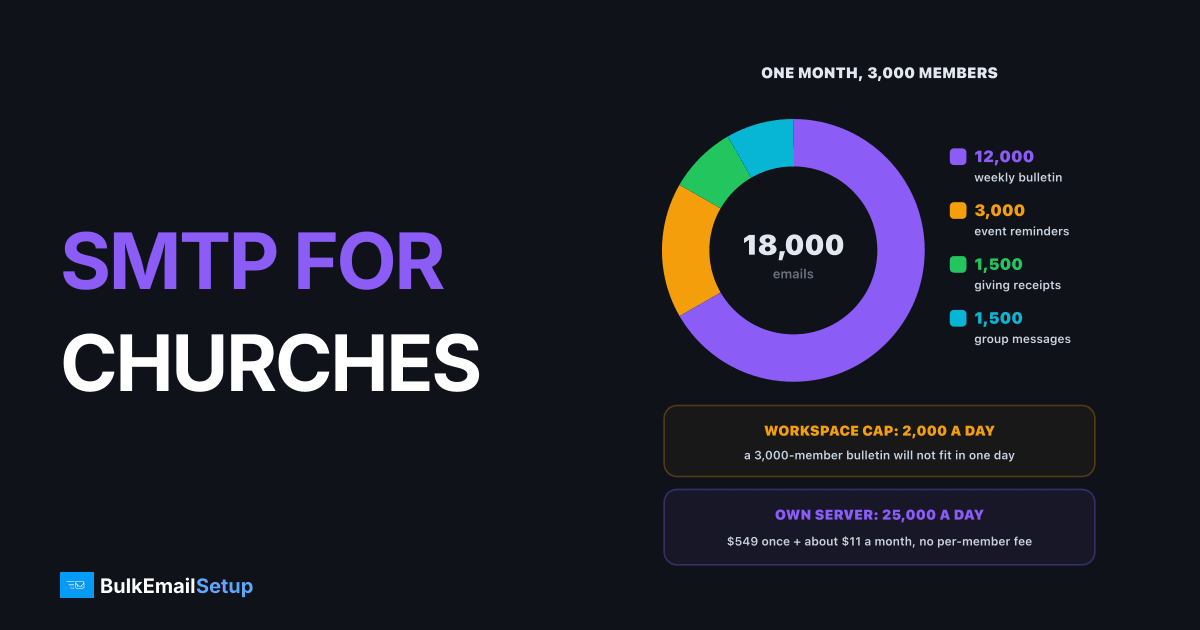
Church email is mostly a steady weekly rhythm, not big campaigns. A worked example for a 3,000-member congregation:
One month for a 3,000-member church. The bulletin is two thirds of it.
| Per month | Notes | |
|---|---|---|
| Weekly bulletin | 12,000 | 4 sends to 3,000 members |
| Event reminders | 3,000 | one per event to sign-ups |
| Giving receipts and statements | 1,500 | transactional, must land |
| Small group and ministry messages | 1,500 | smaller lists |
| Total | 18,000 | an example, not a rule |
That is modest volume. The problem is not the monthly total but the daily peak: the whole bulletin goes out on one morning.
How many emails a church can send per day
One Workspace user cannot send a 3,000-member bulletin in a day.
| Tool | Daily limit |
|---|---|
| Google Workspace user | 2,000 messages, 1,500 by mail merge |
| New or trial Workspace account | lower, until the account builds history |
| Church app or newsletter tool | set by plan, usually monthly |
| Own server, Basic plan | 25,000 a day, about 1,050 an hour |
Google publishes its caps in Gmail sending limits for Workspace. Splitting a bulletin across several staff accounts to get around the cap is a common workaround and a bad one, because it spreads the risk of a suspension across every staff mailbox. For more on this wall, see what to do when you outgrow Gmail SMTP.
Do churches need consent to email members?
Mostly the rules are lighter for members than for marketing, but each country draws the line differently.
| Country | What applies to a church emailing members |
|---|---|
| United States | CAN-SPAM covers commercial email, so a bulletin is mostly outside it; ticket or merchandise sales can bring it in |
| Canada | membership, donating or volunteering gives two years of implied consent under CASL |
| UK and EU | a church list reveals religious belief, special data under GDPR, with an exception for religious bodies emailing their own members |
The GDPR point is the one churches miss. Article 9 of the GDPR lets a not-for-profit body with a religious aim process data about its members, former members and people in regular contact with it, but only within its own activities and without sharing the data outside the body without consent. In practice: do not hand the member list to a fundraising partner, and keep it on systems you control.
Whatever the country, three habits keep a church list clean:
- Every email has an unsubscribe link, even the bulletin. See unsubscribe link requirements.
- Separate lists. Members, visitors, volunteers and prayer list kept apart.
- No bought or borrowed lists, ever. They are the fastest route to spam folders.
This is a summary of the rules, not legal advice.
Can a church run its own email server?
Yes, and for larger churches it is usually the cheapest option over a few years. What it takes:
- A host that allows outbound email. Several cloud hosts block port 25 by default.
- DNS records. SPF, DKIM, DMARC and PTR on the church's sending domain.
- Bounce handling, so dead addresses stop being mailed.
- A warm-up. A few weeks of building volume before the full bulletin goes out.
Year one is the setup. After that, only hosting.
Year one on the Basic plan comes to about $691: the $549 setup, about $132 of hosting and $10 for the domain. From year two it is about $142 a year, whatever the congregation size up to 25,000 emails a day. Our nonprofit mass mailing guide covers the same setup for charities.
How BulkEmailSetup helps
We build the church's own sending server: dedicated IPs, a campaign platform for the bulletin, SPF, DKIM, DMARC and PTR, bounce handling and a warm-up plan. The member list stays on a server the church controls, which suits the GDPR point above.
| Plan | One-time fee | Emails per day | Dedicated IPs | Hosting paid to your host |
|---|---|---|---|---|
| Basic | $549 | 25,000 | 3 | about $11 a month |
| Advance | $1,199 | 200,000 | 15 | about $49 a month |
Advance suits a diocese or church network mailing many parishes. No monthly fee to us, unlimited contacts, and a 15-day money-back guarantee that applies until server access is handed over. See the Basic plan or all pricing.
Frequently asked questions
What is the cheapest email option for churches?
For a small congregation, the free route works: Google Workspace's nonprofit edition, or a church app with a free tier for small groups. Costs rise with members, because church tools and newsletter services price by contact count. For several thousand members, or a diocese mailing many parishes, a church's own email server is usually cheapest over time: BulkEmailSetup's Basic setup is $549 once plus about $11 a month in hosting.
Do churches need consent to email members?
Usually the rules are lighter for members, but they still apply. In the US, CAN-SPAM covers commercial email, so a bulletin to members is mostly outside it, though selling tickets or merchandise can bring it in. In Canada, membership or a donation gives two years of implied consent. In the UK and EU, a church list reveals religious belief, which GDPR treats as special data with a specific exception for religious bodies emailing their own members.
Can a church run its own email server?
Yes. A church can run a dedicated SMTP server with its own IPs and domain, like any organisation. It needs SPF, DKIM, DMARC and PTR records, a host that allows outbound email on port 25, bounce handling and a short warm-up. Most churches do not have staff to build that, which is why a one-time setup service is the common route rather than building it in-house.
How many emails can a church send per day?
It depends on the tool. A Google Workspace user can send up to 2,000 messages a day, and 1,500 through mail merge, with lower limits on new or trial accounts. Church apps and newsletter services set their own monthly caps by plan. A church's own server on BulkEmailSetup's Basic plan sends up to 25,000 a day, so a 3,000-member weekly bulletin goes out in one morning.
Can our church use Gmail to send the weekly bulletin?
Only for a small list. Gmail and Workspace are built for person-to-person mail, and Google can suspend sending if one account blasts thousands of members. A bulletin to more than a few hundred people belongs in a newsletter tool or on a sending server, which also gives you unsubscribe links, bounce handling and open stats that Gmail does not.
Should a church email prayer requests to the whole list?
Be careful. Prayer requests often contain health or family details about named people, which is sensitive in its own right. Share them only with people who opted in to a prayer list, keep that list separate from the general bulletin, and get permission from the person named before anything goes out by email.


