
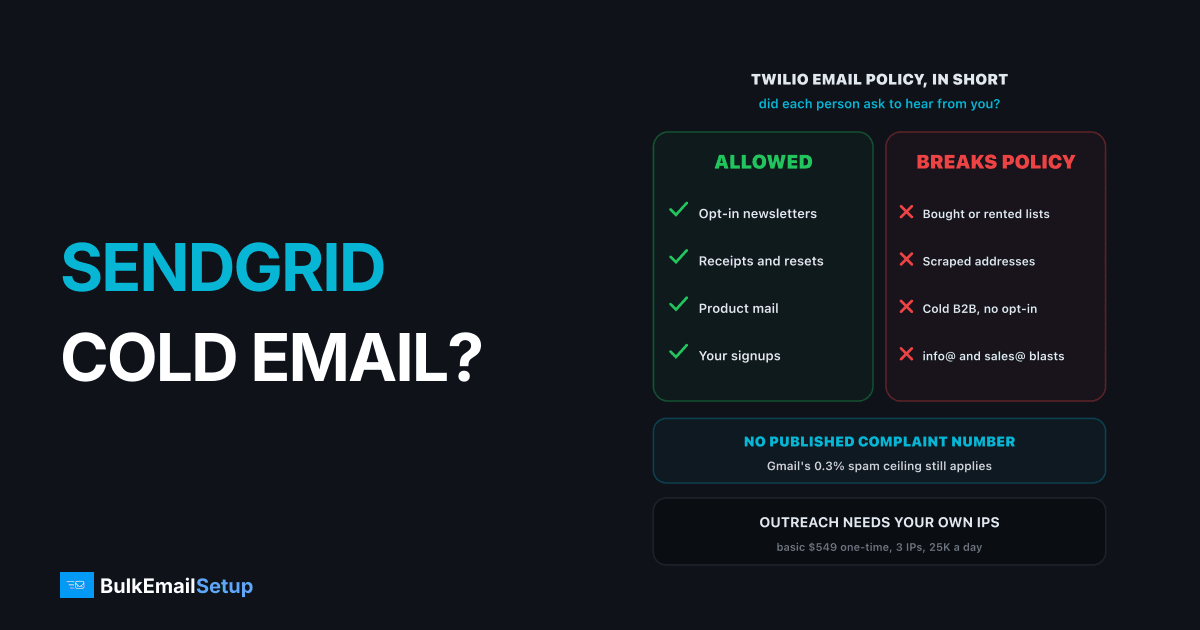
No, SendGrid does not allow cold email. The Twilio Email Policy that governs SendGrid requires affirmative consent before you send any email, and it bans purchased or rented lists, addresses taken from the internet or social media, generic aliases like info@, and unsolicited bulk sending. Cold outreach fails the consent rule on the first message. If you want to run outreach, it has to go through infrastructure where you carry your own reputation, and it still has to follow the law and Gmail's limits.
I get asked this a lot by sales teams who already use SendGrid for product email and want to add an outbound sequence. The answer is the same every time, and trying it anyway usually takes the product email down with it.
What the SendGrid policy actually says
SendGrid is owned by Twilio, and sending through it is bound by the Twilio Email Policy, last updated April 9, 2026. These are the clauses that matter for outreach.
| Policy clause | What it says | What it means for cold email |
|---|---|---|
| Affirmative consent | you must obtain affirmative consent prior to sending any emails | a prospect who never opted in cannot be mailed |
| Consent from each recipient | blanket consents or consents provided on behalf of a third party are not acceptable | "the data vendor says they opted in" does not count |
| Purchased lists | using purchased or rented email lists is prohibited | bought B2B databases are out |
| Harvested addresses | no emails to addresses obtained from the Internet or social media | scraped websites and LinkedIn lists are out |
| Generic aliases | no emails to generic email aliases | info@, sales@, contact@ are out |
| Bulk unsolicited | no unsolicited or unwanted emails in bulk | the whole category is out |
| Filter evasion | no spreading sends across domains or IPs to dodge filters | rotating domains to stay under the radar is out |
Read together, there is no version of cold email that fits. Every common list source is named, and the consent rule covers anything left over.
Is B2B outreach different?
No. People often assume business email is fair game because US law allows it. The policy has no B2B carve-out. Consent has to be given freely by each recipient to each sender, so a work address is treated the same as a personal one.
The third-party consent line is the one that catches agencies. Many lead databases say their contacts "agreed to be contacted by partners". SendGrid's policy rules that out by name.
Any no answer means the send breaks the Twilio Email Policy
How SendGrid enforces it
The policy does not publish a number. Twilio decides violations case by case, and the triggers it names are an unreasonable number of spam complaints and excessive block listings. In practice, cold campaigns trip both: prospects hit "report spam" far more often than subscribers do, and harvested lists carry spam traps that land IPs on blocklists.
| Signal | Where the line sits | Who sets it |
|---|---|---|
| Spam complaints | unreasonable number, no figure given | Twilio, case by case |
| Block listings | excessive, or slow to resolve | Twilio, case by case |
| Gmail spam rate | 0.3% hard limit, under 0.1% target | Google sender guidelines |
| Authentication | SPF, DKIM and DMARC required for bulk senders | Gmail and Yahoo |
The reason SendGrid is strict is the shared pool. On shared IPs, your complaints raise the risk for every other customer on the same addresses. So the provider has to act before Gmail does. That is not unfair. It is the cost of cheap shared sending.
Cold email is often legal, SendGrid just won't carry it
The policy is a contract rule, not the law. In the US, the FTC's CAN-SPAM guide allows commercial email without prior consent if you follow its rules. Other places are stricter.
| Rule source | Cold B2B email allowed? | Main conditions |
|---|---|---|
| US law (CAN-SPAM) | yes | honest headers and subject, physical address, opt-out honored within 10 business days |
| UK and EU law | limited | stricter for individuals, needs a lawful basis and an easy opt-out |
| Gmail and Yahoo rules | yes, if recipients don't complain | spam rate under 0.3%, authentication, one-click unsubscribe for bulk |
| SendGrid policy | no | prior affirmative consent from every recipient |
So the question is not "is cold email allowed" but "allowed where". SendGrid is the strictest line in that table. Our CAN-SPAM page and GDPR page cover the legal side in more depth.
What happens if you send it anyway
The usual sequence: a complaint spike, a review hold, then a suspension that also stops your password resets and order emails if they share the account. We walk through that recovery in SendGrid suspended my account.
The longer cost is the domain. Gmail and Microsoft record complaints against the sending domain, not the provider. A cold campaign sent from your main domain on SendGrid can drag down the domain your customers get invoices from, for weeks after the account is gone.
On a shared pool your complaints are everyone's problem, on your own IPs they are only yours
Where cold email can run
Outreach needs infrastructure where the only reputation at risk is yours. These are the realistic options.
| Option | Typical volume | Good for | Trade-off |
|---|---|---|---|
| Google Workspace or Microsoft 365 inboxes + outreach tool | 30 to 50 a day per inbox | small teams, high personalization | many inboxes and domains to manage |
| Cold email platform with its own sending | plan-based | quick start | their policy and their shared pool again |
| Dedicated SMTP server, own IPs | thousands a day | agencies, high-volume outbound | you own warm-up and list quality |
| SendGrid or another shared ESP | n/a | product and opt-in mail only | bans cold email |
Keep SendGrid for what it is good at: transactional and opted-in marketing mail. Send outreach from separate domains on separate infrastructure. SMTP providers that allow cold email compares the providers, and dedicated SMTP for cold email outreach shows the setup.
Running outreach safely on your own server
Owning the IPs removes the policy conflict. It does not remove the rules that decide whether you reach the inbox.
- Send from a separate domain or subdomain, never the domain your invoices come from.
- Verify the list first. Keep hard bounces under 2 percent. See email list cleaning.
- Keep spam complaints under 0.1 percent, well inside Gmail's 0.3 percent limit.
- Add a clear opt-out to every message and honor it fast.
- Warm the IPs up over 2 to 4 weeks before full volume.
- Target tightly. A relevant 500 beats a scraped 50,000.
How BulkEmailSetup helps
We build dedicated SMTP infrastructure you own: your own server and IPs, SPF, DKIM, DMARC and PTR set up, bounce handling, and an email marketing platform with campaign stats. There is no shared pool, so no acceptable use policy decides whether your compliant outreach is too risky for someone else's customers. The law and Gmail's rules still apply, and the setup is built so you can meet them.
The Basic plan is $549 one-time for 1 SMTP server, 3 dedicated IPs, 25,000 emails a day and unlimited contacts, plus about $11 a month in hosting paid to your host. Advance at $1,199 runs 15 IPs and 200,000 a day for agencies. There is a 15-day money-back guarantee. See pricing.
Outreach on BulkEmailSetup servers follows our anti-spam policy: lawful B2B email to business contacts you researched yourself, a working opt-out honoured within 10 business days, your physical address in every message, and complaints under 0.1%. Bought, rented or scraped lists are not allowed.
Frequently asked questions
Does SendGrid allow cold email?
No. The Twilio Email Policy that covers SendGrid says you must obtain affirmative consent before sending any email through the service. It also bans purchased or rented lists, addresses taken from the internet or social media, generic aliases such as info@, and unsolicited bulk email. Cold outreach, by definition, goes to people who have not opted in, so it breaks the policy.
What does SendGrid's acceptable use policy ban?
The Twilio Email Policy, last updated April 9, 2026, bans sending without prior affirmative consent, using purchased or rented lists, mailing addresses found online or on social media, mailing generic aliases, sending unsolicited bulk email, and evading spam filters by spreading sends across domains or IPs. It also bans content such as phishing, pyramid schemes and unapproved health claims.
Will SendGrid ban me for B2B outreach?
It can. The policy has no B2B exception: consent must come from each recipient, and consent collected by a third party, such as a data vendor, is not accepted. Twilio judges complaints and block listings case by case with no published threshold, so a B2B campaign that draws spam reports is a common route to suspension.
Which SMTP providers allow cold email?
Most shared ESPs ban it for the same reason SendGrid does: one sender's complaints hurt everyone on the shared IPs. Cold email usually runs on dedicated infrastructure: outreach mailboxes on Google Workspace or Microsoft 365, or a dedicated SMTP server such as BulkEmailSetup's Basic plan, $549 one-time for 3 dedicated IPs and 25,000 emails a day. The law and Gmail's 0.3 percent complaint limit still apply.
Is cold email legal if SendGrid does not allow it?
Often yes. In the US, CAN-SPAM allows commercial email without prior consent if it has honest headers and subject lines, a physical address and a working opt-out honored within 10 business days. The UK and EU are stricter, especially for individuals. SendGrid's policy is a contract rule, stricter than US law, not a statement of what the law allows.
Can I use SendGrid for cold email if I verify my list first?
Verification lowers bounces but does not create consent, and consent is what the policy requires. A verified list of prospects who never opted in is still a cold list under SendGrid's rules. Clean data helps deliverability on any platform, but on SendGrid it does not change whether the send is allowed.
What happens to my domain if SendGrid suspends me for cold email?
The suspension stops SendGrid sending, but the spam complaints that caused it are already recorded against your domain at Gmail and Microsoft. That reputation follows the domain to any new provider. This is why outreach is usually sent from separate domains, so a bad campaign cannot hurt the domain your invoices and support mail come from.


