
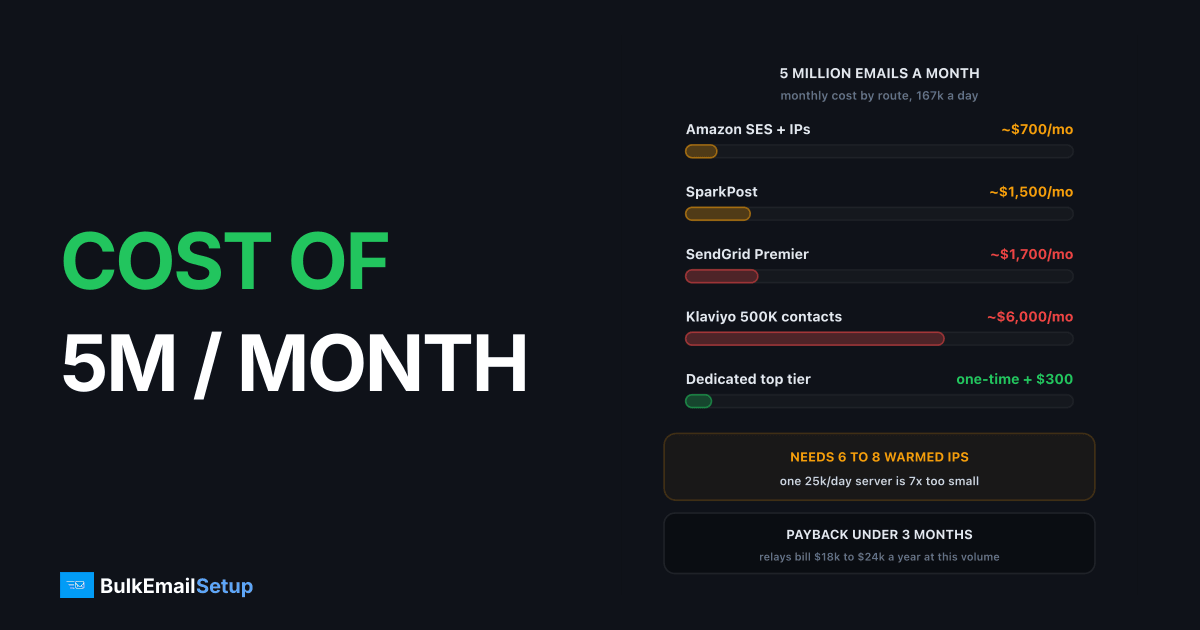
Sending 5 million emails a month costs roughly $500 on Amazon SES, $1,500 to $2,000 on a Mailgun or SendGrid enterprise contract, and $5,000 to $8,000 or more on Klaviyo or Mailchimp with a 500,000-contact list. A dedicated SMTP build handling 200,000 a day is a one-time price plus hosting. The spread is about 16x, and it comes down to how much of the platform you are paying for on top of the sending.
5 million a month is about 167,000 a day. That number matters more than the monthly one, because it is past what any published relay plan covers and past what one or two IPs can deliver. Everything below is priced with that in mind. I've run mail at this level through SES, SendGrid and my own MTAs, and the sticker price is never the whole story.
Cost to send 5 million emails a month by provider
| Provider | Monthly cost at 5M | Pricing model | Dedicated IPs | What you still own |
|---|---|---|---|---|
| Amazon SES | ~$500 + $150-200 IPs | $0.10 per 1,000 | $24.95 each | Everything except the send |
| SparkPost | ~$1,200-1,800, custom | Per email, volume tiers | Included at this tier | List hygiene, monitoring |
| Mailgun | ~$1,500-2,000, custom | Per email, Enterprise | Several included | Reputation, hygiene |
| SendGrid Premier | ~$1,500+, custom | Per email, negotiated | Several included | List hygiene |
| Brevo Enterprise | ~$2,000-3,000, custom | Per email + seats | Paid add-on | Little |
| Mailchimp Premium | ~$5,000-7,000 | Per contact, 500K list | Not offered | Little |
| Klaviyo | ~$5,000-8,000+ | Per contact, 500K list | Paid add-on | Little |
| Dedicated SMTP, top tier | one-time build + $200-400 hosting | Flat | 15 yours | Warm-up, hygiene |
The SES figure comes straight off the Amazon SES pricing page: $0.10 per 1,000 outbound, $24.95 per dedicated IP per month. Every other relay in the table has stopped publishing a price at this volume and moved you to a sales call, so treat those as ranges from real quotes, not list prices.
Two things jump out. SES is 3x cheaper than the nearest relay while doing far less. And the contact-priced platforms at the bottom cost more in a quiet month than SES costs in a busy one, because they bill for the list, not the sends.
The 12-month totals
Monthly numbers hide how fast the gap compounds. Here is a year at 5 million a month, with the IPs and the obvious add-ons included.
| Route | Year one | Year two | What is in the number |
|---|---|---|---|
| Amazon SES | ~$8,000 | ~$8,000 | $500 send + $175 IPs + ~$3,000 engineering time |
| SparkPost | ~$18,000 | ~$18,000 | Contract, IPs included |
| Mailgun Enterprise | ~$21,000 | ~$21,000 | Contract, validation add-on |
| SendGrid Premier | ~$20,000 | ~$20,000 | Contract, dedicated IPs, support tier |
| Klaviyo, 500K contacts | ~$72,000 | ~$80,000+ | List growth pushes the tier up |
| Dedicated SMTP, top tier | one-time build + ~$3,600 hosting | ~$3,600 hosting | Server, 15 IPs, no per-email fee |
The SES row is the one people argue about. $500 a month in send fees is real, but so is the engineer who builds the bounce processing, the SNS hooks, the suppression store and the reputation alerts SES does not give you. At 5 million a month that is 5 to 10 hours a month at minimum, and I have put a modest $3,000 a year on it.
The Klaviyo row is not a typo. Contact pricing at 500,000 stored addresses is what it is, and the Klaviyo vs dedicated SMTP comparison walks through why it climbs even when sends do not.
What 5 million a month needs in infrastructure
This is where 5 million differs from 2 million. At 2 million you can get away with a mid-size relay plan and a handful of IPs. At 5 million you need a proper MTA and enough IPs that no single one is doing the heavy lifting.
| Requirement | Minimum at 5M/month | Comfortable | Why |
|---|---|---|---|
| Dedicated IPs | 5 | 6-8 | Per-IP hourly throttles at Gmail and Microsoft |
| Throughput | 20 msg/sec | 50-100 msg/sec | 167K a day in a 2-hour window needs ~25/sec |
| Queue depth | 200K messages | 500K | A weekly campaign to a 1M list lands at once |
| Bounce processing | Automated, same day | Real-time, feeds suppression | 5% bounce is 8,000 addresses a day to remove |
| Feedback loops | Microsoft JMRP, Yahoo CFL | Plus Postmaster Tools API | Complaint data arrives per IP |
| Sending domains | 2 (marketing, transactional) | 3-4 subdomains | Contain damage to one stream |
| Monitoring | Daily deferral check | Alerting on 4xx spikes | A throttled IP at 3am costs a day |
Throughput is the number that surprises people. 167,000 a day sounds like a lot until you divide by 86,400 seconds and get under 2 messages a second. The catch is that nobody sends evenly. A campaign to 800,000 addresses that has to land before lunch is 800,000 in 3 hours, or about 75 a second. Size the MTA for the burst, not the average. See infrastructure to send 100K emails a day for the server side in detail; 5 million a month is that setup with more IPs.
Why a Basic tier is too small here
A dedicated server at 25,000 a day with 3 IPs is the right size for 500,000 to 750,000 a month. It is not the right size for 5 million. You would be running it at 7x its rated volume, which means 55,000 a day per IP into Gmail, and Gmail will defer most of it.
The two honest options on the dedicated route:
- One top-tier server rated for 200,000 a day with 15 IPs. That covers the 167,000 daily average with 20% headroom and enough IPs to spread the load at 11,000 to 15,000 per IP per day.
- Two mid-tier servers if you want marketing and transactional on physically separate boxes. More hosting, more admin, but a campaign complaint spike cannot slow an order confirmation.
Either way, one server rated for 25,000 a day is a false economy at this volume. You will burn the IPs in the first month trying to push the difference through them.
Staffing and ops hours
The infrastructure is a cost. The person running it is a bigger one, and every route needs someone.
| Task | SES | Managed relay | Dedicated, self-run | Dedicated, managed build |
|---|---|---|---|---|
| Initial setup | 40-80 hrs | 5-10 hrs | 40-60 hrs | included |
| Warm-up, 6 IPs | 6-8 weeks, yours | often automated | 6-8 weeks, yours | plan included |
| Bounce and suppression | build it, 20-40 hrs | included | configure, 5-10 hrs | included |
| Weekly monitoring | 2-4 hrs | 1-2 hrs | 2-4 hrs | 1-2 hrs |
| Incident response | you, no support line | ticket, SLA if paid | you | you, with docs |
At 5 million a month, budget 100 to 150 hours a year of someone's time on whichever route you take. A relay reduces that but does not remove it, because list hygiene and complaint monitoring are your job everywhere. The difference is whether the setup and warm-up hours are yours or someone else's.
Deliverability at this volume
The cost that nobody puts in a spreadsheet is a bad week at 5 million a month. If 20% of your mail defers for five days, that is 160,000 emails a day not arriving, and on a shared pool you may never learn why.
Gmail's published rules for bulk senders are the ones that bite first. Google's sender guidelines require SPF, DKIM and DMARC, a one-click unsubscribe, and a spam rate in Postmaster Tools kept below 0.3%, with 0.1% as the target you should actually hold. At 5 million a month, 0.1% is 5,000 complaints. That is your whole margin.
Per-IP throttling is the second wall. Gmail and Microsoft rate-limit each IP on an hourly and daily basis that scales with that IP's reputation, not with your account. A new IP might get a few hundred an hour into Gmail. A warmed one with a good record gets tens of thousands. This is why the IP count matters more than server size. The per-IP figures are in how many emails per day per IP.
Warm-up is the third. Six IPs warmed in parallel, each starting at 200 to 500 a day and growing about 30% every two days, take roughly 6 to 8 weeks to reach 30,000 a day each. During those weeks you are still sending 5 million a month somewhere, so plan an overlap with your current provider rather than a hard cutover. Rushing this is how people burn a fresh IP set and restart on a damaged domain.
Break-even on a dedicated build
The break-even is short at this volume because the relay bills are large.
| Compared against | Monthly relay cost | Dedicated ongoing | Monthly saving | Payback on a build |
|---|---|---|---|---|
| Amazon SES + IPs + eng time | ~$925 | ~$300 hosting | ~$625 | 3-5 months |
| SparkPost | ~$1,500 | ~$300 | ~$1,200 | 2-3 months |
| SendGrid Premier | ~$1,700 | ~$300 | ~$1,400 | 1-2 months |
| Mailgun Enterprise | ~$1,750 | ~$300 | ~$1,450 | 1-2 months |
| Klaviyo, 500K contacts | ~$6,000 | ~$300 + self-hosted software | ~$5,500 | under 1 month |
The "dedicated ongoing" column is hosting for a server sized for 200,000 a day, usually $200 to $400 a month depending on the host and whether you take a backup box. There is no per-email line, no per-IP line, no overage line. That is the whole argument, and at 5 million a month the arithmetic does not need help.
The caveat is the one from the staffing table. A dedicated server saves money only if someone owns it. If nobody will check deferrals weekly, the saving is spent on a damaged domain within a quarter.
Who should stay on SES
Not everyone at 5 million a month should move. SES is the right call when:
- You have engineers who want the job. SES plus your own tooling is the cheapest recurring cost in the table, and if the bounce processing and monitoring already exist, the $3,000 engineering estimate drops toward zero.
- Your mail is mostly transactional. Receipts, alerts and password resets have high engagement and near-zero complaints, so the reputation risk that pushes marketing senders to owned IPs barely applies.
- Volume is uneven month to month. Per-email pricing means a 1 million month costs $100. A dedicated server costs the same whether you use it or not.
- You are on AWS anyway. The SNS and Lambda plumbing SES expects is already familiar, and the IAM model fits your existing setup.
SES is the wrong call when your sending is marketing-heavy, when your list has any age on it, or when a sandbox review or sending-quota pause would stop the business. SES pauses accounts at a 5% bounce rate or a 0.1% complaint rate with little warning, and there is no phone to call. The Amazon SES vs dedicated SMTP server comparison covers the operating differences.
Which route fits at 5 million a month
SES if you have the engineering and the mail is mostly transactional.
A relay enterprise contract if $18,000 to $24,000 a year is easier to sign than a build project, and you want a support ticket queue when something breaks.
Dedicated if you are staying at this volume or growing, you send marketing, and someone will own warm-up and hygiene. The payback against any relay is under three months.
A contact-priced platform only if the automation and CRM are what you are actually buying. At 500,000 contacts you are paying $60,000-plus a year for the sending layer of a tool whose value is elsewhere. Pair a dedicated server with MailWizz, Mautic or Listmonk and keep the automation for a fraction of that.
For the tiers below, 1 million a month and 2 million a month follow the same method with smaller numbers.
How BulkEmailSetup helps
We build the dedicated route as a one-time job sized for your peak day, not your average: your own server, your own IPs, full SPF/DKIM/DMARC/PTR configuration, MTA tuning for burst throughput, bounce and feedback-loop handling wired into suppression, and a parallel warm-up plan for the full IP set.
Basic starts at $549 one-time, covering 1 SMTP server, 3 dedicated IPs, 25,000 emails/day and unlimited contacts. Higher tiers scale to 15 IPs and 200,000 emails/day, which is the tier 5 million a month needs. See pricing for the full breakdown.
Frequently asked questions
How much does it cost to send 5 million emails a month?
Between roughly $500 and $8,000 a month depending on the route. Amazon SES bills about $500 in send fees plus $25 per dedicated IP. Mailgun and SendGrid land on custom enterprise contracts around $1,500 to $2,000. Klaviyo or Mailchimp at 500,000 contacts run $5,000 to $8,000 or more. A dedicated SMTP build is a one-time price with no per-email fee.
How many dedicated IPs do I need for 5 million emails a month?
Plan on 5 to 8 warmed IPs. 5 million a month averages 167,000 a day, and Gmail and Microsoft throttle each IP separately, so a single IP pushing 100,000-plus a day into Gmail sees deferrals during peaks. Six IPs at roughly 30,000 a day each handles the average with headroom for a campaign spike.
How long does it take to warm up IPs for 5 million a month?
Six to eight weeks for a set of six IPs warmed in parallel. Each IP starts at a few hundred emails a day and grows about 30% every two days, so reaching 30,000 a day per IP takes roughly 6 weeks. Warming them one after another instead of together stretches the timeline to several months.
Is Amazon SES the cheapest way to send 5 million emails?
On send fees, yes, at about $500 a month plus $150 to $200 for 6 to 8 dedicated IPs. What SES does not include is a queue you control, a campaign tool, bounce dashboards or anyone watching reputation. At 5 million a month those gaps cost a part-time engineer, which is usually more than the send fee.
Can a single dedicated server send 5 million emails a month?
Yes, if it is sized for it. A tuned MTA such as PowerMTA or Postal on a modern server handles 50 to 100 messages a second, which is 167,000 a day in under an hour of actual sending. The limit is IP throttling at the receivers, not server CPU, so you need the IPs more than the extra hardware.
When does a dedicated server break even against SendGrid at 5 million a month?
In the first month. A SendGrid Premier contract at this volume is roughly $1,500 to $2,000 a month, or $18,000 to $24,000 a year. A dedicated build sized for 200,000 a day costs a one-time fee plus $200 to $400 a month in hosting, so year-one savings are typically $12,000 or more.


