
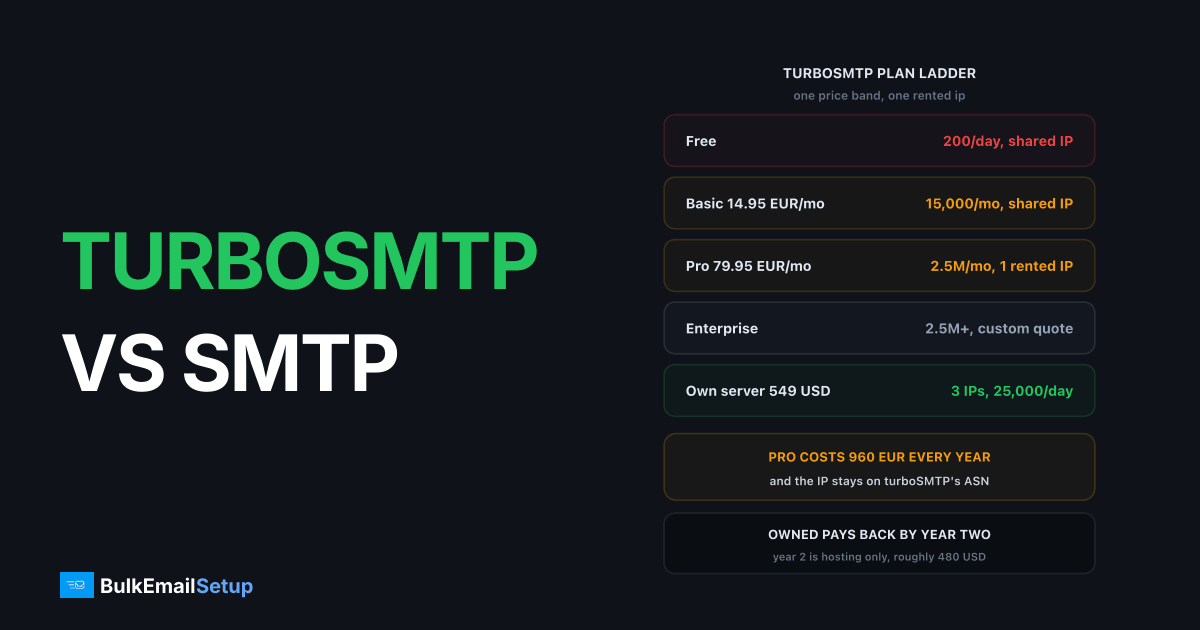
turboSMTP is a cheap SMTP relay: €14.95 a month for 15,000 emails, €79.95 for the Pro tier that covers up to 2.5 million and finally includes a dedicated IP. You get sending credentials, an API and analytics, and no infrastructure of your own. That trade works well up to a few hundred thousand emails a month. Past roughly 500,000 steady sends, the €79.95 you are paying largely to escape the shared pool buys less than a server you own outright.
I have run mail through cheap relays and through boxes I built myself. The cheap relay is not a bad product. It is a specific bargain, and the price you pay is not on the invoice.
What turboSMTP actually is
turboSMTP, which also trades as serversmtp.com, is a volume-banded SMTP relay aimed at small and mid senders. You point your app at their endpoint on port 587 or 465, authenticate, and mail goes out over their IPs. No server to build, no MTA to tune, no PTR record to set. That is the entire pitch and it is an honest one.
The plan ladder as published on the turboSMTP pricing page looks like this. Prices are in euros and the page is the authority, so check it before you budget.
| Plan | Price | Volume | Dedicated IP |
|---|---|---|---|
| Free | €0 for first 6 months | 200 emails/day | No |
| Basic | €14.95/month | 15,000 emails/month | No |
| Pro | €79.95/month | 15,000 to 2.5M/month | Yes, included |
| Enterprise | Custom | 2.5M+ or on demand | Yes, IP pools |
There is a second route: pay-as-you-go credits from €49 for 50,000 emails to €790 for 1 million, bought once and burned down. Useful if your sending is seasonal. Expensive per message if it is not.
The typical customer is a WordPress site owner escaping their host's mail function, a SaaS with a few thousand transactional messages a day, or a small agency sending client newsletters. All three want credentials and nothing else.
The shared pool question
This is the part that decides whether the €14.95 tier is a bargain or a trap. On Free and Basic you are on turboSMTP's shared IP pool. Your mail leaves from IPs that hundreds of other customers also use, and Gmail judges those IPs on the aggregate behaviour of everyone on them.
Shared pools are not automatically bad. A well-policed pool kept warm by thousands of clean senders beats a cold dedicated IP you just bought. The variable is who else is on it, and price is the strongest predictor. Cheap plans attract senders with cheap lists, and a relay charging €14.95 a month cannot review every signup the way a $300-a-month vendor can.
| Pool factor | Cheap shared tier | Premium shared pool | Your own IP |
|---|---|---|---|
| Neighbour quality | Mixed, price-selected | Vetted, higher spend | You only |
| Complaint tolerance | Under 0.3% | Under 0.3% | Receiver rules only |
| Blocklist blast radius | Everyone on the IP | Everyone on the IP | You alone |
| Reputation you build | The vendor's | The vendor's | Yours, portable |
| Recovery from a listing | Wait for the vendor | Wait for the vendor | You file it yourself |
The blast radius row is the one people underestimate. If a co-tenant on your shared IP gets that IP listed on Spamhaus, your password resets sit in spam too, and you cannot file the delisting because it is not your IP. You open a ticket and wait. Our Spamhaus delisting guide covers the process for IPs you control, which is the whole difference.
The Pro tier at €79.95 fixes this with a dedicated IP. Note the context: €79.95 a month is roughly €960 a year, and the IP still sits on turboSMTP's ASN under turboSMTP's account. You rent the reputation. Leave, and it stays behind. We work through that trade in dedicated IP vs shared IP.
Feature by feature against a dedicated server
| Capability | turboSMTP | Your own dedicated server |
|---|---|---|
| SMTP relay | Yes, all tiers | Yes, you run the MTA |
| Web API | Yes, all tiers | Whatever you install |
| Analytics retention | 30 days Basic, 365 days Pro | Unlimited, your logs |
| SPF / DKIM setup | Guided, vendor domain option | You configure, full control |
| Custom sending domains | Pro tier and up | Always |
| Subaccounts | Up to 100 on Pro | Unlimited, you define them |
| List management | Minimal, it is a relay | None, bring your own sender |
| Support | Chat and ticket, phone on Pro | Setup provider or per incident |
| Suspension risk | Real, shared platform policy | None from a relay |
The list-management row matters more than it reads. turboSMTP is a relay, not a marketing platform. You still need Mautic, Sendy, Interspire or your own app on top to hold contacts and build campaigns. A dedicated server is the same, so it is not a difference, just a cost people forget when comparing a relay against Mailchimp.
Analytics retention is a real difference. Thirty days on Basic means you cannot look back at what your bounce pattern did last quarter. On your own server the logs go back as far as your disk does.
The cost at 50K, 250K and 1M a month
Here is the money, using turboSMTP's published plan prices and a dedicated server at our Basic tier. Euro figures are the vendor's; the server figure is a one-time build plus ongoing hosting, so year one and year two differ sharply.
| Monthly volume | turboSMTP plan | turboSMTP year 1 | Dedicated server year 1 | Dedicated server year 2 |
|---|---|---|---|---|
| 50,000 | Pro, €79.95/mo | ~€959 | $549 + ~$480 hosting | ~$480 |
| 250,000 | Pro, €79.95/mo | ~€959 | $549 + ~$480 hosting | ~$480 |
| 1,000,000 | Pro, €79.95/mo | ~€959 | $549 + ~$480 hosting | ~$480 |
Notice what that table does. turboSMTP's Pro band covers 15,000 to 2.5 million a month at one price, which is good value at the top of the band and poor value at the bottom. Send 50,000 a month and you are paying Pro prices for Basic volume purely to get the dedicated IP. Send 2 million and €79.95 is one of the cheapest deals in the relay market.
So the crossover is not really about volume. It is about what €960 a year buys. On turboSMTP it buys one rented IP and a plan band. On owned infrastructure the same money in year one buys 3 dedicated IPs, 25,000 emails a day, and hardware that keeps working in year two for hosting cost alone. By year three the owned path has cost roughly a third as much. We map every vendor on the same axis in cost per 1,000 emails across every provider.
Add the sub-band problem: on Basic at €14.95, a list that grows to 20,000 contacts blows the 15,000 cap in one send and you jump straight to €79.95. No middle plan. That cliff catches people.
The deliverability reality of low-cost pools
Cheap relays run tighter policy than expensive ones, not looser. That surprises people who assume low price means low scrutiny. The logic is margin: at €14.95 a month, a customer generating complaints is not worth the reputation damage, so enforcement is fast and usually automated.
In practice:
- Complaint rate. Google's bulk sender rules put the hard line at 0.3% and the target at 0.1%. On a shared pool your relay will act before Google does, because the pool has to stay clean for everyone.
- Bounce rate. Sustained bounces above roughly 5% read as a purchased list. Expect a pause, not a warning email.
- Content policy. Affiliate offers, crypto, anything a policy team reads as risky gets declined faster on cheap tiers because the vendor has less to gain from arguing.
- No appeal route. A €14.95 account has no account manager. Your escalation path is the same ticket queue as everyone else's.
None of this is turboSMTP being unreasonable. It is what any shared platform must do. The point is that the low price does not buy tolerance, and if your sending sits anywhere near the edge you are on borrowed time. We list the warning signs in red flags in cheap SMTP providers.
Receiver rules apply identically either way. Gmail and Yahoo require SPF, DKIM and DMARC all passing for bulk senders, one-click unsubscribe, TLS in transit and valid reverse DNS, and the thresholds do not soften because you paid less. The full list is in Google's sender guidelines. On turboSMTP the vendor handles reverse DNS and much of the authentication. On your own server you set every record: more work, more control.
What happens when you outgrow it
Three signals, in the order they usually arrive.
You buy Pro purely for the IP. Sending 60,000 a month, well inside a cheaper band, and paying €79.95 anyway because the shared pool scared you. That is the clearest sign the relay model has stopped fitting. You are already paying dedicated-infrastructure prices for rented infrastructure.
You need stream separation. Password resets and marketing on the same IP means a bad campaign delays a login. turboSMTP gives you up to 100 subaccounts on Pro, but subaccounts are not separate IPs. Real separation needs multiple IPs: an Enterprise conversation on a relay, a config line on your own server.
You hit the 2.5 million ceiling. Above that, Pro stops and Enterprise starts, custom-priced pay-as-you-consume billed the following month. Custom pricing is where cheap relays stop being cheap. Get a quote before assuming it scales linearly.
A fourth signal has nothing to do with volume: you got paused once. A single suspension tends to predict a second, because the cause is usually your list rather than a fluke. Fix the list either way, but after that the argument for IPs nobody else can trip over gets much stronger.
Where the crossover sits
| Signal | Stay on turboSMTP | Move to your own server |
|---|---|---|
| Monthly volume | Under 250,000 | Over 500,000 steady |
| Volume pattern | Spiky or seasonal | Consistent month to month |
| Current plan | Free or Basic, €14.95 | Pro at €79.95, for the IP |
| Streams | One | Transactional plus marketing |
| Team | Nobody reads SMTP logs | At least one engineer, or a partner |
| Horizon | Under 12 months | Multi-year sending programme |
| Suspension history | Never paused | Paused once already |
Two rows pointing right is worth modelling. Four is a decision.
Be honest about the spiky case, because it genuinely favours the relay. A dedicated IP needs roughly 50,000 messages a month of steady traffic to hold its warmth. Send 400,000 in November and 10,000 in February and that IP goes cold, then your Black Friday blast trips Gmail deferrals within hours. A shared pool kept warm by other senders protects you from exactly that. The same logic runs through SMTP2GO vs a dedicated SMTP server.
The other caveat: a dedicated server's control is worth nothing if nobody uses it. Raw logs, per-destination throttling and your own warm-up schedule help only when someone reads and acts on them. If your team will not, turboSMTP's €79.95 buys the absence of that work, and that is a legitimate purchase.
One thing does not change on either side. A list with a 5% bounce rate and a 0.4% complaint rate fails on turboSMTP's shared pool, on its Pro dedicated IP, and on a server you built yourself. Infrastructure decides how much your good behaviour is worth. It does not rescue bad behaviour.
How BulkEmailSetup helps
If you are paying turboSMTP's Pro tier mainly to get off the shared pool, you are renting the thing you could own. We build dedicated SMTP infrastructure in your name: your own server, your own IPs, full SPF, DKIM, DMARC and PTR configuration, MTA tuning, bounce handling and a warm-up plan. After handover the IPs are yours, the logs are yours, and the reputation you build travels with you instead of staying on a vendor's ASN.
Basic is $549 one-time, covering 1 SMTP server, 3 dedicated IPs, 25,000 emails/day and unlimited contacts. Higher tiers scale to 15 IPs and 200,000 emails/day. See pricing, or compare the whole market first in cost per 1,000 emails across every provider.
Frequently asked questions
How much does turboSMTP cost?
turboSMTP's published plans start at a free tier of 200 emails a day, then Basic at €14.95 a month for 15,000 emails, then Pro at €79.95 a month covering 15,000 to 2.5 million emails a month. Above 2.5 million it moves to custom Enterprise pricing billed the month after you consume it. There is also a pay-as-you-go credit ladder from €49 for 50,000 emails up to €790 for 1 million.
Does turboSMTP give you a dedicated IP?
Yes, but only from the Pro plan at €79.95 a month upward. The free and Basic tiers put you on turboSMTP's shared pool alongside every other low-cost customer. Enterprise adds IP pools. On the shared tiers your inbox placement is partly decided by senders you have never met.
Is turboSMTP good for deliverability?
It is adequate for transactional mail and small campaigns, and the Basic tier at €14.95 is genuinely cheap for 15,000 messages. The weakness is structural: cheap plans attract high-risk senders, so the shared pool carries more complaint risk than a premium relay's pool. Complaint tolerance on those tiers is tight, usually well under 0.3%, because one bad customer damages the ranges everyone shares.
When should I move off turboSMTP to my own server?
Around 500,000 emails a month of steady sending, or sooner if you are already paying for the Pro tier mainly to get off the shared pool. At that point you are paying €79.95 a month, roughly €960 a year, for one rented IP. A dedicated server at $549 one-time gives you 3 IPs you own outright and 25,000 emails a day.
What is the difference between turboSMTP and serversmtp.com?
They are the same product. serversmtp.com is the long-running brand and turbosmtp.com is the newer name, and the pricing page at serversmtp.com/pricing carries the current plan ladder. If you see both names quoted at different prices, check the live page before you budget rather than trusting a comparison table.
Can turboSMTP suspend my account?
Yes. Every shared-pool relay reserves that right, and cheap relays enforce it harder than expensive ones because their margin per customer is thin. A bounce rate above roughly 5% or a complaint rate above 0.3% is enough to trigger a review. There is no notice period you can rely on, which is the main operational argument for owning your own IPs.


