
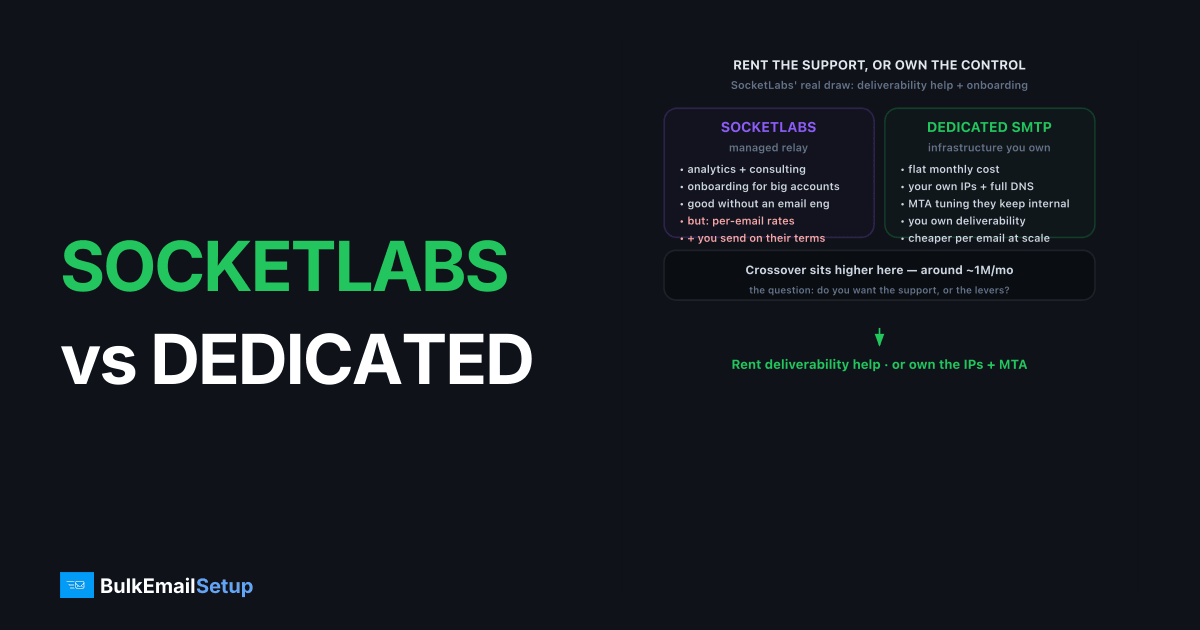
SocketLabs is a strong managed relay for high-volume senders who value deliverability support; a dedicated SMTP server wins on flat-rate cost and direct control once you send consistently past roughly 1M emails per month. SocketLabs bills per email and bundles analytics and onboarding help. A dedicated SMTP server is infrastructure you own: a flat monthly cost, your own IPs, full SMTP and DNS access, and MTA tuning the managed model keeps internal.
What is SocketLabs built for?
SocketLabs is an email delivery platform aimed at high-volume transactional and marketing senders, with deliverability analytics and consulting. It bills by monthly volume and provides onboarding for larger accounts. As of early 2026, dedicated IPs are available on higher-volume plans.
The deliverability support is a real draw for teams without an email engineer. The trade-off is the same as any managed relay: you send on their terms, through their infrastructure, at per-email rates.
How do SocketLabs and a dedicated SMTP server compare?
| Factor | SocketLabs | Dedicated SMTP server |
|---|---|---|
| Price model | Per-email tiers | Flat monthly |
| Best for | High-volume managed sending | High volume, full control |
| Deliverability help | Bundled consulting | Provider or self-managed |
| Dedicated IP | Higher tiers | Included, you control it |
| Setup effort | Minutes to hours | Hours to days (or managed) |
| Deliverability control | Provider-managed | Full: IP, warm-up, DNS, MTA |
| Support | Strong, plan-based | Provider or self-managed |
Figures are directional as of early 2026. Confirm current tiers on the SocketLabs pricing page.
When does a dedicated SMTP server win on cost?
Cost flips at sustained high volume. Per-email pricing is fair at 500K/month and heavy at 5M/month, because the bill grows with every send while a dedicated server stays flat. We work the numbers in self-hosted SMTP vs ESP cost at 1 million emails and cost to send 500,000 emails per month.
Cost isn't the only lever. If you want several isolated IPs, your own warm-up cadence, or MTA-level throttling, a dedicated server gives you direct control SocketLabs manages on your behalf.
What about deliverability and control?
SocketLabs manages reputation and consults on it; a dedicated server makes it yours. You configure SPF, DKIM, and DMARC, the PTR record, and run the warm-up. When a 550 5.7.1 block lands, you delist from your own logs instead of routing it through a provider.
A dedicated IP only helps if you keep it warm and clean, roughly 50K+/month consistently. Deliverability still rides on list hygiene and a low complaint rate. No consultant fixes a bad list for long.
What does the cost look like at volume?
SocketLabs targets high volume, so its per-email rates are competitive in the bands it serves, and the bundled consulting adds value you'd otherwise staff for. But per-email still scales with each send while a flat dedicated plan holds. Here's a directional comparison as of early 2026.
| Monthly volume | SocketLabs (per-email) | Dedicated SMTP server (flat) |
|---|---|---|
| 500K | Competitive, consulting included | Flat plan, roughly comparable |
| 1M | Reasonable, climbing | Often break-even or better |
| 5M | Heavy line item | Flat plan usually cheaper per email |
| 10M+ | Largest cost driver | Flat plan, clearly cheaper per email |
The deliverability consulting is genuine value if you lack an email engineer. The question is whether that managed support justifies the per-email premium once your volume is large and steady. We work the numbers in self-hosted SMTP vs ESP cost at 1 million emails and cost to send 500,000 emails per month.
Where is SocketLabs the better choice?
SocketLabs wins when you want high-volume sending plus hands-on deliverability help. Teams without an email-infrastructure specialist get real value from the onboarding and consulting, which can shortcut months of trial and error on reputation and authentication. That support is a product, not a brochure line.
It's also a sensible pick when you'd rather not run servers at all. SocketLabs manages the IPs, warm-up, and MTA for you, so you trade control for not having to operate it. For an organization that wants high throughput and expert guidance without staffing for it, the managed model can be the right call even at substantial volume.
Where does a dedicated SMTP server win?
A dedicated SMTP server wins when you'd rather own the IPs and MTA than rent them, and when flat cost beats per-email at your scale. You get several isolated IPs, your own warm-up cadence, and MTA-level throttling control that SocketLabs handles internally. At sustained multi-million volume, the flat bill is usually cheaper.
Control is the deeper win. When a 550 5.7.1 block lands, you delist from your own logs and adjust your own pacing rather than routing it through a provider. You isolate a bad stream onto its own IP, shape retry behavior directly, and see raw SMTP responses in real time. For senders who treat deliverability as an engineering problem they want to own, that access is the point.
How do you migrate from SocketLabs to a dedicated server?
Migration is DNS and warm-up, not a rewrite. Both speak standard SMTP on ports 587 or 465, so swapping host and credentials is quick. The slow part is reputation: a new dedicated IP starts cold and warms over four to six weeks, longer if very high volume needs spreading across several IPs.
Stage the move. Stand up the server with SPF, DKIM, DMARC, and PTR verified. Ramp new IPs on a warm-up schedule while SocketLabs carries the bulk, watching placement at each step. At multi-million volume, plan for multiple IPs and a longer ramp so no single IP gets shocked. Shift remaining traffic only once each IP holds steady. In setups we've provisioned at the multi-million scale SocketLabs serves, a single IP tops out near 700K to 900K a day to Gmail before deferrals climb, so a 5M/day sender needs six to eight warmed IPs in rotation, not one. Teams that try to force that volume through two or three IPs see the same 421 4.7.28 rate limits that warm-up was supposed to prevent.
Who should pick which?
| Your situation | Better pick |
|---|---|
| Want deliverability consulting | SocketLabs |
| High volume, no infra team | SocketLabs |
| Want managed reputation | SocketLabs |
| Want to own IPs and MTA | Dedicated SMTP server |
| Sustained multi-million sends | Dedicated SMTP server |
| Need MTA-level throttling control | Dedicated SMTP server |
| Cost-per-email is your top line | Dedicated SMTP server |
What deliverability rules carry over no matter which you pick?
Leaving SocketLabs doesn't change what receivers demand. Gmail and Yahoo's bulk sender rules (5,000+ recipients a day) require SPF, DKIM, and DMARC all passing, one-click unsubscribe per RFC 8058, TLS, valid PTR or reverse DNS, and a spam complaint rate under 0.3%, ideally under 0.1%. SocketLabs and its consultants manage much of this for you; on a dedicated server you own each record. Neither path lets you skip the thresholds.
The records carry technical floors worth knowing. Your DKIM key should be 2048-bit, with 1024 the weak minimum. Your SPF must resolve in 10 DNS lookups or fewer, or receivers return a PermError and fail the check. DMARC steps through none, quarantine, then reject as your authentication proves stable. At high volume these basics gate inbox placement more than any consulting engagement.
What goes wrong when senders switch badly?
The classic mistake is cutting all traffic to cold IPs at once. New dedicated IPs with no history that suddenly push high volume look like spam cannons to Gmail, which replies with 421 4.7.28 rate limits or soft blocks to the spam folder. The fix is patience: at high volume, spread sending across several IPs and ramp each from roughly 50 to 100 a day, doubling every few days while watching placement.
The second mistake is moving a dirty list to fresh infrastructure, then blaming the server. New IPs with a 5% bounce rate and rising complaints burn reputation faster than a managed pool would, because the damage concentrates on IPs that are entirely yours. Clean the list, suppress hard bounces, and let your most engaged contacts lead each IP's warm-up. A switch is the worst moment to skip list hygiene.
How much volume justifies owning your infrastructure?
Because SocketLabs targets high volume, the cost crossover arrives later than for premium transactional relays, but it still arrives. A dedicated IP needs steady volume to stay warm, with a rough floor near 50K a month per IP. At the multi-million scale SocketLabs serves, you're warming and balancing several IPs, which is exactly the level where owning the MTA pays off.
Cost reinforces the move. SocketLabs' per-email rates are competitive in its bands, yet the bill still grows with every message while a flat dedicated plan holds. Once that bill becomes your largest line item, the bundled consulting is a premium you may no longer need. There's a staffing factor too, and it cuts the other way for SocketLabs: a dedicated server's controls only help if someone will read logs, tune warm-up, and manage DNS. If you lack that capacity, SocketLabs' hands-on help keeps real value. If you have it, owning the stack at scale is usually cheaper and more controllable. How many emails before you need dedicated infrastructure covers the signals.
How BulkEmailSetup helps
If SocketLabs' per-email model has become your largest cost, or you want to own your IPs and MTA, a dedicated SMTP server gives you flat-rate sending with direct control. We provision clean dedicated IPs, configure authentication, and run the warm-up so you scale without per-message billing. See plans on our pricing page.
Frequently asked questions
Is SocketLabs cheaper than a dedicated SMTP server?
At low to moderate volume, SocketLabs' per-email pricing with bundled deliverability tooling is competitive. Once you send consistently above roughly 500K-1M emails per month, a flat-rate dedicated SMTP server usually costs less per email because the bill stops scaling with each message.
Does SocketLabs offer dedicated IPs?
Yes, SocketLabs offers dedicated IPs on higher-volume plans, often with onboarding support. A dedicated SMTP server includes the IP plus full DNS and MTA control, so you handle warm-up, PTR, and reputation directly rather than through a managed platform.
Is SocketLabs good for high-volume sending?
SocketLabs is built for high-volume senders and emphasizes deliverability consulting and analytics. For senders who prefer to own their IPs and MTA rather than rely on a managed relay, a dedicated SMTP server offers more direct control at a flat cost.
When should I move off SocketLabs?
Consider moving when per-email cost dominates your bill, when you want multiple isolated IPs you control, or when you need MTA-level tuning and your own warm-up cadence. That usually happens at sustained high volume past 1M emails per month.


