
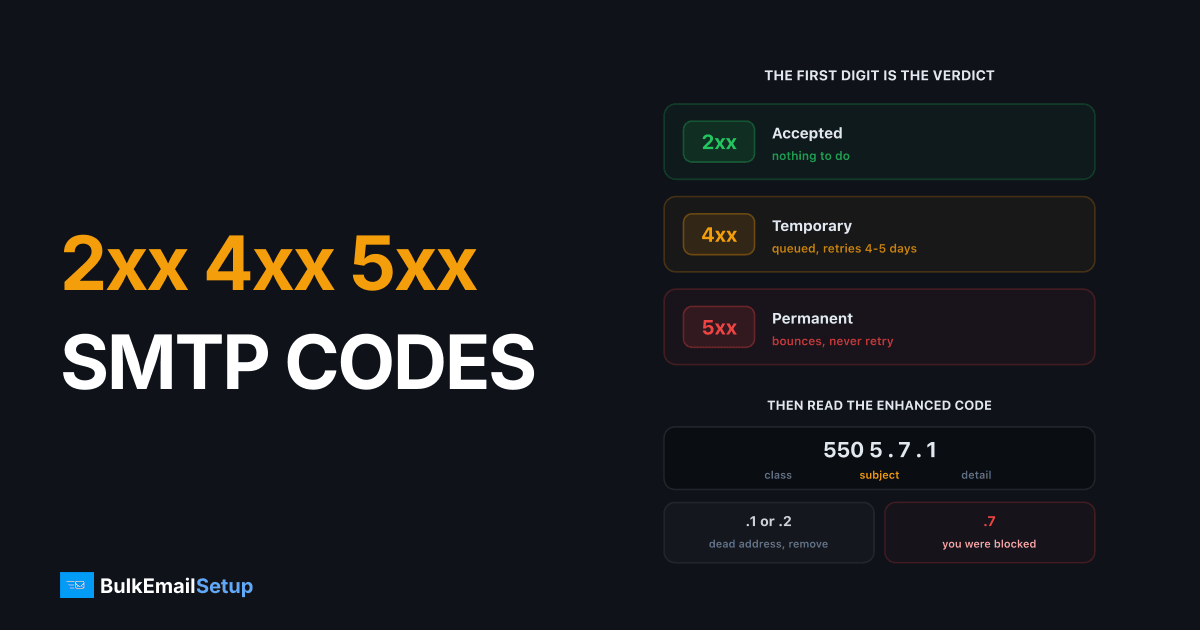
Every SMTP reply starts with 2, 4 or 5, and that first digit is the whole verdict. 2xx means accepted. 4xx means try again later, the message stays queued. 5xx means rejected permanently, the message bounces. There are 3xx codes too, but they only appear mid-conversation while the server waits for more input.
Get that one distinction right and most bounce handling becomes obvious.
The three classes
| Class | Meaning | What your server does | Called |
|---|---|---|---|
| 2xx | Accepted | Moves on, done | Success |
| 3xx | Send more data | Continues the transaction | Intermediate |
| 4xx | Temporary failure | Queues, retries for 4-5 days | Soft bounce |
| 5xx | Permanent failure | Gives up, bounces to sender | Hard bounce |
The practical rule: never retry a 5xx, never delete on a single 4xx. Both mistakes are common and both are expensive. Retrying 5xx responses looks like spam behaviour to receiving servers. Deleting on a first 4xx throws away subscribers whose mailbox happened to be full that morning.
What you will actually see at volume
The codes that matter in bulk sending, by how often they show up:
2xx   250 OK                    accepted, nothing to do
      251 forwarded

4xx   421 service unavailable   you are being throttled
      450 mailbox unavailable   temporary, often rate limiting
      451 local error           greylisting lives here
      452 insufficient storage  mailbox full, or too many recipients

5xx   550 mailbox unavailable   address dead, or you are blocked
      552 storage exceeded      message too large
      553 mailbox name invalid  bad address format
      554 transaction failed    content or reputation rejection
Two of these carry more weight than the rest. 421 at volume almost always means the receiving server is rate limiting you, not that it is broken. 550 is ambiguous by design: it covers both "this address does not exist" and "we are refusing your mail", and the text after the code is what separates them.
Reading the enhanced code
Modern servers add a three-part code after the basic one, defined in RFC 3463:
550 5.7.1 Message blocked
    │ │ │
    │ │ └── detail
    │ └──── subject: 7 = policy / security
    └────── class: 5 = permanent
The subject digit is the useful part:
| Subject | Means | Typical cause |
|---|---|---|
| .1 | Address problem | Recipient does not exist |
| .2 | Mailbox problem | Full, or disabled |
| .3 | Server problem | Receiving side is struggling |
| .4 | Network problem | Routing or DNS |
| .5 | Protocol problem | Bad command sequence |
| .7 | Policy or security | You were blocked |
So 5.1.1 is a dead address, a list hygiene issue. 5.7.1 is a block, a reputation issue. Same 5xx class, completely different response from you. Sorting your bounce log by the subject digit tells you in a minute whether you have a list problem or a reputation problem.
What to do with each
2xx. Nothing. Accepted is not the same as delivered to the inbox, though. A 250 followed by silence usually means the message landed in spam, which is a placement problem, not a delivery one.
4xx. Let the queue do its job. Retry timing backs off automatically, and the whole window is typically 4 to 5 days. If the same domain defers everything you send, you are being throttled and the fix is slower sending, not more retries. Details in why your email is stuck in the queue.
5xx. Remove the address immediately if the subject digit is .1 or .2. If it is .7, the address is fine and your sending reputation is the problem, so removing subscribers will not help. Work the IP or domain reputation instead.
Sorting bounces this way is the single highest-value thing you can do with your log, and most senders never do it.
The classic mistakes
- Treating every bounce as a hard bounce. Deleting on 4xx quietly shrinks your list by a few percent per send.
- Retrying 5xx responses. Some homegrown senders do this. Receiving servers read it as abuse.
- Ignoring the enhanced code. The basic 550 tells you almost nothing on its own.
- Not logging the text after the code. Providers put the actual reason there, often with a delisting URL.
How BulkEmailSetup helps
Bounce classification is part of the build, not something you wire up afterwards. We set up dedicated SMTP infrastructure with bounce and complaint handling that separates 4xx deferrals from 5xx rejections automatically, keeps list hygiene clean, and stops dead addresses quietly eroding your sender reputation.
Basic starts at $549 one-time, covering 1 SMTP server, 3 dedicated IPs, 25,000 emails/day and unlimited contacts. See pricing, or read SMTP bounce code classes for the deeper reference.
Frequently asked questions
What do 2xx, 4xx and 5xx mean in SMTP?
The first digit is the verdict. 2xx means the server accepted the command or the message. 4xx is a temporary failure, so the sending server queues the message and retries later. 5xx is a permanent failure, so the message is rejected outright and bounces back to the sender. There are also 3xx codes, used mid-transaction to say the server is waiting for more input.
Is a 4xx code a bounce?
Not yet. A 4xx is a deferral, meaning try again later. Your server keeps retrying on a back-off schedule, typically for 4 to 5 days. Only when that retry window expires does the message convert into a hard bounce. This is why 4xx codes are called soft bounces.
What is the difference between 5xx and 4xx?
4xx is temporary and retryable, such as a full mailbox or a rate limit. 5xx is permanent, such as an address that does not exist or a block on your IP. Retrying a 5xx is pointless and, if you keep doing it, receiving servers treat it as a spam signal.
Should I remove addresses that return 4xx codes?
Not on the first occurrence, because the failure is temporary by definition. Remove an address once repeated 4xx responses have exhausted the retry window and converted to a bounce, or if the same address defers on every send for weeks. Removing on a single 4xx throws away valid subscribers.
What does the second part of an SMTP code mean, like 5.7.1?
That is the enhanced status code, defined in RFC 3463. The first digit repeats the class (2, 4 or 5), the second is the subject (for example 7 means a security or policy problem), and the third is the specific detail. So 5.7.1 is a permanent failure caused by a policy rule, which usually means your mail was blocked rather than misaddressed.


