
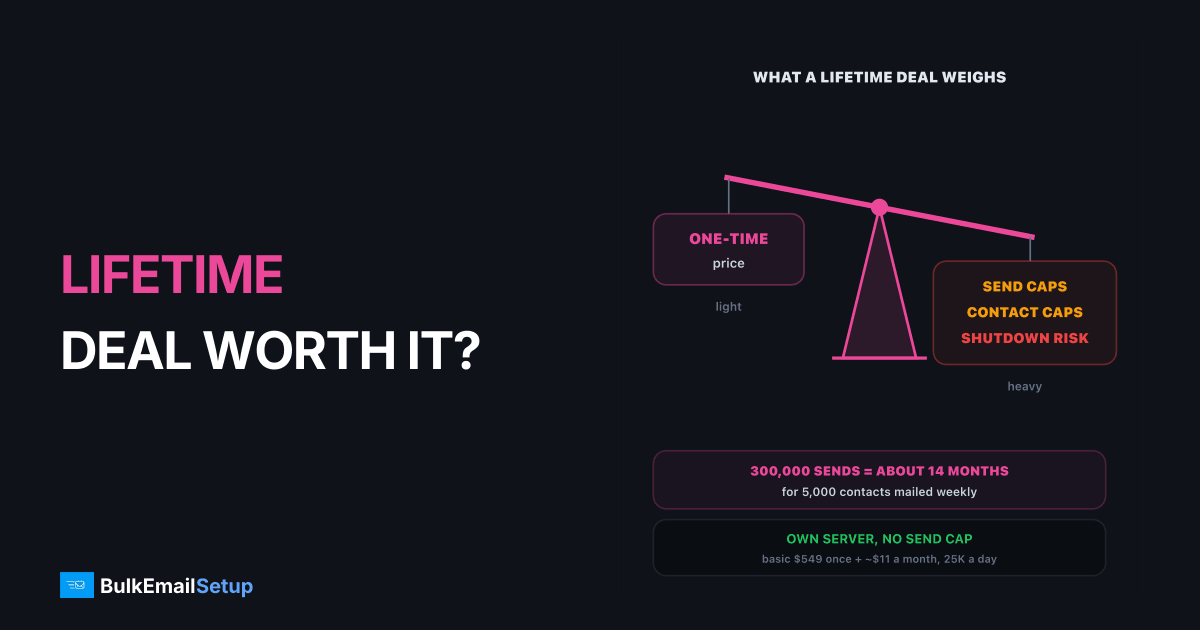
Lifetime deal email tools are worth it for small lists and light sending, and rarely worth it at volume. Nearly every deal caps something, usually contacts, monthly sends or a fixed number of lifetime sends, because a one-time payment cannot cover sending costs that repeat forever. "Lifetime" also means the life of the product, not yours. If you mail more than a few thousand people a week, the one-time purchase that holds up is a sending server you own.
What a lifetime deal actually buys
The headline price is the visible part. The terms underneath decide how long it lasts.
The price is the small part of a lifetime deal
| What the deal page shows | What to check in the terms |
|---|---|
| one-time price | lifetime send cap, or monthly send cap |
| "unlimited" something | which thing is unlimited, and which is not |
| contacts included | do unsubscribed or inactive contacts count |
| lifetime access | lifetime of the product, plan or code tier |
| stacking codes | whether old codes keep their limits when the vendor changes plans |
| refund window | how long, and what happens after it closes |
Why lifetime deals cap sending
Every email costs the vendor something on its sending infrastructure, its IPs and its abuse handling. A one-time payment covers none of that past year one. So deals ration it.
| Cap type | How it bites | Who hits it first |
|---|---|---|
| Lifetime sends | a fixed pool that never refills | weekly newsletters |
| Monthly sends | resets, but flat as the list grows | growing lists |
| Contacts | stops imports past the tier | lead-gen and ecommerce |
| Features | automations or API on higher tiers only | anyone scaling |
Buyers on AppSumo's own SendFox review pages describe reaching a lifetime send cap and being asked to move to a monthly subscription. Whatever the vendor's intent, that is the pattern to plan for.
The maths is simple. If a deal includes 300,000 lifetime sends and you mail 5,000 contacts weekly, you send about 21,650 a month, and the pool is gone in about 14 months.
| List size, weekly send | Sends a month | 300,000 lifetime sends last |
|---|---|---|
| 1,000 | ~4,330 | ~69 months |
| 5,000 | ~21,650 | ~14 months |
| 10,000 | ~43,300 | ~7 months |
| 25,000 | ~108,250 | ~3 months |
The lifecycle of a typical deal
Most deals feel generous in year one and tight by year two
None of this is a scam. Lifetime deals are a way for young products to raise cash and find users. It just means the deal is a bet on the vendor, not a purchase of a fixed thing.
Self-hosted software is a different kind of one-time buy
Some tools sell a one-time licence for software you install yourself. Sendy is the best-known: $69 one-time for one domain, with free updates until the next major version. MailWizz is sold on a similar one-time licence.
| Factor | Lifetime deal (hosted) | Self-hosted licence | Your own SMTP server |
|---|---|---|---|
| You pay once for | access to the vendor's app | the software | the setup |
| Send cap | usually yes | none from the software | your server's capacity |
| Who sends the mail | vendor, shared IPs | Amazon SES or your SMTP | your own IPs |
| If the vendor closes | sending stops | software keeps running | nothing changes |
| Monthly cost | none, until the cap | hosting plus sending | hosting only |
A self-hosted licence removes the vendor's cap, but you still need something to send through. That is where most people pair Sendy with Amazon SES or their own server. See Sendy SMTP setup and Sendy alternatives.
Questions to ask before you buy
Ask these on the deal page or in the vendor's own terms, and screenshot the answers. Terms that are not written down are the ones that change.
- Is there a lifetime send cap, a monthly send cap, or both? Get the number.
- Do unsubscribed, bounced or archived contacts count toward the contact limit?
- Does stacking codes raise every limit, or only some?
- What happens to old codes when plans change? Are they grandfathered, in writing?
- Which IPs does mail go out from? Shared pool, or is a dedicated IP available?
- Can you bring your own SMTP? If yes, the send cap matters far less.
- What is the refund window, and does it run from purchase or from activation?
Question 6 is the one most buyers skip. A tool that lets you plug in your own SMTP server turns into software you paid for once, with sending you control.
If your deal hits its cap
- Export everything now. Contacts, unsubscribes, bounces, tags and signup dates. Unsubscribes matter most: you are legally bound to keep honouring them.
- Do not buy a second code to buy time unless the terms say stacked codes raise the send cap.
- Price the monthly upgrade against a move. A monthly plan at your list size, over 3 years, versus a one-time setup and hosting.
- Move the sending first, the app second. If the tool allows your own SMTP, point it there and keep using the interface.
When a lifetime deal is the right call
- Small list, light sending. Under a few thousand contacts, a few sends a month.
- Side project or test. You want to learn email marketing before committing.
- You can afford to lose it. Treat the price as spent on day one.
When it is the wrong call
- Email is revenue. A cap or a shutdown stops income, not just a tool.
- The list is growing. Caps are flat, your list is not.
- You send weekly or more. Lifetime send pools empty fast.
- You need control over IPs and domains. Hosted deals send from shared pools.
How BulkEmailSetup helps
If what you want from a lifetime deal is to pay once and stop paying per contact, owning the server is the version without a cap. We set up a dedicated SMTP server you own, with a campaign platform, unlimited contacts, your own IPs and domains, and SPF, DKIM, DMARC and PTR done.
| Plan | One-time fee | Emails per day | 3-year cost with hosting |
|---|---|---|---|
| Basic | $549 | 25,000 | $549 + 36 x ~$11 = ~$945 |
| Advance | $1,199 | 200,000 | $1,199 + 36 x ~$49 = ~$2,963 |
There is no monthly fee to us, nothing for a vendor to switch off, and a 15-day money-back guarantee. Compare the numbers in one-time fee vs monthly email platform, or see Basic plan details and all pricing.
Frequently asked questions
Are lifetime deal email tools worth it?
For small lists and side projects, often yes: a one-time payment can cover a year or two of light sending. At volume, usually not. Most deals cap contacts or sends, the vendor can change terms or shut down, and you still send on shared IPs you do not control. Past a few thousand contacts mailed weekly, the caps tend to bite within the first year or two.
Why do lifetime deal tools cap sending?
Because every email costs the vendor money on its sending infrastructure, and a one-time payment does not cover a cost that repeats forever. Caps on lifetime sends, monthly sends or contacts keep heavy users from costing more than they paid. Buyers on AppSumo's own review pages report caps being added or enforced later, with an upgrade to a monthly plan offered as the fix.
What happens if a lifetime deal company shuts down?
Your lifetime ends with it. Lifetime means the life of the product, not yours. If the vendor closes, is sold, or stops honouring old codes, sending stops and you have to export and move. Marketplace refunds only cover a short window after purchase, so a shutdown in year two is usually a total loss of the deal price.
Is owning the server safer than a lifetime deal?
For volume senders, yes. With your own SMTP server you own the IPs, the domains and the software install, so no vendor can add a send cap or switch you off. The trade-off is that you pay hosting each month and someone must look after warm-up and list quality. BulkEmailSetup's Basic plan is $549 once plus about $11 a month of hosting for 25,000 emails a day.
Is Sendy a lifetime deal?
Sort of. Sendy is a one-time $69 licence for self-hosted software on one domain, with free updates until the next major version. It is not a hosted service, so there is no send cap from Sendy, but you still need hosting and a sending service such as Amazon SES or your own SMTP server, which you pay for as you send.
How long does a capped lifetime deal last for a weekly newsletter?
Work it out from the cap. If a deal includes 300,000 lifetime sends and you mail 5,000 contacts once a week, you send about 21,650 a month, so the sends run out in about 14 months. Double the list and it lasts about 7 months. A monthly or per-contact plan usually follows.


