
"Unlimited SMTP" is essentially never truly unlimited. The word almost always means unlimited within fair-use caps, rate throttles, and shared-pool limits that don't appear on the sales page. Even if a provider genuinely didn't cap you, Gmail, Yahoo, and Microsoft enforce their own per-IP rate limits, so no plan can deliver unlimited mail to real inboxes. What "unlimited" usually hides is a dirty shared pool where your reputation is at the mercy of strangers. What you actually want is capacity you control.
What does "unlimited SMTP" really mean?
"Unlimited SMTP" means unlimited sends within limits the provider doesn't advertise: fair-use policies, per-hour throttles, and shared-pool capacity that everyone draws from. The headline word sells the plan; the fine print and the mailbox providers enforce the real ceiling.
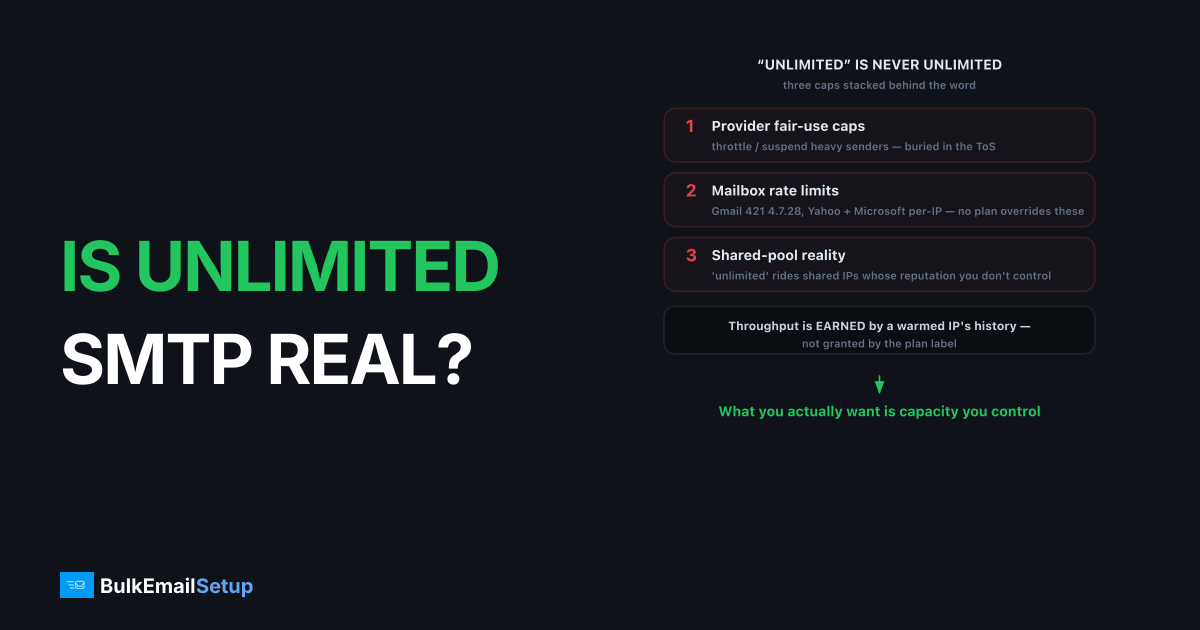
There are three caps stacked behind the word:
- Provider fair-use caps, buried in terms of service, that let them throttle or suspend heavy senders.
- Mailbox-provider rate limits, enforced by Gmail, Yahoo, and Microsoft per IP, which no SMTP plan can override.
- Shared-pool reality, where "unlimited" volume rides shared IPs whose reputation you don't control.
The honest version of "unlimited" is "we won't bill you per email, but we'll throttle you, and the inbox providers will too." That's a legitimate flat-rate model. The dishonest version implies you can fire-hose a million cold emails through a shared IP with no consequences, which is exactly how those pools end up on Spamhaus.
Why can't any SMTP plan be truly unlimited?
No SMTP plan can be truly unlimited because the receiving servers, not your provider, set the real limits. Gmail throttles per sending IP and returns 421 4.7.28 when you exceed its rate, a limit its bulk sender guidelines make explicit. Yahoo defers with temporary 421s. Microsoft applies its own per-IP ceilings. Your provider can promise unlimited; the inbox still says no.
These limits scale with IP reputation, not with what you paid. A warmed dedicated IP with a year of clean history earns higher ceilings than a fresh or shared one. That's the mechanism: throughput is earned through history and good metrics, and you can read the per-provider numbers in how many emails per day per IP.
"Unlimited SMTP" cannot bypass mailbox-provider rate limits: Gmail returns 421 4.7.28 when a sending IP exceeds its per-IP rate, and Yahoo and Microsoft enforce similar per-IP ceilings (provider postmaster documentation, 2026). Throughput scales with the reputation of a warmed IP, not with the plan label, so true unlimited delivery to real inboxes does not exist.
What's the hidden risk in cheap unlimited plans?
The hidden risk is the shared pool. Cheap unlimited SMTP plans route your mail through shared IPs where spammers churn in and out, and you inherit whatever blocklist hits and low reputation they leave behind. Your deliverability becomes a function of strangers' behavior, not your own.
We've seen a sender on a cheap unlimited plan watch inbox rates drop from 95% to 12% overnight, with no change to their own sending. A poolmate had triggered a Spamhaus CSS listing, and everyone on that IP range took the hit. There was nothing the sender could do but wait in a provider queue.
The trade-off behind "unlimited" pricing:
| What you get | What you give up |
|---|---|
| No per-email billing | A reputation you control |
| Simple flat price | Visibility into who shares your IP |
| Easy signup | Protection from poolmates' blocklist hits |
| "Unlimited" marketing | Honest throughput expectations |
This is the same dynamic we cover in dedicated IP vs shared IP for email. Shared is fine when the operator polices the pool. "Unlimited" providers rarely do, because policing pools is the opposite of selling unlimited volume.
What should you buy instead?
Buy capacity you control instead of a word. A dedicated IP, full SMTP access, correct authentication, and a flat plan sized to your real volume gives you a reputation nobody else can wreck. You lose the "unlimited" label and gain the thing that actually determines inbox placement at scale.
The honest pitch: a dedicated IP needs a 4 to 6 week warm-up and consistent sending above ~50K/month to hold its reputation. That's a real cost "unlimited" plans hide from you by never warming anything. But once warmed, your throughput is yours, your blocklist status is your own doing, and no poolmate can sink you. For the cost angle, see hidden costs of ESP overage fees.
How do you spot the catch in an "unlimited" plan?
Spot the catch by reading the fair-use clause in the terms of service and asking two direct questions: is the IP shared, and what's the per-hour or per-day throttle. If the answer to the first is yes and the answer to the second is vague, "unlimited" means "shared and throttled," which is the version that risks your deliverability.
The questions that reveal the real plan:
- Is my sending IP shared or dedicated? Shared means you inherit poolmates' reputation.
- What's the fair-use cap? There's always one; ask for the number.
- What are the per-hour rate limits? Real throughput is gated here, not by the word unlimited.
- Who else is on my IP, and do you police abusers? Unpoliced pools end up on Spamhaus blocklists fast.
In the "unlimited" plans we've examined, the fair-use clause and a shared-pool architecture are nearly universal. The plans that genuinely don't meter per email almost always run shared IPs, because dedicated infrastructure at true unlimited volume isn't economical to give away. The word and the architecture are in tension, and the architecture wins.
A pattern we've watched repeatedly: the "unlimited" plan is fine right up until a real launch. One sender pushed roughly 80K in a single evening on an unlimited shared plan and got a same-night account review email, sending paused, because that burst tripped the fair-use clause buried in section 9 of the terms. The cap was never a number on the pricing page. It was a human reading a queue and deciding 80K from a low-tier account looked like abuse.
What's the realistic throughput you can actually get?
Realistic throughput is governed by your IP's reputation and the receiving providers' per-IP limits, not by your plan. A warmed dedicated IP with clean history might sustain tens of thousands of sends per hour to a major provider; a fresh or shared IP gets throttled far lower, with 421 deferrals when it pushes too hard.
What actually sets your ceiling:
| Factor | Effect on throughput |
|---|---|
| IP reputation | Higher reputation, higher per-IP limits |
| Warm-up status | Fresh IP starts at ~50 to 100/day |
| Shared vs dedicated | Shared inherits the pool's ceiling and risk |
| Complaint rate | Above 0.3% triggers throttling and blocks |
| Consistency | Steady volume earns higher limits over time |
The honest takeaway: no plan label raises these ceilings. You earn throughput through a warmed IP and clean metrics, which is exactly what a controlled dedicated setup is built to give you. We map the per-provider numbers in how many emails per day per IP.
How do you size capacity instead of chasing "unlimited"?
Size capacity off your real peak send, not a marketing word. Most senders don't need unlimited; they need enough headroom to clear their busiest hour without deferrals. Once you know your peak per-hour and per-day volume, you can pick a plan and a warmed IP that comfortably covers it, which is a concrete number instead of a promise.
A practical sizing pass:
- Find your peak hour, the single busiest sending window you actually hit, not your daily average.
- Check the per-IP ceiling at your main receiver. A warmed IP's safe throughput is covered in how many emails per day per IP.
- Divide peak volume by IP capacity to see whether one warmed IP clears it or you need more.
- Add warm-up lead time, since a fresh IP starts at ~50 to 100/day and ramps over 4 to 6 weeks.
| If your peak is | What you likely need |
|---|---|
| Under ~50K/month | A quality shared or single dedicated IP |
| 50K - 500K/month | One warmed dedicated IP |
| 500K - several M/month | Multiple dedicated IPs, possibly split by stream |
| Bursty launches | Headroom IPs warmed ahead of the spike |
"Unlimited" is a non-answer to a sizing question. The useful question is never "can I send infinite mail" but "can this setup clear my peak hour to Gmail without 421 deferrals." That's measurable, and a controlled dedicated setup gives you a real number to plan against instead of a word that evaporates under load. For the cost angle of the same decision, see hidden costs of ESP overage fees.
How BulkEmailSetup helps
Instead of selling you "unlimited," we give you capacity you actually control: a dedicated IP, full SMTP access, and SPF, DKIM, DMARC, and PTR configured correctly, on a flat monthly plan. We warm the IP and monitor reputation so your throughput grows on real history, not marketing words. See plans on our pricing page.
Frequently asked questions
Is unlimited SMTP actually unlimited?
Almost never. "Unlimited" usually means unlimited within fair-use caps, rate throttles, and shared-pool limits that aren't on the sales page. The mailbox providers also cap you per IP regardless of what your SMTP provider promises, so true unlimited sending doesn't exist.
Why do unlimited SMTP providers throttle me?
Because the real limits come from Gmail, Yahoo, and Microsoft, not your provider. Each enforces per-IP rate limits, so even an "unlimited" plan has to throttle to avoid deferrals like 421 4.7.28. The plan can be unlimited on paper and still capped in practice.
Is cheap unlimited SMTP bad for deliverability?
Often, yes. Many cheap unlimited plans run dirty shared pools where spammers churn, so you inherit their blocklist hits. The reputation you send from is shared with strangers you can't see, which is the real risk hiding behind the word unlimited.
What should I buy instead of unlimited SMTP?
Buy capacity you control: a dedicated IP, full SMTP access, and a flat plan sized to your real volume. You give up the word unlimited and gain a reputation that's yours alone, which is what actually determines whether your mail inboxes at scale.


