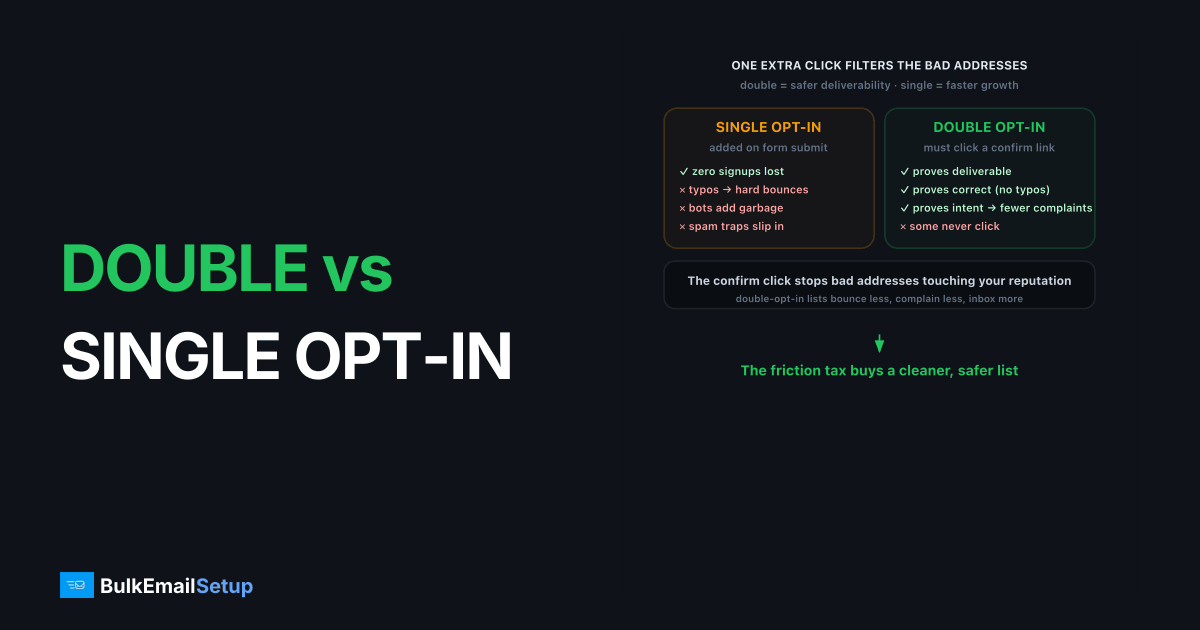
Double opt-in is the safer choice for deliverability, and single opt-in is the faster choice for list growth. With single opt-in, a subscriber is added to your list the moment they submit the form. With double opt-in, they receive a verification email first and join only after clicking the confirmation link. That extra click filters out typos, bots, and spam traps before they ever touch your sender reputation, which is why double opt-in lists tend to bounce less, complain less, and inbox more often.
What is single opt-in?
Single opt-in is a signup method where the address is added to your list immediately on form submission, with no confirmation step. Someone types an email, clicks subscribe, and they're in. No verification message, no waiting. It's the lowest-friction way to grow a list, and it captures every address that hits the form, including the ones that should never have made it through.
The upside is obvious: zero people lost between intent and subscription. Nobody forgets to confirm. Nobody's confirmation email lands in spam and gets missed.
The downside is what you can't see. A single fat-fingered gmial.com becomes a hard bounce. A bot filling forms adds garbage. And recycled spam traps, old addresses mailbox providers reactivated to catch careless senders, slip straight onto your list because nobody proved a human was on the other end.
What is double opt-in?
Double opt-in is a signup method where a subscriber must confirm their address before being added to your list. After they submit the form, you send a verification email with a unique confirmation link. They click it, and only then do they join. No click, no subscription. This single extra step is the difference between "someone typed an address" and "a real person, at a real inbox, asked to hear from you."
That confirmation does three things at once. It proves the address is deliverable, the email reached an inbox and someone opened it. It proves the address is correct, typos and throwaway addresses rarely confirm. And it proves intent, which is your strongest defense against complaints later. The trade-off is that some people never click. They get distracted, the confirmation lands in Promotions, or they simply lose interest. That's the friction tax double opt-in charges in exchange for a cleaner list.
Single opt-in vs double opt-in compared
The two methods diverge on every metric that matters for sending at volume. The table below lays out the trade-off across list growth, deliverability risk, spam-trap exposure, legal standing, and signup friction.
| Factor | Single opt-in | Double opt-in |
|---|---|---|
| List growth speed | Faster, every submission counts | Slower, unconfirmed signups drop off |
| Deliverability risk | Higher, unverified addresses inflate bounces | Lower, confirmed addresses bounce less |
| Spam-trap exposure | Higher, traps join unfiltered | Much lower, traps rarely confirm |
| Typos and bots | Land on the list directly | Filtered out before joining |
| Complaint rate | Higher, weak intent and recipient surprise | Lower, recipients chose to confirm |
| GDPR / consent proof | Weaker audit trail | Strong, click is provable evidence |
| Signup friction | Minimal | One extra step, some attrition |
| Best fit | Low-risk lists, high-intent buyers | Cold-acquired, EU, or high-volume lists |
Notice the pattern. Single opt-in wins the column nobody gets blocked for (raw growth) and loses every column that affects whether your mail reaches the inbox.
Why double opt-in protects deliverability
Mailbox providers judge you on behavior, not intentions. Gmail and Yahoo's bulk sender rules ask senders mailing 5,000+ per day to keep spam complaints under 0.3%, ideally under 0.1%, alongside valid SPF, DKIM, and DMARC. Double opt-in attacks the inputs to those numbers directly: fewer bad addresses means fewer bounces, and confirmed intent means fewer complaints.
Spam traps are the clearest example. A recycled trap is a dead address a provider brought back to life specifically to flag senders who don't clean their lists. A pristine trap is an address that was never valid and only ever appears where addresses are scraped or mistyped. Neither will ever click a confirmation link, so double opt-in keeps almost all of them off your list. Single opt-in lets them straight in, and one trap hit can tank inbox placement for an entire campaign.
We have onboarded senders whose single opt-in forms had no confirmation and no bot protection, and the damage was visible in the first send. One list of about 40,000 single opt-in addresses came in with a 9% hard bounce rate on the first campaign, mostly typo domains like gmial.com and hotmial.com that a confirmation step would have caught at the door. The same brand's older double opt-in segment bounced under 0.5%. Same sender, same content, two lists built differently.
Bounces tell the same story. A typo'd domain is a guaranteed hard bounce, and a high bounce rate is one of the fastest ways to look like a spammer. Double opt-in catches the typo at the door. If you're already mailing a list built without confirmation, pair this with an email list cleaning guide to remove the dead weight before it costs you.
When single opt-in is the right call
Single opt-in isn't reckless by default. The risk depends entirely on where your addresses come from. The cleaner and more intentional the source, the less a confirmation step adds.
- High-intent, post-purchase signups. A customer who just bought from you and checked a box is low-risk. The address is already validated by the transaction.
- Lead magnets you deliver by email. If the confirmation link and the freebie are the same click, you're effectively running double opt-in anyway.
- Tightly controlled internal lists. Employee or member lists where every address is known and verified elsewhere.
The danger zone is cold or scraped acquisition: paid lists, scraped contacts, co-registration, anything where you can't vouch for the source. There, single opt-in is how spam traps and angry strangers end up on your list. For that profile, double opt-in isn't optional, it's damage control. Whichever method you pick, your sender reputation ultimately decides where the mail lands.
How BulkEmailSetup helps
Opt-in method shapes your list quality, but your sending infrastructure decides what happens to a clean list once you press send. We provision dedicated SMTP servers with a dedicated IP you control, SPF, DKIM, DMARC, and PTR configured correctly, and warm-up guidance so your confirmed subscribers actually see your mail in the inbox. A confirmed list on a clean, well-authenticated IP is the combination mailbox providers trust. See our pricing page for plans.
Frequently asked questions
What is the difference between single and double opt-in?
Single opt-in adds someone to your list the instant they submit the form. Double opt-in adds them only after they click a confirmation link in a verification email. Double opt-in proves the address is real, deliverable, and genuinely wanted.
Does double opt-in improve deliverability?
Yes, indirectly but reliably. By confirming each address before it joins your list, double opt-in filters out typos, fake addresses, and many spam traps. That keeps bounce and complaint rates low, which mailbox providers reward with better inbox placement.
Is double opt-in required by GDPR?
GDPR does not explicitly mandate double opt-in. It requires provable, freely given consent, and a confirmation click is the cleanest evidence you can keep. Many EU-focused senders use it precisely because the audit trail is hard to dispute.
Does single opt-in grow my list faster?
Usually yes. You capture every submitted address with no confirmation step to lose people. But some of those addresses are typos, bots, or spam traps, so part of that extra growth is reputation risk rather than real subscribers.