
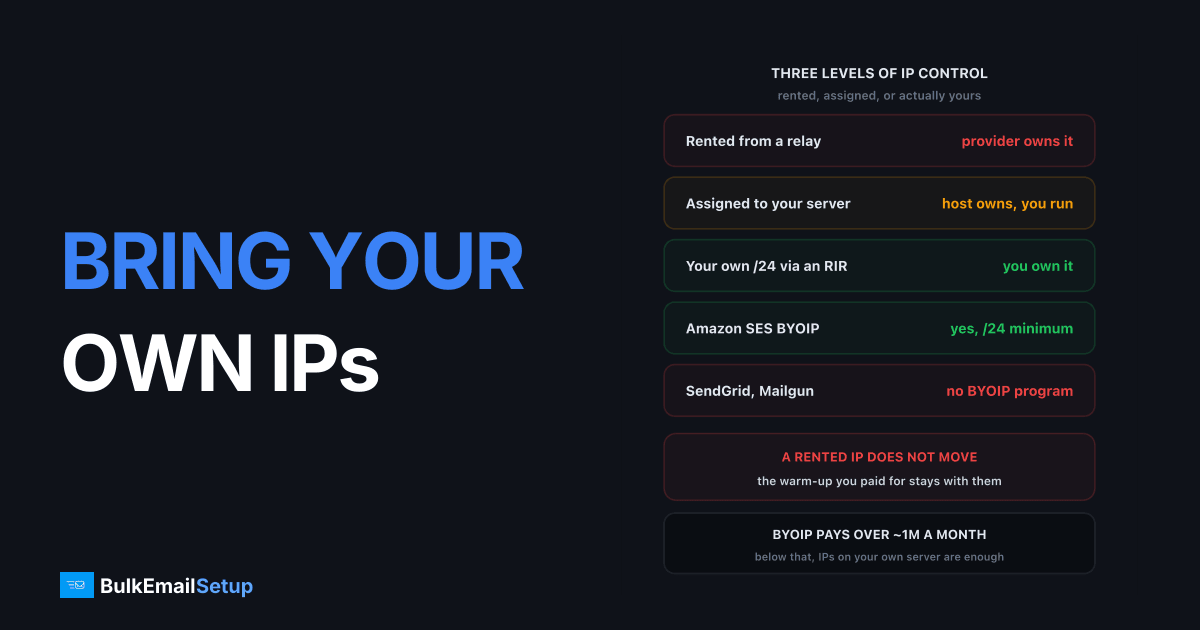
On shared relays the answer is almost always no. Amazon SES is the notable exception: its BYOIP feature accepts a full /24 (256 addresses) registered with an RIR to a business entity, with a clean history, for a monthly fee per address. Getting your own /24 in the first place costs roughly $9,000 to $14,000 on the IPv4 transfer market plus around EUR 1,550 a year for LIR membership. Below about 5 million emails a month, none of that pays for itself, and a dedicated IP that comes with a server does the same job.
The question people ask is "can I bring my own IPs." The question they actually mean is "do I have to start from zero every time I change providers." Those are different problems with different fixes, so let me separate them.
The three levels of IP ownership
Almost every argument about BYOIP falls apart because people mix up three very different arrangements. Here they are, from least to most yours.
| Level | What it is | Who owns it | Who controls it |
|---|---|---|---|
| Rented from a relay | A dedicated IP add-on at SendGrid, Mailgun or SES | The provider | The provider, you get PTR by request |
| Assigned to your server | An IP that comes with a VPS or dedicated box at Hetzner, OVH, DigitalOcean | The host | You, day to day: PTR, rDNS, HELO |
| Your own block via an RIR | A /24 registered to your company at ARIN, RIPE NCC or APNIC | You | You, and it moves between networks |
Level 1 is what most senders have. Level 2 is what a self-hosted or managed dedicated SMTP setup gives you. Level 3 is the only one that is genuinely "your IP" in the sense a lawyer would recognise.
The gap between level 2 and level 3 is smaller in daily operation than people expect and larger in the one scenario that matters, which is leaving.
Why most providers refuse BYOIP
Every shared relay I've asked has said no, and their reasons are consistent. Two of them are good reasons.
They cannot vouch for the history. An IP block has a past. It might have been a spam operation's block three years ago, sitting on UCEPROTECT level 2 and half a dozen private blocklists nobody publishes. The provider inherits that mess the moment they announce your range from their network, and their other customers' ranges sit in the same neighbourhood.
It breaks pool management. A relay's whole model is moving traffic between IPs based on live reputation. If your addresses are pinned to your account and cannot be swapped, rebalanced or retired, you are a special case in a system designed to have none. Support cost goes up, automation goes down.
The third reason is commercial. Dedicated IP add-ons at $24.95 to $59 a month are pure margin. A customer who brings their own is one they cannot upsell.
| Provider | BYOIP on their SMTP product | What they sell instead |
|---|---|---|
| Amazon SES | Yes, manual dedicated IPs only, /24 minimum, per-request approval | Standard dedicated IPs at $24.95 per IP per month |
| SendGrid | No public BYOIP program | Dedicated IP add-on, ~$30 per IP per month on Pro |
| Mailgun | No public BYOIP program | Dedicated IP add-on, ~$59 per IP per month |
| Postmark | No | Dedicated IP add-on, $50 per month |
| Mailchimp, Brevo, Klaviyo | No | Dedicated IP on higher tiers or not at all |
| Your own server at a host | Not applicable, IPs come with the box | Hosting, IPs included |
I've listed only what these vendors publish. If a provider does not document a BYOIP program, assume there isn't one, because a program like this needs legal paperwork and a documented process to exist at all.
What Amazon SES actually requires
SES publishes its conditions, and they are stricter than most people expect. Straight from the SES BYOIP documentation:
| Requirement | The rule |
|---|---|
| Minimum block | A full /24, 256 addresses. Individual IPs cannot be transferred |
| Registration | Registered with an RIR (ARIN, RIPE NCC, APNIC) to a business or institution, never a person |
| Proof | A signed authorization message proving you own the range |
| History | Clean. AWS investigates and reserves the right to reject a range with poor reputation |
| Overlap | The range cannot already be in another AWS service such as EC2 |
| Region | One AWS Region per range, five ranges maximum per Region |
| Shared pool | Once you use BYOIP, you lose access to the SES shared IP pool in that Region |
| IP type | Manually configured dedicated IPs only, not Dedicated IPs (managed) |
| Cost | A monthly charge per BYOIP address, on the SES pricing page |
You email the request in and AWS responds within 48 business hours. It is a review, not a form submission, and the stated purpose is stopping their platform being used for unsolicited mail.
Read the second requirement again. "Registered to a business or institutional entity and can't be registered to a person" rules out most individual senders before anything else. So does the /24 floor, because you cannot buy 4 addresses and bring those.
What it takes to get your own block
Assume you want level 3. Here is the actual path, and none of the steps are optional.
- Become an LIR or work through one. At RIPE NCC that means membership, roughly EUR 1,550 a year plus a one-time sign-up fee. ARIN charges annual registration fees on a similar scale. Some sponsoring LIRs will hold the resource for you for a few hundred a year instead.
- Get the IPv4 space. There is no free pool left. RIPE hands out at most a /24 from a waiting list that has run years long, so in practice you buy on the transfer market at roughly $35 to $55 per address, which is $9,000 to $14,000 for a /24.
- Get an ASN if you need one. Free to cheap at the registry level, but you only need it if you announce the block yourself or want it portable across hosts. If one host announces it for you, skip it.
- Sign ROAs under RPKI. A Route Origin Authorisation says which ASN may announce your prefix. Plenty of large networks now drop routes that fail RPKI validation, so an unsigned prefix is partially unreachable rather than merely untidy.
- Find a network that will announce it. Not every host does BGP for customer prefixes. The ones that do usually want a commit, a signed LOA, and a technical contact who can answer questions about your routing.
Realistic timeline: 6 to 12 weeks from decision to first packet, most of it waiting on the transfer and the RIR paperwork.
Note what step 5 means. Owning the block does not make it reachable. Somebody with a network still has to announce it, and if they drop you, your mail stops until another network picks it up.
The reputation portability question
This is the real reason people ask about BYOIP, so here it is plainly.
| Scenario | What happens to your warm-up |
|---|---|
| Leave SendGrid, dedicated IP included | The IP stays with SendGrid. You start cold at the next provider |
| Leave a VPS host, IP came with the box | The IP goes back to their pool, often to another customer within days |
| Leave a network, block registered to you | You keep the addresses. Reputation carries, only the route changes |
Six to eight weeks of warm-up at 30% ramp every two days is real work and real deferrals. Doing it twice because you changed vendors is the cost people are trying to avoid.
But be honest about the size of that cost. A warm-up is 4 to 8 weeks of reduced volume, once, at a provider change you might make every three years. Against $9,000 to $14,000 plus EUR 1,550 a year, the maths only works if you are switching often or your sending is large enough that eight weeks at reduced volume is a six-figure revenue hole.
There is a second, quieter benefit. An IP registered to your company cannot be taken away by a provider's policy team over a use case they decided they no longer like. If you have been shut down mid-campaign before, you already know what that is worth.
The cost comparison across all three levels
Twelve months, three dedicated IPs' worth of sending capacity, so it is like for like.
| Line item | Rented from relay | Server with assigned IPs | Your own /24 |
|---|---|---|---|
| Up-front | $0 | $549 one-time (BulkEmailSetup Basic) | $9,000-14,000 for the block |
| Annual registry fees | $0 | $0 | ~EUR 1,550 LIR, or a few hundred via a sponsor |
| Monthly IP cost | $75-177 for 3 IPs | $0, included | $0, or SES BYOIP per-address fee |
| Hosting or plan | $35-90 a month plan gate | ~$40-120 a month server | ~$100-300 a month for a BGP-capable host |
| Setup time | 1 day | 3-7 days | 6-12 weeks |
| Year 1 total | $1,320-3,200 | ~$1,100-2,000 | $12,000-20,000 |
| Value if you leave | $0 | $0 | The block, still worth $9,000+ |
The last row is the only one that argues for level 3 on money. IPv4 addresses have held value for a decade, so a /24 is closer to an asset than an expense. That is a treasury argument, not a deliverability one, and I'd rather you decide it as such.
When BYOIP is genuinely worth it
Four situations, and I've seen all four work.
- Sustained volume above 5 million a month. At that scale eight weeks of warm-up costs more than the block, and you probably need multiple IPs anyway.
- You resell sending. An ESP with customers on your infrastructure cannot afford to re-warm the whole platform because an upstream vendor changed terms. SMTP infrastructure for ESPs reselling email covers the pool segmentation that goes with it.
- You have been shut down before. If a provider's policy team has killed your sending once over a legitimate use case, owning the addresses removes that specific risk permanently.
- You already run network infrastructure. If you have an ASN, a BGP session and someone who understands RPKI, the marginal cost is paperwork rather than a new capability.
And when it is not worth it, which is most of the time:
- Under about 5 million emails a month. The setup cost exceeds the value of the warm-up you are protecting, by a lot.
- You want better delivery. A fresh /24 has no reputation. It warms up exactly like a rented IP, over the same 4 to 8 weeks. Ownership buys portability, not inbox placement.
- You do not have a business entity. RIRs and AWS both require one. This is a hard stop, not a hurdle.
- You cannot fill the addresses. A /24 is 256 IPs and each one needs roughly 1,000 to 2,000 emails a day to hold a reputation. Most senders can keep 3 to 5 warm, not 256.
That last point deserves emphasis. You do not have to announce all 256, and nobody does. But if you bought a /24 to use 4 addresses, you spent $12,000 to solve a $549 problem. Work out how many IPs your volume can actually keep warm before anything else, and dedicated IP vs shared IP plus do you need a dedicated IP will get you to that number.
The decision, in order
Run these four questions top to bottom and stop at the first no.
| Question | If no |
|---|---|
| Are you sending over 5 million a month, sustained? | Buy a server with dedicated IPs. Stop here |
| Do you have a registered business entity? | You cannot hold RIR resources. Stop here |
| Can you spend $12,000-20,000 in year one? | Level 2 gives you 90% of the benefit for 5% of the cost |
| Do you have or can you hire BGP and RPKI skills? | Find a host that announces for you, or stop here |
Most people reading this stop at the first row, and that is the correct answer, not a consolation. A dedicated IP assigned to a server you control gives you your own PTR, your own reputation, nobody else's complaints on your addresses, and no shared-pool policy team. The only thing it does not give you is the ability to walk out with the addresses.
How BulkEmailSetup helps
We build dedicated SMTP infrastructure at level 2: your own server, your own dedicated IPs, full SPF, DKIM, DMARC and PTR configuration, MTA tuning, bounce handling and a warm-up schedule that matches your list, not a generic curve. Nobody else sends from those addresses and no policy team decides whether your use case is too risky for other customers on a pool.
Basic is $549 one-time, covering 1 SMTP server, 3 dedicated IPs, 25,000 emails/day and unlimited contacts. Higher tiers scale to 15 IPs and 200,000 emails/day. See pricing. If you get to the volume where owning a /24 makes sense, you will already have the warm-up process and the monitoring in place to use it.
Frequently asked questions
Can I bring my own IPs to an SMTP provider?
On shared relays like Mailchimp, Brevo or Postmark, no. Amazon SES is the main exception: its BYOIP feature accepts a full /24 registered with an RIR to a business entity, with a clean history, and charges a monthly fee per address. Most other providers refuse because they cannot verify the block's sending history and it breaks their IP pool management.
What does Amazon SES require for BYOIP?
A full /24 (256 addresses) registered with a Regional Internet Registry such as ARIN, RIPE NCC or APNIC, registered to a business or institution rather than a person, plus a signed authorization message proving ownership and a clean reputation history. The range works in one AWS Region only, up to five ranges per Region, and it cannot already be brought into another AWS service like EC2.
How much does it cost to get your own IP block?
Budget $6,000 to $12,000 to start. An IPv4 /24 on the transfer market runs roughly $9,000 to $14,000 at $35 to $55 per address, an LIR membership at RIPE NCC is around EUR 1,550 a year, and an ASN plus RPKI setup adds a few hundred. Renting a /24 instead costs roughly $200 to $400 a month with no exit value.
Does IP reputation move with me if I switch providers?
Only if you own the IP. A dedicated IP you rent from SendGrid or Mailgun stays with them when you leave, so the 6 to 8 weeks of warm-up you paid for evaporates and you start cold. An IP block registered to your own company keeps its reputation because the address itself never changes, only the network announcing it.
At what volume is BYOIP worth it?
Roughly 5 million emails a month and above, sustained. Below that the $8,000 to $15,000 setup and the ongoing RIR and engineering overhead cost more than the warm-up you are trying to protect. Under 5 million a month, dedicated IPs that come with a server give you the same delivery for a fraction of the money.
Do I need an ASN to use my own IP block?
Not always. If a hosting provider will announce your block for you under their ASN, you skip it. If you want the block portable between networks or you announce it yourself, you need your own ASN, which is a separate RIR request and roughly EUR 50 to $550 depending on the registry. Either way you need ROA records signed under RPKI or many networks will not accept the route.
Is a rented IP at a VPS host the same as owning one?
No. An IP assigned to your Hetzner or OVH server is controlled by you day to day, so you set PTR and rDNS and nobody else sends from it, but the host still owns the registration. Cancel the server and the IP goes back into their pool and to another customer, taking your reputation with it. That is the middle level, not ownership.
Will my own IP block deliver better than a provider's dedicated IP?
No, not on day one. A fresh /24 you bought has no reputation at Gmail or Microsoft and warms up exactly like any other new IP, over 4 to 8 weeks. Ownership buys portability and independence from provider policy, not a delivery advantage. The delivery advantage comes from list quality and authentication, which are the same either way.


