
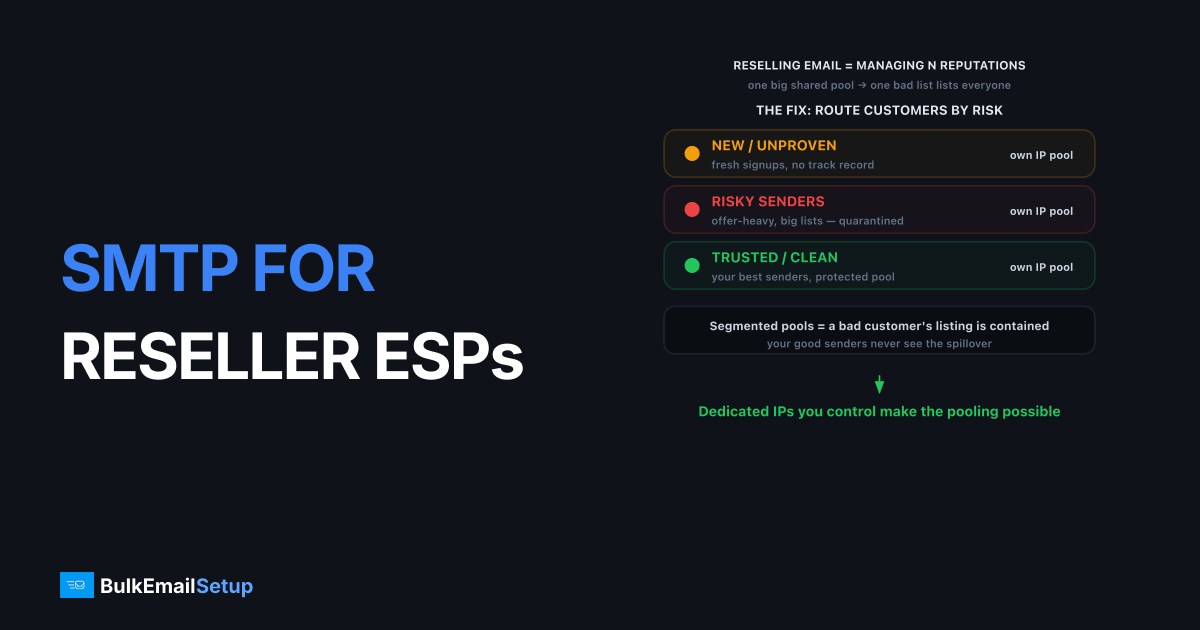
SMTP infrastructure for ESPs reselling email centers on dedicated IPs you control, segmented IP pools, white-label sending, and per-customer reputation monitoring, so you can profitably resell sending without one bad customer torching the whole platform. When you resell email, you are renting reputation to people whose sending you do not fully control. The infrastructure has to let you isolate risk, contain damage, and protect your good senders. Get the pooling and isolation right and you run a stable business; get it wrong and one spam run lists your IPs and every customer suffers.
Reselling email is a reputation-management business wearing a sending-platform costume. The product your customers actually buy is inbox placement, and inbox placement is reputation. Your job is keeping that reputation clean across a roster of senders with mixed habits.
Why reselling email is a reputation problem
Reselling email is fundamentally a reputation problem because your platform's deliverability is the sum of every customer's sending behavior, and you cannot fully control any of it. One customer importing a dirty list can generate enough complaints and spam-trap hits to get a shared IP listed on Spamhaus, and suddenly every customer on that IP sees 550 5.7.1 rejections. The challenge is structural: shared upside, shared downside.
The risks you have to manage:
- Contagion. Without segmentation, one bad sender's blocklist hit spreads to everyone on the same IP.
- New-customer uncertainty. A new signup has no track record, so you cannot trust them on your best pool.
- Complaint thresholds. Gmail and Yahoo enforce a 0.3% complaint ceiling per sender identity, set out in Gmail's bulk sender guidelines, and a careless customer blows past it.
- Delisting overhead. Every listing is your operations team's problem to resolve, fast.
The answer is not one big shared pool. It is many controlled pools with customers routed by risk, which only dedicated IPs you control make possible.
Shared upstream vs your own dedicated IPs
Many would-be ESPs start by reselling on top of a shared upstream provider, then hit a wall. Here is why owned dedicated IPs change the business.
| Factor | Reselling a shared upstream | Your own dedicated IPs |
|---|---|---|
| Reputation control | None (upstream owns it) | Full |
| IP pool segmentation | Not possible | Yours to design |
| Isolating bad customers | No | Yes, per pool |
| White-label DKIM | Limited | Full |
| Delisting control | Upstream's queue | You control it |
| Margin model | Their pricing + markup | Flat cost, your pricing |
| Customer trust | Borrowed | Owned |
With your own IPs, you can segment, isolate, and price freely. The dedicated IP versus shared IP economics that matter to a single sender matter even more when you are managing reputation for dozens.
How to segment IP pools for resale
IP pool segmentation is the core technique that keeps a reselling ESP alive: you group customers by reputation and risk, then route them onto separate dedicated IPs so damage stays contained. A single contaminated pool should never be able to take down your whole platform. Good segmentation is the difference between a bad week and a dead business.
Tier customers by risk
Put established, clean senders on your best, most-warmed pools. Route new customers and high-risk verticals onto separate starter pools where their early mistakes cannot hurt anyone else. As a customer proves clean sending over time, promote them to better pools. This tiering is your main defense.
Monitor reputation per customer
Track complaint rate, bounce rate, and blocklist status per customer, not just per platform. Tools like Google Postmaster Tools and feedback loops give per-stream signals. Catch a customer trending toward a 0.3% complaint rate before they trip a block, and you can intervene instead of cleaning up after.
Authenticate every customer correctly
Each customer needs aligned SPF and DKIM on their own sending domains, white-labeled under your brand. Misaligned authentication triggers 550 5.7.26 and drags reputation down. Our SPF, DKIM, and DMARC guide covers the per-domain setup you replicate for every customer you onboard.
Common mistakes that sink reselling ESPs
The failures that kill reselling platforms are operational, not technical, and they almost always trace to skipping the unglamorous policing work. ESPs that enforce standards from day one keep their pools clean and their margins intact, while those that chase signups without vetting them watch one bad customer list a whole pool. The recurring traps are predictable.
- One big shared pool. Without segmentation, a single dirty importer lists the IP and every customer eats
550 5.7.1rejections. Tier customers across pools from the start. - Trusting new signups on good IPs. A customer with no track record on your best pool is a gamble. Start everyone on a starter pool and promote on proven behavior.
- No per-customer monitoring. Watching only platform-level metrics hides the one customer trending toward a 0.3% complaint rate. Monitor each sender's complaints, bounces, and blocklist status.
- Weak onboarding checks. No list-source verification or sending-policy agreement invites exactly the customers who burn pools. Vet before you provision.
Build the suspension and isolation tooling before you need it. When a customer's complaints spike at 2am, you want an automated route to a quarantine pool, not a manual scramble while the rest of your platform's reputation slides. The pattern we see most often with new resellers: one importer uploads a purchased list of 80K addresses, the shared pool's complaint rate crosses 0.3% within a single send, and every other customer on that IP starts catching 550 5.7.1 Spamhaus rejections inside a few hours. With per-customer monitoring and a quarantine route in place, you pull that one sender before the pool tips. Without it, the whole pool is delisting for days.
Protecting margin while reselling
Reselling email profitably depends on a cost base that does not scale per email, paired with usage-based customer pricing. Flat-rate dedicated SMTP underneath means your cost per message falls as total volume rises, while you charge customers on per-volume tiers. The spread between your flat infrastructure cost and your usage pricing is your margin, and it widens as you grow.
This is the opposite of reselling on a per-email upstream, where your cost rises in lockstep with usage and the margin stays thin forever. Flat-rate infrastructure lets you build a real business, not a pass-through with a markup. Our cost per email comparison shows how the per-message economics shift with volume.
We are honest about the work involved: infrastructure gives you the IPs, pools, and white-label control. Running a clean platform still requires you to police customers, enforce sending standards, and manage warm-up. No provider makes reputation management automatic.
How BulkEmailSetup helps
We provide dedicated SMTP servers with dedicated IPs you control, full SMTP access for white-label sending, and SPF, DKIM, DMARC, and PTR configured correctly so you can segment customers across clean pools. Flat monthly pricing protects your resale margin as you scale. See plans on our pricing page.
Frequently asked questions
What infrastructure does an ESP reselling email need?
A reselling ESP needs dedicated IPs it controls, the ability to segment customers across IP pools, full SMTP access for white-label sending, and per-customer reputation monitoring. The core challenge is isolating one customer's bad sending so it can't poison every other customer on the platform.
How do ESPs stop one bad customer from hurting others?
Through IP pool segmentation. You group customers by reputation and risk, route high-risk or new senders onto separate IPs, and keep your best senders on clean, established pools. When a customer's complaints spike, the damage stays contained to their pool, not the whole platform.
Can I white-label a dedicated SMTP server?
Yes. With full SMTP access and your own IPs, you can present sending under your own brand, your own domains, and your own DKIM signatures. Your customers connect to your service, not the underlying provider, which is essential for a reselling business.
What margin model works for reselling email?
Flat-rate dedicated SMTP underneath, with per-customer or per-volume pricing on top, protects margin. Because flat-rate infrastructure cost does not scale per email, your cost per message falls as you grow, while you can price customers on usage tiers. The spread is your margin.


