
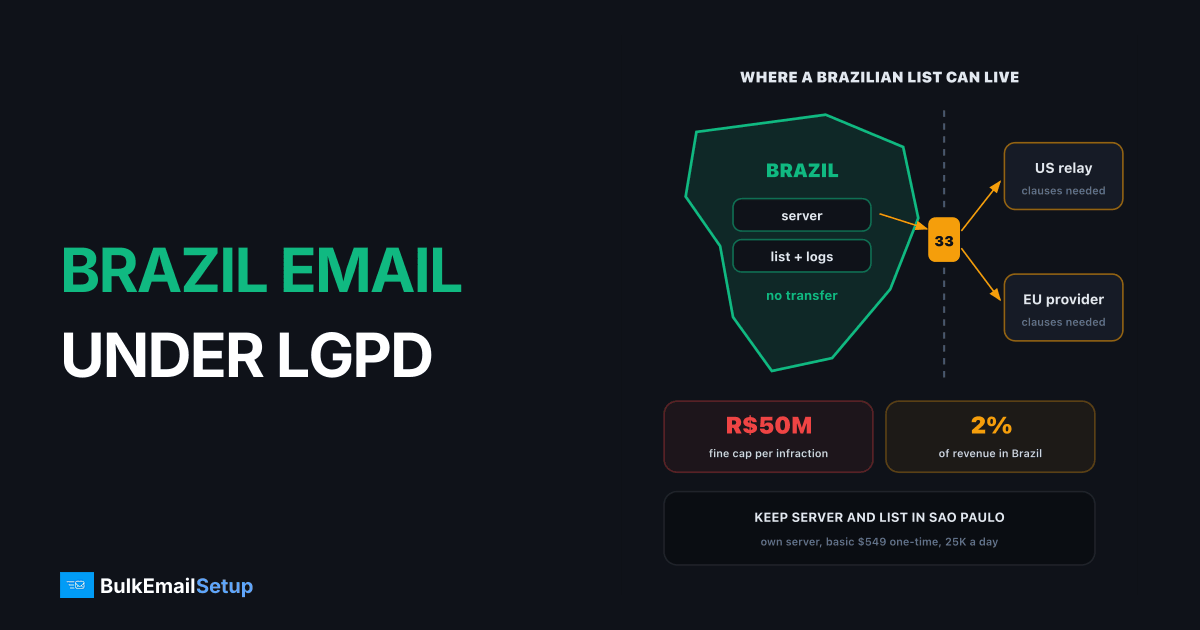
Bulk email in Brazil runs under LGPD, which lets a business send marketing email on consent or legitimate interest, but makes the sender prove consent, honour revocation at any time, and justify any transfer of the list outside Brazil. Fines reach 2% of revenue in Brazil, capped at R$50 million per infraction. For your sending setup that boils down to three things: keep a record of how each address joined, process unsubscribes automatically, and know which country your server and list sit in.
What LGPD requires for email marketing
The rules live in a few articles of Lei 13.709/2018. The regulator is the ANPD, now the Agência Nacional de Proteção de Dados, at gov.br/anpd.
| Article | What it says | What it means for your mailer |
|---|---|---|
| Art. 7, I | consent is a legal basis | store the signup source, date and IP |
| Art. 7, IX + Art. 10 | legitimate interest is a basis, within what people expect | existing customers, related offers only |
| Art. 8, § 2 | the controller carries the burden of proving consent | your records, not the provider's |
| Art. 18, IX | people can revoke consent | unsubscribe must work in every email |
| Art. 33 | international transfers need a legal basis | know where your server and list live |
| Art. 52 | fines up to 2% of revenue, R$50 million per infraction | plus blocking or deletion orders |
The burden-of-proof line is the one that bites. If a complaint reaches the ANPD, "our ESP has the data" is not an answer. You need the consent record yourself.
Consent is easier to prove. Legitimate interest is narrower than it looks.
Consent or legitimate interest?
Most Brazilian newsletters run on consent, and for good reason. It is a single fact you can prove: this person filled this form on this date.
Legitimate interest is real but narrow. Article 10 ties it to what the person would reasonably expect. A customer who bought a printer expecting to hear about its toner fits. A list of 40,000 addresses bought from a lead vendor does not fit anything, and our own anti-spam policy rules those out on servers we build.
A practical rule: use consent for newsletters and promotions, and keep legitimate interest for service notices to existing customers. Our double opt-in guide covers the confirmation step that turns a signup into proof.
Where the data can live
LGPD does not require local hosting. It requires a legal basis when personal data leaves Brazil.
| Where your server and list sit | Transfer question | What you need |
|---|---|---|
| São Paulo data centre | none | your normal records |
| EU, with an EU provider | yes | Article 33 basis, e.g. standard clauses |
| US relay or US-hosted ESP | yes | standard clauses in the provider contract |
| Several countries at once | yes, for each hop | a basis for every transfer |
The ANPD approved its standard contractual clauses in Resolution CD/ANPD 19 of 23 August 2024, and the grace period to add them to contracts ended on 23 August 2025. If you use a foreign relay, ask the provider whether its contract carries the ANPD clauses. If it only offers EU clauses, that is a gap.
Inside Brazil there is no transfer question. Every border crossing needs a basis.
The simplest answer for most senders is to keep the sending server, the list and the logs in one Brazilian data centre. Then there is no transfer to justify.
Which sending setups suit Brazilian senders
| Option | Where it sends from | Billing | Fit |
|---|---|---|---|
| Amazon SES, São Paulo region | sa-east-1 since April 2020 | USD per email, local AWS billing | cheap, you build the rest |
| Brazilian platforms (RD Station, Locaweb) | Brazil | reais, monthly plans | easy, priced per contact or plan |
| Global relays (SendGrid, Mailgun) | mostly US or EU | USD, international card | transfer clauses needed |
| Own dedicated server in São Paulo | Brazil | one-time setup + hosting | no transfer, no shared pool |
Amazon SES is the cheapest per email, and the AWS announcement confirms the São Paulo region. You still build bounce handling, suppression and the campaign tool yourself. Local platforms are simpler but bill per contact, which climbs fast as the list grows.
The ceiling is per infraction, not per year
What your sending stack must do for LGPD
Whatever you pick, check these before the first campaign:
- Store consent proof. Signup form, date, time and IP, kept as long as you mail the address.
- One-click unsubscribe. In every email, processed without a login. See our unsubscribe rules.
- Suppression that sticks. An unsubscribed or bounced address must never be re-imported by a sync job.
- Know your processors. List every company that touches the list: host, relay, tracking tool.
- Use a sending subdomain. Keeps a bad campaign away from your main domain, per our subdomain guide.
If you also mail Europe, the GDPR rules are close but not identical. Our EU-hosted SMTP guide covers that side.
How BulkEmailSetup helps
We build a dedicated SMTP server on hosting you own, so you choose the country. Put it in a São Paulo data centre and the list, the logs and the sending all stay in Brazil.
| Plan | One-time fee | Emails per day | Dedicated IPs | Hosting you pay your host |
|---|---|---|---|---|
| Basic | $549 | 25,000 | 3 | about $11 a month |
| Advance | $1,199 | 200,000 | 15 | about $49 a month |
Every plan includes the campaign platform, SPF, DKIM and DMARC, bounce handling and automatic unsubscribe processing, with unlimited contacts and no monthly fee to us. The 15-day money-back guarantee applies until server access is handed over. This is infrastructure, not legal advice: check your consent records with a Brazilian privacy lawyer. See Basic plan details or all pricing.
Frequently asked questions
What does LGPD require for email marketing?
A legal basis under Article 7, usually consent or legitimate interest, plus the ability to prove it. Article 8 puts the burden of proof for consent on the sender, and Article 18 lets people revoke it at any time. In practice that means a stored record of how each address joined, a working unsubscribe in every email, and a suppression list your SMTP setup actually honours.
Which bulk email providers serve Brazil?
Amazon SES has run a South America (São Paulo) region since April 2020. Brazilian marketing platforms such as RD Station and hosts such as Locaweb sell sending plans billed in reais, and the global relays all accept Brazilian customers. A dedicated server can sit in São Paulo or anywhere else, as long as your transfer basis covers where the data goes.
Can I pay for bulk email in BRL?
With local providers, yes, and AWS bills Brazilian accounts through its local entity. Most global relays charge in US dollars on an international card. BulkEmailSetup prices in US dollars: the Basic plan is a $549 one-time setup, and the roughly $11 a month of hosting is paid to your own host, which can be a Brazilian one billing in reais.
Where should a Brazilian sender host email?
LGPD does not force data to stay in Brazil. It does require a legal basis under Article 33 for any international transfer, such as the standard contractual clauses the ANPD approved in Resolution 19 of August 2024. Hosting the server and the list in Brazil removes that question entirely, which is why many senders choose a São Paulo data centre.
What is the fine for breaking LGPD with email?
Article 52 allows a simple fine of up to 2% of the company's revenue in Brazil, capped at R$50 million per infraction. The ANPD can also order the data to be blocked or deleted and publish the infraction. For email, the more common day-to-day cost is lost deliverability: complaints from people who never agreed to hear from you.
Is legitimate interest enough for a newsletter in Brazil?
Sometimes. Article 7, IX allows processing for the controller's legitimate interest unless the person's rights outweigh it, and Article 10 limits it to what the person would reasonably expect. Mailing existing customers about related products often fits. Mailing a list you bought does not. Most senders use consent for newsletters because it is easier to prove.
Do I need double opt-in under LGPD?
The law does not name double opt-in. It does require you to prove consent, and a confirmation click with a stored timestamp and IP address is the cleanest proof you can show the ANPD. It also keeps typos and fake signups off the list, which protects your sending IPs.


