
Brevo, the platform that used to be Sendinblue, suspends bulk senders for five things: a list import its checks flagged as bought or scraped, a hard bounce rate over roughly 5%, a spam complaint rate over roughly 0.1%, a volume jump of 3x or more in a day, or its validation team declining your use case outright. The notice names the category but not the campaign. The right response is different for each, so before you write to support, pull your last 7 days of statistics and work out which of the five you actually hit. If you can't name the cause, the appeal fails.
Which notice did you get
Brevo has three account states that people lump together as "suspended". They are not the same, and only one of them is a numbers problem.
| Notice type | Typical wording | When it happens | Realistic outcome |
|---|---|---|---|
| Validation pending | "Your account is under review", "we need more information" | New account, first campaign | Released or declined in 1-3 business days |
| Suspended | "Your account has been suspended", "sending has been paused" | Established account after a bad send | Reinstated in 3-10 days if you show cause and fix |
| Closed | "Your account has been closed", "violation of our terms" | Any account, any age | Permanent |
Validation pending is not a suspension. It is Brevo's normal gate on every new account, and it is where cold outreach, affiliate and restricted-niche senders usually get stopped. Suspended is about metrics. Closed is a decision. Writing the same angry ticket for all three is how a fixable case becomes permanent.
How Brevo's validation works on your first campaign
Brevo does not let a new account send to a list until a human has looked at it. Expect 24 to 48 hours between clicking send on campaign one and anything leaving the platform. The reviewer checks the website on your sender domain, whether the signup form on that site matches the contacts you imported, where the contacts came from, and what the campaign says.
A few things fail this review on sight:
- A first import over about 10,000 contacts with no visible signup source on your site.
- Contacts spread evenly across Gmail, Yahoo, Outlook and a long tail of corporate domains. Opt-in lists skew heavily to one or two consumer providers; scraped lists don't.
- A campaign that reads as first contact ("I came across your company").
- A category Brevo declines on shared infrastructure: cold B2B outreach, affiliate promotion, and most of the restricted niches (crypto, gambling, loans, adult).
If you were declined here, nothing about your sending numbers matters. It is a policy call about what you send, and you will get the same call at Mailchimp, Klaviyo and Constant Contact. Skip to the route decision below.
The 7-day numbers that decide the appeal
Pull these for the 7 days before the suspension, per campaign, from the Statistics page while you still have dashboard access.
| Metric | Brevo's practical line | Gmail's line | What it points to |
|---|---|---|---|
| Hard bounce rate | ~5% | ~2% draws throttling | list provenance |
| Spam complaint rate | ~0.1% | 0.3% hard, 0.1% target | consent or targeting |
| Unsubscribe rate | ~0.5% | none published | frequency or relevance |
| Blocked / deferred | rising 4xx at one receiver | none | that receiver already rejects you |
| Daily volume change | 3x+ jump | none | automated review trigger |
Brevo has to act below Gmail's 0.3% because your complaints land on IPs shared with thousands of other customers. Google's own bulk sender guidelines set 0.3% as the line where Gmail starts rejecting mail and 0.1% as the target, and every shared provider polices tighter than that.
Sort bounces by recipient domain. A bought list shows as a wall of unknown-user bounces at Gmail, Yahoo and Outlook at once. A stale list shows as bounces concentrated at corporate domains where people changed jobs. Complaints concentrated in one campaign give you the segment; complaints spread across everything mean the whole list has a consent problem.
Export contacts, suppression lists and campaign reports now. A closed account takes the data with it.
What to send support
One message, three facts, no argument. Brevo's compliance team reads hundreds of these a week and reinstates the ones that make its decision easy.
- The segment. "The 42,000-contact import from 3 March, list ID 17, a 2022 trade-show export" beats "some older contacts".
- The removal, with a count. "Deleted list 17, suppressed 2,300 hard bounces, list is now 58,000 opt-in addresses from our site form."
- The process change. Double opt-in on the form, 12-month engagement sunset, no imports without a documented source.
Leave out anything about how much you pay, how long you have been a customer, or how unfair it is. None of that changes the numbers. Expect 3 to 10 days. A reinstated account often comes back with a lower daily quota for a few weeks, and a second suspension on the same account is nearly always the end of it.
What the send did to your domain
The suspension is Brevo's problem. The send that caused it is yours, and it moved with your domain.
Check three places:
- Google Postmaster Tools for your sending domain. A domain reputation of "Low" or "Bad" means the next provider starts with the same handicap.
- DMARC aggregate reports for the week, to see which receivers rejected mail and whether anything unauthenticated was riding on your domain.
- Blocklists. Brevo's shared IPs are Brevo's concern, but your domain can land on a URI blocklist like Spamhaus DBL if the send looked like spam. Check that before you point the domain at anything new.
If domain reputation dropped, plan on 4 to 8 weeks of careful low-volume sending to engaged addresses before it recovers, whatever you send from. That clock starts when you stop sending bad mail, not when the appeal resolves.
Route decision: list problem or policy problem
Everything above narrows to one fork.
| Factor | List problem | Policy problem |
|---|---|---|
| Trigger | bounces, complaints, flagged import | declined use case, validation refused |
| Appeal | worth one careful message | almost never works |
| Fix | clean the list, then send from anywhere | different infrastructure |
| Moving providers | moves the problem, burns a second reputation | removes the conflict |
| Typical time to full volume | 2-4 weeks after cleaning | 4-8 weeks warm-up on new IPs |
If it was the list, fix it before you move anywhere. Every shared provider suspends for the same behaviour. Run the list cleaning process, suppress every hard bounce, drop anyone with no open or click in 12 months. On a typical list that removes 20 to 30% of addresses, and those are the ones that generated the complaints.
If it was policy, meaning your sending is legal and the recipients are yours, but Brevo won't carry it on shared IPs, no amount of list hygiene changes the answer. Cold B2B outreach with a valid business reason, affiliate promotion to your own subscribers, restricted niches with the right licences: all of these are banned on shared pools because they raise complaint rates for other customers on the same IP. On dedicated IPs, the only reputation at risk is your own, and the compliance decision comes back to you. The law and the receivers' rules still apply. Brevo vs a dedicated SMTP server covers what changes in practice.
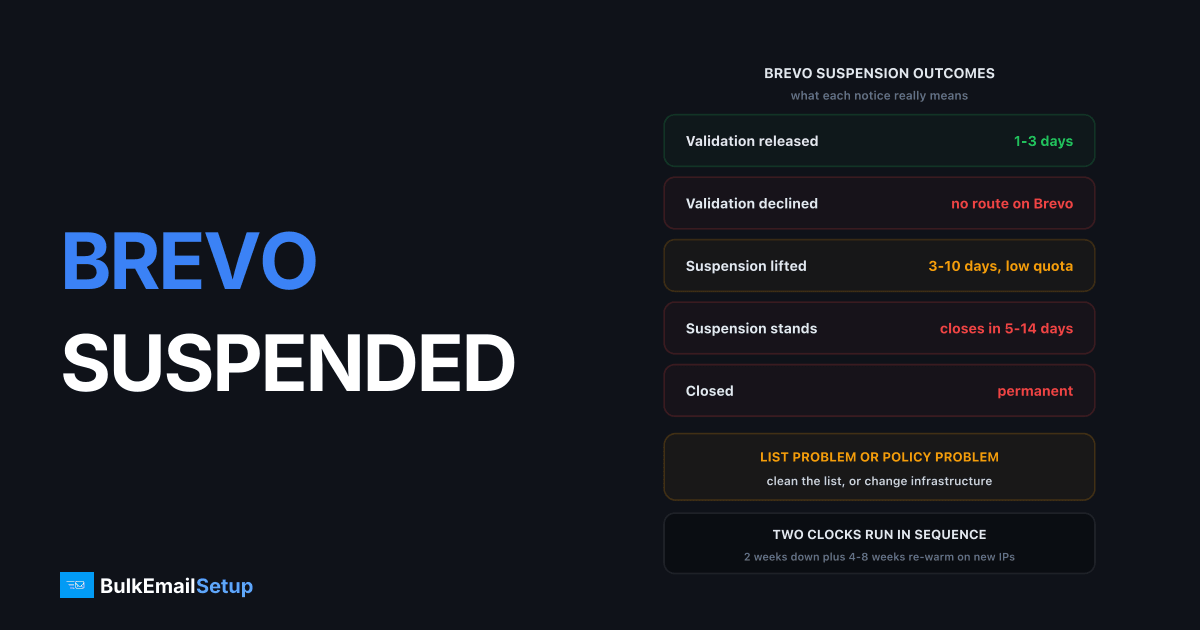
Outcomes and timelines
| Outcome | How often I see it | Time | What it looks like after |
|---|---|---|---|
| Validation released | most new accounts with a real opt-in source | 1-3 business days | normal sending, watched closely for 30 days |
| Validation declined | cold, affiliate, restricted niches | 1-3 business days | no route on Brevo, closed if you retry |
| Suspension lifted | one-off bad segment, evidence supplied | 3-10 days | reduced quota, second strike is final |
| Suspension stands | bought list, no segment identified, argument instead of evidence | 5-14 days | account closes |
| Closed | repeat offence, terms breach, duplicate account | immediate | permanent, domain flagged internally |
What the outage costs, including the billing
Brevo bills on monthly email volume rather than contacts. As of 2026, Starter runs from around $9 a month for 5,000 emails and Business from around $18 a month for the same 5,000, with volume tiers climbing past 150,000 a month. Check Brevo's pricing page for your tier. The part that matters here: subscription volume expires at month end, and pay-as-you-go credits belong to the account. A suspension in week one of a 100,000-email month burns that month's fee. A closed account takes any prepaid credit balance with it.
| Line item | Typical scale |
|---|---|
| Sending down | 1-3 weeks |
| Wasted monthly quota or credits | up to one full billing cycle |
| Revenue from paused campaigns | your normal email revenue for that period |
| Re-warm on new infrastructure | 4-8 weeks |
| Engineering and admin time | 20-40 hours |
| Domain reputation recovery | 1-3 months if it dropped |
The clocks run in sequence. A two-week suspension followed by a six-week warm-up is two months before you are back at full volume. For a sender doing 100,000 a month or more, that is usually a larger number than the annual cost of owning the infrastructure, which is the comparison Brevo alternatives works through by volume.
The 30-day recovery plan
Work this whether or not the appeal succeeds. If Brevo reinstates you, you are ahead.
Days 1-3: contain and export. Pause every automation still queued. Export contacts, suppression lists, bounce logs and campaign reports. Find the segment: bounces by recipient domain, complaints by campaign. Set up Google Postmaster Tools on the domain if it isn't running.
Days 4-7: clean and appeal. Delete the flagged import. Suppress all hard bounces. Drop 12-month non-engagers. Send the one-message appeal with the three facts. Then stop touching the ticket.
Days 8-14: build the fallback.
Set up the new sending path on a subdomain, so future problems stay contained. Publish SPF, DKIM and DMARC at p=none, read the reports for two weeks before tightening. Confirm PTR matches HELO. The same steps apply if you land on another shared provider, which the SendGrid suspension guide covers from that side.
Days 15-45: warm up. A few hundred a day per IP to the most engaged segment first. Ramp about 30% every two days. Watch deferrals, not opens. A rising 4xx rate means slow down.
Ongoing: 15 minutes a week. Complaint rate and bounce rate per campaign, Postmaster domain reputation, one look at the DMARC reports. That is what prevents the second suspension.
What not to do
- Do not open a second Brevo account. Matched on payment method, domain, website and contact overlap. Closed fast, and it turns a fixable case into a permanent one.
- Do not move the same list to Mailchimp or MailerLite. Same numbers, same outcome, two weeks later, with a second provider now holding a note on your domain.
- Do not send at your old volume from new IPs. Cold IPs pushing 50,000 a day get throttled by every major receiver within hours.
- Do not argue in the ticket. Evidence reinstates accounts. Tone does not.
- Do not skip the post-mortem. If you never identify the segment, you repeat it.
How BulkEmailSetup helps
We build dedicated SMTP infrastructure you own: your own server, your own IPs, full SPF/DKIM/DMARC/PTR configuration, MTA tuning, bounce handling and a warm-up plan. Because the IPs are yours alone, there is no shared pool to protect and no validation team deciding whether your legitimate use case is too risky for other customers.
Basic starts at $549 one-time, covering 1 SMTP server, 3 dedicated IPs, 25,000 emails/day and unlimited contacts. Higher tiers scale to 15 IPs and 200,000 emails/day. See pricing, or read Brevo vs a dedicated SMTP server for the direct comparison.
Frequently asked questions
Why did Brevo suspend my account?
Five causes cover nearly every case: a list import Brevo's checks flagged as bought or scraped, a hard bounce rate over roughly 5%, a spam complaint rate over roughly 0.1%, a volume jump of 3x or more in a day, or Brevo's validation team declining your use case, which is common for cold outreach, affiliate offers and restricted niches. The notice names the category but not the campaign, so pull your last 7 days of statistics before you reply.
What is Brevo account validation and why is my first campaign stuck?
Every new Brevo account goes through a manual validation before its first campaign is released, usually within 24 to 48 hours. A human looks at your website, your signup form, where the contacts came from and what the first campaign says. Accounts that import a large list with no visible opt-in source are the ones that get declined at this step, and a decline here is a policy decision, not a metrics problem.
Can I get a suspended Brevo account reinstated?
Yes, if the trigger was a one-off you can name and fix. Reinstatements happen most often when you identify the exact list segment, show it was deleted with a count, and describe the process change. They almost never happen for a declined use case, a second suspension, or an import that was clearly purchased.
How long does a Brevo suspension take to resolve?
A validation hold clears in 1 to 3 business days. A metrics suspension takes 3 to 10 days if you supply the evidence in one message. A closed account is permanent. Plan as if sending is down for at least a week, and note that a metrics suspension often comes with a reduced daily quota when it lifts.
Does Brevo refund unused email credits after a suspension?
Not in practice. Monthly subscription volume expires at the end of the billing cycle whether you sent it or not, and pay-as-you-go credits are tied to the account. If your account is closed, the remaining credits go with it. On a plan carrying 100,000 emails a month, a suspension in week one wastes most of that month's fee.
Can I open a second Brevo account and keep sending?
No. Brevo matches new accounts on payment method, sending domain, website and contact list overlap, and closes duplicates quickly. It also turns a fixable suspension into a permanent one, because the second account is a clear terms breach. Move to different infrastructure instead.
Did the suspension hurt my domain reputation?
The suspension itself did not, but the send that caused it did. Gmail, Yahoo and Microsoft score your sending domain independently of the provider, so a complaint rate over 0.3% at Gmail follows you to whatever you use next. Check Google Postmaster Tools for your domain before assuming a clean start.


