
The best ActiveCampaign alternative for bulk senders depends on what you actually need from ActiveCampaign. If it's the automation and CRM, tools like Brevo or HubSpot compete on features. If it's the email sending, the real problem is cost and control: ActiveCampaign bills per contact and feature tier, which gets expensive at volume, and its sending leans on shared infrastructure. For bulk senders above roughly 50,000 emails a month, a dedicated SMTP server delivers flat pricing and a dedicated IP you own. Here's how the options compare, with honest pricing as of early 2026.
Why ActiveCampaign gets expensive for bulk senders
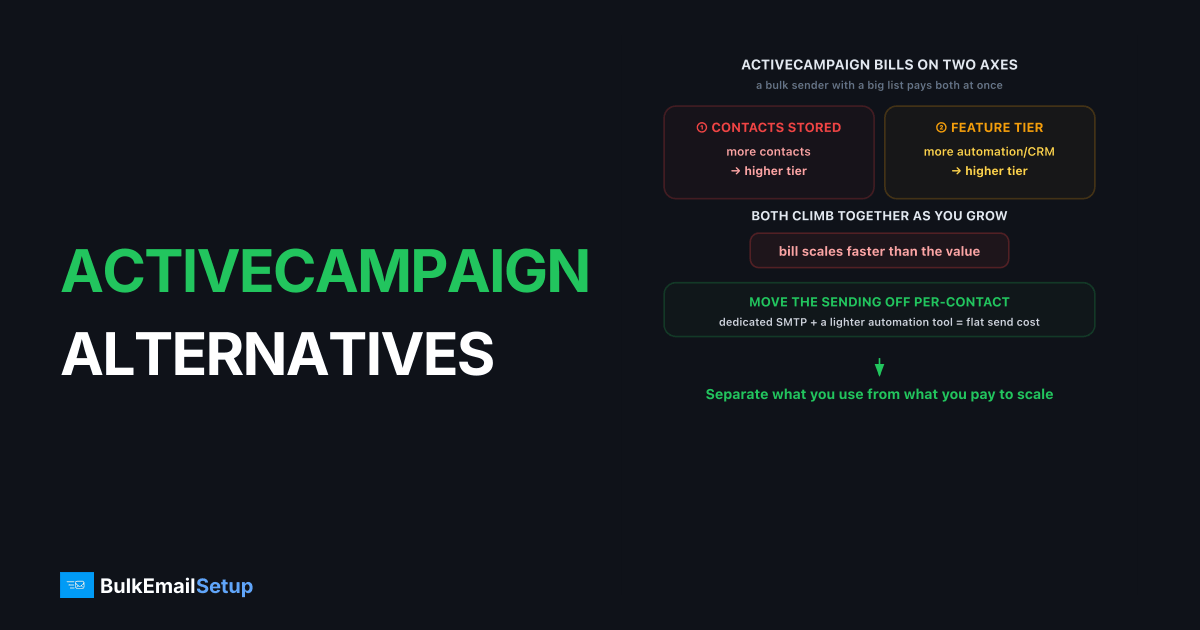
ActiveCampaign prices on two axes: how many contacts you store and which feature tier you're on. Both climb as you grow. A bulk sender with a large list who also wants advanced automation pays on both axes at once, which is why the bill scales faster than the value for high-volume use.
The deliverability angle matters too. ActiveCampaign is automation-first, with sending built around shared pools and dedicated IPs reserved for higher tiers. For a bulk sender who wants to own a reputation and tune warm-up, that's limited headroom compared to running your own SMTP.
In the migrations we run off automation-first platforms, the recurring complaint isn't the headline price, it's the blind spot when placement drops. When a campaign suddenly lands in Promotions, the team has no raw bounce log to read and no per-IP reputation to check, so they open a support ticket and wait. On a dedicated IP we can pull the SMTP responses, spot a 421 4.7.28 deferral pattern at Gmail within the hour, and slow the send before it compounds.
ActiveCampaign alternatives compared
Approximate pricing as of early 2026. Costs depend on contact count, send frequency, and feature tier, so read these as ranges.
| Option | Billing model | Dedicated IP | Best for | SMTP control |
|---|---|---|---|---|
| ActiveCampaign | Per contact + tier | Higher tiers | Automation + CRM | Limited |
| Brevo | Per email sent | Add-on (~$45-60/mo) | Automation on a budget | Limited |
| Mailchimp | Per contact (tiered) | High tiers | Brand marketing | Limited |
| HubSpot | Per contact + suite | Add-on | Full sales/marketing suite | Limited |
| Dedicated SMTP + automation tool | Flat monthly send | Included, you own it | Bulk senders at volume | Full |
How to choose an ActiveCampaign alternative
Choose your ActiveCampaign replacement by separating what you use from what you pay for. ActiveCampaign bundles automation, CRM, and sending into one bill. Most bulk senders use the automation heavily and the sending heavily, but the sending is what scales the cost. Decide whether you're replacing the whole platform or just the expensive part.
Score candidates on five axes:
- Billing model. Per-contact, per-email, or flat. Bulk senders with large lists almost always save by moving sending off per-contact pricing.
- Automation depth. Do you genuinely need ActiveCampaign-grade workflows, or would a lighter tool plus a separate sender cover it?
- Dedicated IP and SMTP control. Can you own a reputation and isolate transactional from marketing streams?
- Deliverability visibility. Can you read your own bounce codes and reputation, or is it a black box?
- Migration cost. Rebuilding complex automations is real work. Factor it in before switching wholesale.
The contrarian read: for many teams the answer isn't a competing all-in-one, it's keeping ActiveCampaign's logic and moving only the sending. That sidesteps the painful automation rebuild while killing the per-contact send cost.
A worked cost example at 150K contacts
Take a 150,000-contact list emailed twice a week. That's roughly 1.2 million emails a month. On a per-contact plan with a mid feature tier, you pay for all 150,000 contacts plus the tier fee every month, frequently several hundred dollars or more, and a dedicated IP add-on sits on top of that.
Route those same 1.2 million sends through a flat-rate dedicated SMTP server and the bill stays fixed within plan limits, with the dedicated IP included rather than billed separately. The more often you mail the same list, the wider the gap, because per-contact pricing charges for the list whether you send to it once or ten times. Frequency is exactly where bulk senders live.
Should you replace ActiveCampaign or just its sending?
For many bulk senders, the smart move isn't a full replacement, it's splitting the stack. Keep an automation tool for workflows and segmentation, then route the actual high-volume delivery through a dedicated SMTP server. The logic layer stays where your team is comfortable, the sending layer moves to infrastructure that's cheaper and that you control.
This split is why people search for cheaper alternatives to ActiveCampaign. The automation isn't usually the cost problem at scale. The per-contact sending fees are. Decoupling them solves the bill without retraining your team.
When a dedicated SMTP server wins
Above roughly 50,000-100,000 emails a month sent consistently, dedicated infrastructure beats per-contact pricing on cost and control. Flat billing means a big campaign doesn't spike your invoice. A dedicated IP gives you a reputation that's yours alone, full SMTP access lets you isolate transactional from marketing, and you control authentication end to end.
The honest part: a dedicated IP needs a 4-6 week warm-up, and inbox placement still depends on list hygiene and keeping complaints under 0.3%. Set up SPF, DKIM, and DMARC correctly, and a dedicated server outperforms a shared pool at volume. For the threshold math, see how many emails before you need dedicated infrastructure.
How do you migrate sending off ActiveCampaign?
Migrating just the sending layer keeps your automations intact while moving delivery to cheaper, controllable infrastructure. ActiveCampaign supports external delivery routing in many configurations, so your workflows still fire, but the actual mail leaves through your own dedicated IP under your sending domains.
The steps are short and one-time:
- Stand up the delivery layer. Provision a dedicated SMTP server with a dedicated IP, host and port 587 with STARTTLS, and auth credentials.
- Point the sending at it. Route bulk delivery through the external SMTP endpoint while keeping ActiveCampaign for logic and segmentation.
- Authenticate the domain. Publish SPF, DKIM, and DMARC plus a valid PTR record for the sending domain or subdomain.
- Warm the IP over 4-6 weeks before pushing full volume.
- Watch reputation and bounces during the cutover, especially
421 4.7.28rate-limit deferrals at Gmail that signal you're ramping too fast.
Honest framing: the swap lowers cost and gives you reputation control. It does not rescue a dirty list. Deliverability still rides on list hygiene and complaint rates, not the billing change.
What to keep and what to replace
The smartest ActiveCampaign migration replaces the costly layer and keeps the valuable one. ActiveCampaign's automation and CRM are genuinely strong; its per-contact sending is where the bill balloons. Rebuilding complex automations elsewhere is expensive and risky, so don't replace what's working.
A simple way to decide what stays and what goes:
- Keep: multi-step automations, lead scoring, CRM data, and segmentation logic your team relies on daily.
- Replace: the high-volume sending, where per-contact fees and a shared-leaning pool cost you cash and control.
- Add: a dedicated SMTP server with a dedicated IP for the actual delivery, isolating transactional from marketing.
This split keeps your team in familiar tools while the expensive part moves to flat-rate infrastructure. It's also lower-risk than a full platform migration, because you're not retraining anyone or rebuilding workflows. You're rerouting one pipe. For senders whose automation is light, a full move to a cheaper all-in-one may still win; for automation-heavy teams, the split is almost always the better economics.
Does leaving ActiveCampaign hurt deliverability?
Leaving ActiveCampaign doesn't hurt deliverability on its own; how you send does. Many teams worry that moving sending breaks a reputation they've built. In practice, a clean sender moving to a dedicated IP trades a borrowed shared reputation for one they own and can't have damaged by a neighbor.
The rules that decide inbox placement don't change with the provider. Over 5,000 sends a day, Gmail and Yahoo require SPF, DKIM, and DMARC, one-click unsubscribe (RFC 8058), a valid PTR record, and a complaint rate under 0.3%. A dedicated SMTP server exposes every one of those controls. ActiveCampaign's automation-first design abstracts some of them away, which is convenient until you need to tune deliverability and can't.
So measure the move on control, not fear. If your list is clean and your authentication is correct, a dedicated setup outperforms a shared pool at bulk volume. If they're not, fix them first, because no migration rescues bad sending behavior. The technical baseline is in SPF, DKIM, and DMARC.
How BulkEmailSetup helps
If ActiveCampaign's per-contact bill is outrunning your list value, a dedicated SMTP server gives you flat pricing, a dedicated IP you own, and full SMTP access while you keep whatever automation tool fits your team. We provision the server, run the warm-up, and monitor reputation. See plans on our pricing page.
Frequently asked questions
Why do bulk senders leave ActiveCampaign?
ActiveCampaign charges by contact count and feature tier, so a large list gets expensive fast, especially when you also pay for advanced automation. Bulk senders who mail big lists frequently usually find flat-rate or usage-based sending far cheaper at the same volume.
What is the best ActiveCampaign alternative for high volume?
For consistent volume above roughly 50K-100K emails a month, a dedicated SMTP server gives flat pricing and a dedicated IP you control. You can keep an automation tool for logic and route the actual delivery through dedicated infrastructure to cut cost and own your reputation.
Does ActiveCampaign provide a dedicated IP?
Dedicated IPs are available on higher ActiveCampaign tiers, but you still send within its shared-leaning environment with limited SMTP control. A standalone dedicated SMTP server gives you the IP plus full control over warm-up, routing, and authentication.
Can I keep automation and change my email sending?
Yes. Many teams keep an automation platform for workflows and CRM while routing bulk delivery through a separate SMTP server. That splits the logic layer from the sending layer, lowering cost and giving you a reputation you control.


