
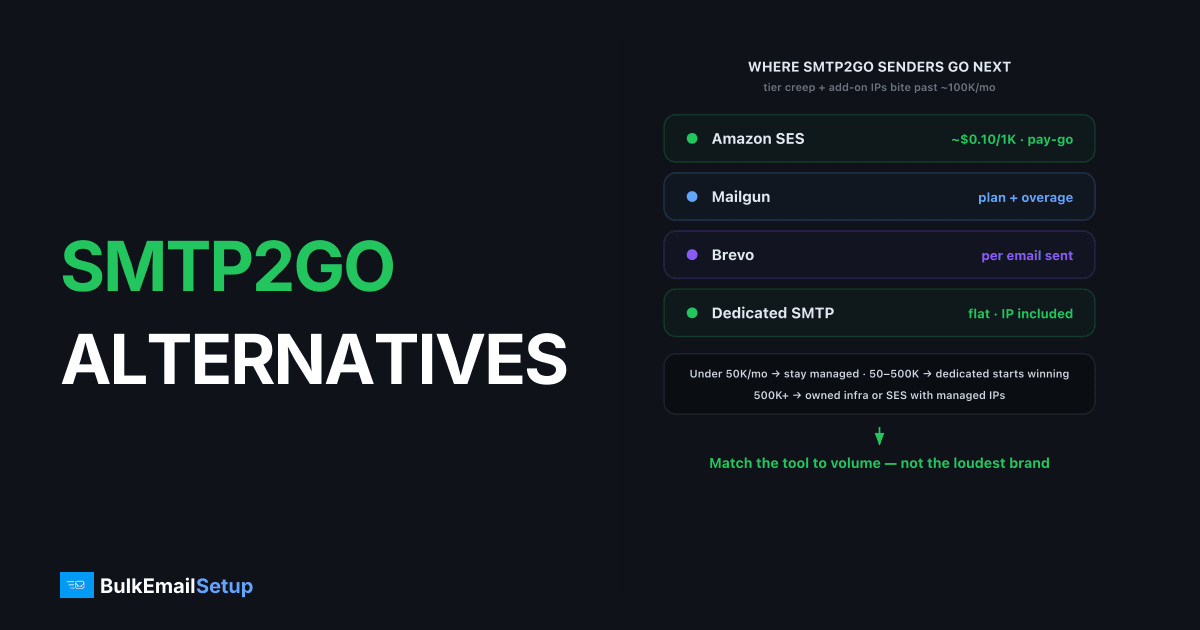
The best SMTP2GO alternatives for high-volume senders are Amazon SES for raw cost, Mailgun for built-in tooling, and a dedicated SMTP server for flat pricing and a dedicated IP you control. SMTP2GO is genuinely easy to start with, but its per-email tiers and add-on dedicated IPs get expensive as volume climbs. Past roughly 100K emails/month, senders who want predictable cost and full control over their sending reputation usually do better on owned infrastructure than on any metered relay.
Why look for an SMTP2GO alternative?
Senders outgrow SMTP2GO when per-email tier pricing, add-on IP costs, and limited control start to bite at scale. SMTP2GO works well for small and mid-volume sending: clean setup, decent reporting, reliable delivery. The friction appears as you grow, when tiers escalate and you need control the platform does not expose.
Three common triggers:
- Tier creep. Each volume jump moves you to a pricier tier, and dedicated IPs are extra on top.
- Limited MTA control. You can adjust content and authentication, but not connection limits, routing, or stream isolation at the server level.
- Per-email economics. At high, steady volume, metered pricing loses to flat infrastructure on cost-per-email.
SMTP2GO alternatives compared
The right alternative depends on whether your priority is cost, tooling, or control. Here is how the main options line up for a high-volume sender weighing a switch.
| Option | Pricing model | Dedicated IP | Setup effort | Best for |
|---|---|---|---|---|
| SMTP2GO | Per-email tiers | Add-on (higher tiers) | Low | Easy mid-volume sending |
| Amazon SES | ~$0.10/1,000, pay-as-you-go | Add-on (std/managed) | High | Lowest raw cost |
| Mailgun | Plan + overage | Add-on (higher plans) | Low | Built-in tooling |
| Brevo | Per email sent | Add-on (higher tiers) | Low | Big lists, light sending |
| Dedicated SMTP server | Flat monthly | Included, you control it | Medium | Flat cost + full control |
Which alternative fits your volume?
The right pick scales with your monthly volume and how much engineering time you can spend. Below roughly 50K/month, staying on a managed relay like SMTP2GO or moving to Mailgun usually beats running your own server. The math shifts as volume grows and sends become predictable.
- Under 50K/month: A managed relay is fine. The control of owned infrastructure does not pay off yet.
- 50K-500K/month, steady: A dedicated SMTP server with a dedicated IP starts winning on cost and control. SES wins if you want the lowest unit price and can build tooling.
- 500K+/month: Owned infrastructure or SES with managed dedicated IPs. Per-email relays become the expensive option.
For the threshold in detail, see how many emails before you need dedicated infrastructure, and for the relay price landscape, SMTP relay pricing comparison.
The cost math behind those bands is simple. Metered relays charge per email and add dedicated IPs as separate line items, so your bill grows with every send and spikes when a campaign runs hot. A flat dedicated plan holds the same figure whether you send 200K or 800K in a month. At 100K/month the per-email difference is small in absolute dollars, so SMTP2GO's convenience can win. By 500K and beyond, the tier creep plus add-on IPs usually cost more than a flat plan that bundles the volume and the dedicated IP into one predictable number. Forecastable billing is half the reason senders switch, not just the lower unit cost.
The choice also depends on what you send. Transactional-heavy senders care most about speed and reliability, which favors Mailgun. Marketing senders with big lists mailed occasionally lean toward send-based pricing like Brevo. Cold-email and high-volume newsletter operators usually want dedicated IPs they control, because reputation isolation is the whole game. SMTP2GO tries to serve all of these at once, and that generalist position is exactly why specialized senders eventually outgrow it.
What does setup involve on each alternative?
Setup effort is the hidden cost the price columns do not show, and it varies widely. A managed relay like SMTP2GO or Mailgun is mostly a domain verification plus a few DNS records, then you point your app at the SMTP or API endpoint and you are sending within an hour. Amazon SES adds AWS work: leaving the sandbox, requesting limit increases, and wiring bounce handling through SNS, which is a day or two of engineering.
A dedicated SMTP server sits in the middle on setup but pays back on control. You configure the sending domain's SPF, DKIM, DMARC, and a valid PTR record, then warm the IP over 4-6 weeks. With a managed dedicated SMTP provider, most of that is done for you, so the effort drops back toward the easy end while you keep the control of owned infrastructure. Whichever route you pick, the authentication records are non-negotiable: get SPF wrong and you trip 550 5.7.23 SPF-fail rejections at Gmail.
What to look for in an SMTP2GO alternative
The features that matter in an alternative are the ones SMTP2GO's tiered model holds back at scale: pricing predictability, dedicated IP ownership, and real diagnostic access. Score any option against these before you switch, since a cheaper sticker price means little if the bill still spikes on busy months.
- Pricing that does not punish bursts. Flat plans beat per-email tiers when a one-off announcement to your full list can push you into overage.
- A dedicated IP you actually control. Some platforms rent you an IP but keep the MTA and routing locked. Owning the IP means the reputation is yours alone.
- Authentication done right. SPF under the 10-DNS-lookup limit, DKIM at 2048-bit, DMARC at
quarantineor stronger. Get these wrong and you trip550 5.7.23SPF-fail rejections. - Raw logs and stream isolation. When mail defers, you want to read your own logs and split transactional from marketing, not file a ticket.
- Warm-up support. A new IP needs a 4-6 week ramp. A good provider runs it or guides it instead of leaving you to guess.
Weight these by your own pain. A sender burned by overage cares most about flat pricing. A sender hit by a shared-pool blocklisting cares most about a dedicated IP.
Why a dedicated SMTP server is the strongest high-volume option
For consistent high volume, a dedicated SMTP server is the strongest SMTP2GO alternative because it removes both the metering and the shared-reputation risk in one move. Per-email relays meter every message and rent you an IP inside their platform. A dedicated server gives you a flat plan, an IP you own, and full MTA access, so cost stays predictable and the sending reputation is yours alone.
The economics flip past roughly 100K emails/month sent consistently. Below that, the per-email cost on a managed relay is trivial and not worth the operational ownership. Above it, metered pricing and add-on IPs become the expensive option, and the control of owning the infrastructure starts to pay for itself. You can split traffic across multiple dedicated IPs, isolate a complaint-prone marketing stream from transactional mail, and diagnose a 550 5.7.1 block in your own logs the moment it appears. In migrations we've run off SMTP2GO, the senders who felt the pinch were almost always around the 400K to 600K mark, where the next tier plus two add-on dedicated IPs pushed the monthly bill past a flat plan that bundled the same volume and IPs. The trigger was rarely a single big number; it was the add-on IPs stacking on top of tier creep. That is the exact capability SMTP2GO abstracts away, and the reason high-volume senders eventually outgrow it.
What you control on your own SMTP server
On your own SMTP server you control the dedicated IP, the MTA configuration, stream separation, and the diagnostic logs, which is exactly what metered relays hold back. That control is the real reason high-volume senders leave platforms like SMTP2GO. When mail goes to spam, you can read your own logs, adjust connection limits, and act, instead of filing a support ticket and waiting.
The responsibility that comes with it is warm-up and reputation. A new dedicated IP ramps from roughly 50-100 emails/day to full over 4-6 weeks, and you must keep complaint rates under the 0.3% Gmail and Yahoo threshold. Set authentication correctly first: SPF under the 10-lookup limit, DKIM at 2048-bit, DMARC at quarantine or stronger. Our SPF, DKIM, and DMARC guide and SMTP2GO vs a dedicated SMTP server cover the move in depth.
How BulkEmailSetup helps
If SMTP2GO's tiers and add-on IPs are outgrowing your budget, a dedicated SMTP server gives you flat monthly pricing and a dedicated IP you fully control with full SMTP access. We configure SPF, DKIM, DMARC, and PTR correctly, run the 4-6 week warm-up, and monitor reputation and blocklists so your volume keeps landing in the inbox. See plans and IP counts on our pricing page.
Frequently asked questions
What is the best SMTP2GO alternative for high volume?
It depends on your priority. Amazon SES wins on raw cost, Mailgun on tooling, and a dedicated SMTP server on control and flat pricing. For senders past roughly 100K emails/month who want a dedicated IP they own, a dedicated SMTP server is usually the strongest fit.
Is SMTP2GO expensive at scale?
It can be. SMTP2GO prices in monthly email tiers, and higher volumes plus dedicated IP add-ons push the bill up. Flat-rate dedicated SMTP plans often cost less per email past a few hundred thousand emails a month and remove overage surprises.
Does SMTP2GO give you a dedicated IP?
Yes, as a paid add-on on higher tiers. The IP runs inside the SMTP2GO platform, so you do not control the underlying server, MTA configuration, or routing the way you do with a dedicated SMTP server you own.
Can I keep my deliverability when switching from SMTP2GO?
Yes, if you warm up new IPs. Your domain reputation (SPF, DKIM, DMARC, sending history) is portable. IP reputation is not, so any new platform or dedicated IP needs a 4-6 week warm-up before you push full volume through it.


