
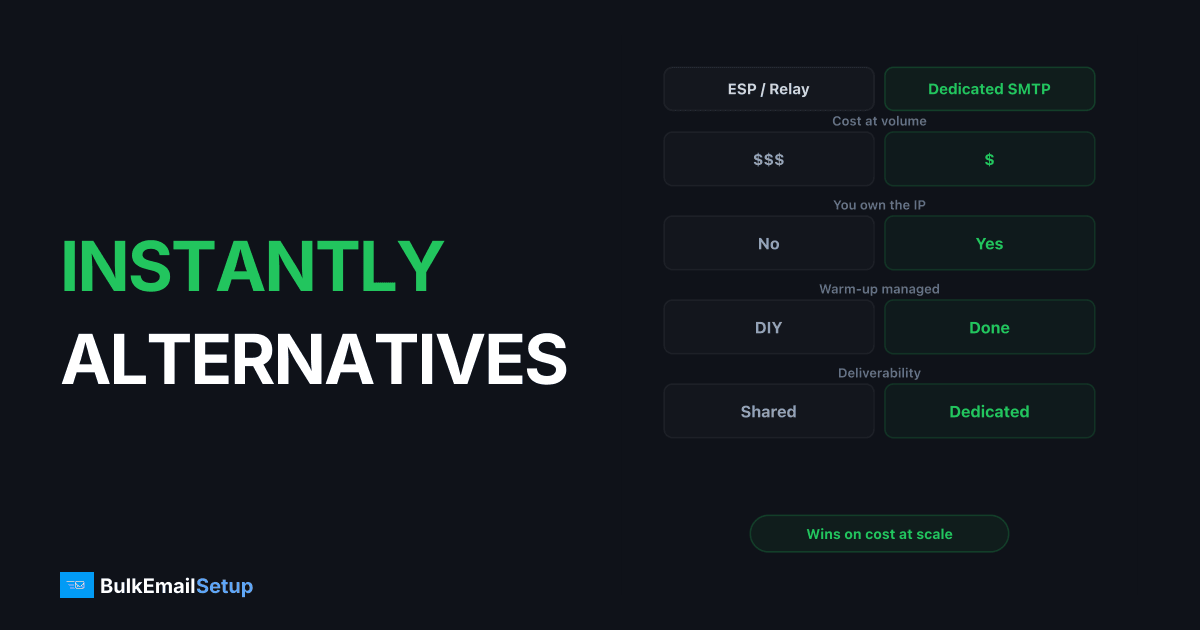
If you're leaving Instantly.ai in 2026, the closest drop-in replacements are Smartlead (unlimited inboxes, ~$39-94/mo), Lemlist (multichannel, $69/seat), and QuickMail ($49/mo), all sequencers that send through inboxes you connect. The bigger upgrade is to stop renting shared sending infrastructure entirely: pair any of those tools with a dedicated SMTP server so your IP reputation is yours, not pooled with thousands of other cold senders. Instantly bundles the sequencer and the inboxes, which is convenient until a shared-pool reputation problem tanks your deliverability and you can't fix it. The right pick depends on whether you want convenience or control.
I've run cold email through Instantly and most of the tools on this list, and I've migrated several teams off it when their reply rates quietly collapsed. Here's how the alternatives actually compare once you stop reading feature pages and start counting what they cost and what they hide.
Why people leave Instantly.ai
Instantly is a slick product. The complaints I hear (and have hit myself) cluster around three things.
First, you don't own the infrastructure. Instantly sells you inboxes on domains and IPs it controls. When one of those shared pools gets flagged, your sends suffer and there's nothing in the dashboard to diagnose or fix. You're a tenant.
Second, price scaling. The entry tier is cheap, but the higher plans charge by active leads and uploaded contacts, not just inboxes. A campaign that grows from 5K to 50K leads can quadruple your bill without sending materially more email.
Third, account risk. Cold email platforms get pressure from inbox providers, and suspensions happen. When your sending account is frozen mid-quarter, every connected inbox goes dark at once. If you owned the SMTP layer, a sequencer ban wouldn't stop your mail.
The 9 Instantly alternatives compared
| Tool | ~2026 price | Inbox model | Who owns reputation | Best for |
|---|---|---|---|---|
| Smartlead | ~$39-94/mo | Unlimited inboxes | Shared (or your SMTP) | Closest direct swap, agencies |
| Lemlist | ~$69/seat/mo | Connect your own | Shared / yours | Multichannel (email + LinkedIn) |
| QuickMail | ~$49-89/mo | Connect your own | Yours | Reply-focused, deliverability nerds |
| Saleshandy | ~$36-99/mo | Connect your own | Shared / yours | Budget teams, simple sequences |
| Woodpecker | ~$29-60/mo | Connect your own | Yours | Agencies, small B2B teams |
| Reply.io | ~$59/seat/mo | Connect your own | Shared / yours | Multichannel sales cadences |
| GMass | ~$25/mo | Gmail-based | Gmail's | Solo senders living in Gmail |
| Amazon SES + sequencer | ~$10 per 100K + tool | Your IP | You | Engineers, cost-driven volume |
| Dedicated SMTP (BulkEmailSetup) + sequencer | Flat ~$50-150/mo + tool | Your warmed IP | Managed for you | Volume senders who want their own reputation |
Prices are 2026 ballparks, check current pricing before committing.
1. Smartlead, the closest direct swap
Smartlead is what most people move to when they leave Instantly. Same workflow: connect inboxes, build sequences, rotate sends across mailboxes, track replies. The difference that matters is it doesn't meter you on active leads the way Instantly's upper tiers do, so it scales cheaper.
It also lets you connect your own SMTP, which is the door to owning your reputation. Plans run roughly $39-94/month in 2026. Best single pick if you want minimal relearning.
2. Lemlist, multichannel outreach
Lemlist adds LinkedIn steps and call tasks alongside email, so a sequence can mix channels. The personalization (images, dynamic landing pages) is genuinely good for low-volume, high-touch outreach.
Around $69 per seat per month, it's not cheap at scale, and the email-sending side is less of a deliverability tool than QuickMail. Right fit for sales teams running multichannel cadences, wrong fit for pure high-volume email.
3. QuickMail, built for reply rates
QuickMail's whole design centers on getting replies and protecting deliverability. Its inbox rotation and auto-throttling are sane, and its analytics actually help you diagnose why a campaign stalled. Around $49-89/month.
Smaller ecosystem than Smartlead, fewer integrations. But if deliverability is the thing keeping you up at night, this is the sequencer to test.
4. Saleshandy, budget-friendly sequences
Saleshandy covers the basics (sequences, inbox rotation, a built-in lead database) at the low end of the price range, roughly $36-99/month. Throughput and analytics are lighter than Smartlead's.
Solid for a small team that wants to send sequences without paying for features they won't use.
5. Woodpecker, agency-friendly
Woodpecker has been around longer than most of this list and leans toward agencies managing multiple client domains. It connects your own inboxes, so reputation stays yours. Around $29-60/month depending on inbox count.
Less flashy than the newer tools, but stable and clear about how it sends.
6. Reply.io, sales cadences at scale
Reply.io is a broader sales-engagement platform: email, calls, LinkedIn, and a CRM-style pipeline. About $59 per seat per month. If your team needs cadence management beyond just email, it earns the price.
For people who only want cold email, it's more tool than you need.
7. GMass, the Gmail-native option
GMass lives inside Gmail. You write campaigns from your inbox, it sends through your Google account. Around $25/month and dead simple for a solo operator.
The ceiling is low: you're bound by Gmail's daily send limits and Google's reputation, not your own. Fine for a few hundred a day, not for real volume.
8. Amazon SES plus a sequencer
Here's where the model changes. Instead of renting shared inboxes, connect Amazon SES (your own sending) to a sequencer like Smartlead or QuickMail. SES costs about $10 per 100K emails, the cheapest raw send rate anywhere.
The catch: SES is strict about cold email and will pause you fast if complaints rise, plus you own all the warm-up and monitoring. I broke down the trade-offs in Amazon SES vs Dedicated SMTP Server and listed cheaper-volume options in Amazon SES alternatives. Great for engineers who want cost and control and accept the operational load.
9. Managed dedicated SMTP plus a sequencer
This is the setup I push teams toward once they're sending real volume. You keep the sequencer you like (Smartlead, QuickMail, whatever), but the actual mail goes out through a dedicated SMTP server with a warmed IP that's yours alone. A provider handles warm-up, blacklist monitoring, and DNS, so a sequencer suspension never touches your sending layer.
Cost is a flat monthly fee, typically $50-150/month, on top of whatever the sequencer charges. At 100K, 500K, or 1M sends the SMTP cost doesn't move. The honest trade-off versus SES or shared pools is a higher floor: at low volume the cheap options win. See is managed SMTP worth it for where the crossover lands.
What does cold email actually cost at volume?
The sequencer price is only half the bill. The other half is the sending infrastructure, and that's where the cost curves diverge.
| Monthly sends | Instantly (bundled) | Smartlead + shared inboxes | SES + sequencer | Dedicated SMTP + sequencer |
|---|---|---|---|---|
| 10K | ~$37 | ~$39 + inbox cost | ~$1 + $39 | ~$50-100 + $39 (overkill) |
| 50K | ~$97 | ~$94 + inbox cost | ~$5 + $39 | ~$50-150 + $39 |
| 200K | ~$297+ | inbox cost climbs | ~$20 + $39 | ~$50-150 flat + $39 |
| 1M | ~$500+ | inbox cost climbs | ~$100 + $39 | ~$100-200 flat + $39 |
Bundled cold-email pricing punishes volume because you pay per lead and per inbox. Flat-fee dedicated infrastructure rewards it. SES stays cheap per email but you carry the deliverability work yourself. For the full math on a million sends, see cost to send 1 million emails per month and cheapest way to send 100K emails per month.
How to choose
- Solo, low volume, living in Gmail: GMass.
- Want the closest swap with the least relearning: Smartlead.
- Multichannel sales cadences (email + LinkedIn): Lemlist or Reply.io.
- Deliverability is your main worry, moderate volume: QuickMail.
- Tight budget, simple sequences: Saleshandy or Woodpecker.
- Engineering team, cost-obsessed, willing to own warm-up: SES plus a sequencer.
- Real volume and you want your own reputation without the 2 a.m. delisting work: a managed dedicated SMTP server behind your sequencer.
The pattern: the more you send and the more deliverability matters, the more you want to own the SMTP layer instead of renting shared pools.
The infrastructure decision that actually matters
Picking a sequencer is the easy part. The decision that determines whether your cold email lands in 2026 is who controls the IP and domain reputation.
Shared pools (what Instantly and the bundled tools sell) mean your inbox placement rides on strangers' behavior. One spammy tenant and your reply rate drops with no warning and no fix. A dedicated IP means the reputation is built only by your sending, which is why dedicated vs shared IP is the first thing I check on a struggling account.
If you go dedicated, two things are non-negotiable: warm the IP over 2-4 weeks before real campaigns (see how long IP warm-up takes), and send cold mail from a subdomain, never your root domain, so a burned reputation doesn't poison your main email (see subdomain vs root domain for sending). Keep an eye on bounce rates too; how to reduce email bounce rate covers the list-hygiene side that no sequencer fixes for you.
Two mistakes I keep seeing
Buying more inboxes to paper over a reputation problem. When sends drop, people add 20 more mailboxes instead of asking why placement fell. More inboxes on the same bad shared pool just spread the damage. Fix the infrastructure, not the inbox count.
Sending cold email from the same domain as everything else. One aggressive campaign can blacklist a domain that also carries your invoices and password resets. Separate cold outreach onto its own subdomain and ideally its own IP. This is the same logic behind keeping streams on infrastructure you control rather than a shared pool.
Whatever platform you land on, cold outreach still has to satisfy the receiving networks. Google's bulk sender guidelines apply from 5,000 messages a day to Gmail, and the 0.3% complaint ceiling is measured against your sending domain, not the tool.
How BulkEmailSetup helps
BulkEmailSetup provides dedicated SMTP servers with managed IP warm-up, blacklist monitoring, and full DNS setup, your own sending reputation, none of the shared-pool roulette that bundled cold email tools force on you. Connect it to whichever sequencer you prefer and a sequencer suspension never stops your mail. At real outreach volume, a flat monthly fee beats per-lead pricing by a wide margin. See pricing for current plans.
Frequently asked questions
What is the best Instantly alternative for cold email in 2026?
Smartlead is the closest feature-for-feature replacement, with unlimited inboxes on most tiers and a per-seat price instead of per-email. For senders who want to own their sending reputation rather than rent shared infrastructure, pairing a sequencer like Smartlead with a dedicated SMTP server gives better long-term deliverability.
Is Smartlead cheaper than Instantly?
At low inbox counts they are close, both start around $30-40/month in 2026. Smartlead pulls ahead as you scale because it doesn't charge per active lead the way Instantly's higher tiers do. Check current pricing, both change tiers often.
Can I use my own SMTP server with cold email tools?
Yes. Smartlead, Lemlist, QuickMail, and most sequencers let you connect any SMTP/IMAP account. Connecting a dedicated SMTP server means you control IP reputation and warm-up instead of relying on the tool's shared sending pool, which is the main reason serious senders move off all-in-one platforms.
Why do people leave Instantly.ai?
The common reasons are price jumps when lead volume grows, account suspensions that lock up sending mid-campaign, and limited control over the underlying IPs. When deliverability drops you can't see or fix the root cause because the infrastructure isn't yours.
Do I still need email warm-up with a dedicated SMTP server?
Yes. Any new IP or domain needs a 2-4 week warm-up regardless of which sequencer sends the mail. The difference is a managed dedicated SMTP provider runs the warm-up and blacklist monitoring for you, so you're not babysitting it inside a cold email tool.


