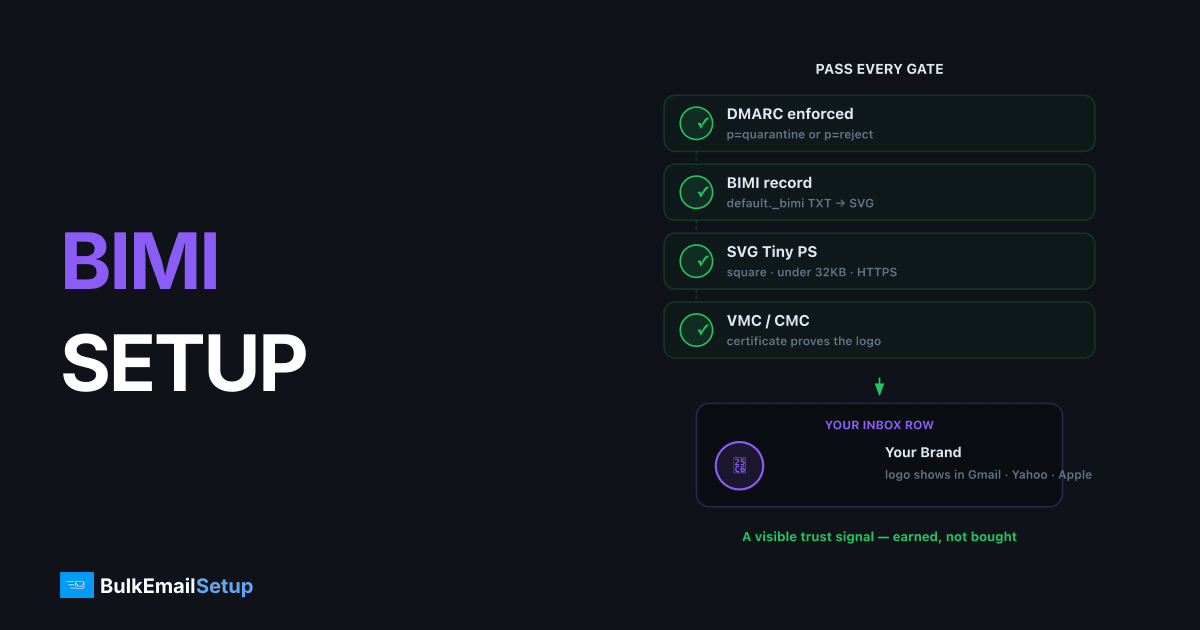
BIMI (Brand Indicators for Message Identification) puts your logo next to your messages in Gmail, Yahoo, and Apple Mail by publishing a DNS TXT record that points to an SVG of your logo. The entry fee is authentication: your domain must enforce DMARC at p=quarantine or p=reject, and Gmail and Apple additionally require a Verified Mark Certificate (VMC) or Common Mark Certificate (CMC) proving you own the logo. Done right, it's a visible trust signal and a measurable open-rate nudge; done without the prerequisites, the record is simply ignored.
How BIMI works
When a supporting mailbox provider receives your message, it checks, in order:
- DMARC passes for the message, and the domain's policy is at enforcement.
- A BIMI record exists at
default._bimi.yourdomain.com. - The SVG at the record's URL meets the SVG Tiny PS profile.
- (Gmail, Apple) The certificate at
a=validates the logo. - The sender's reputation is good enough, providers reserve the right to not display.
Fail any step and the inbox just shows the default initial/avatar. Nothing breaks; you just don't get the logo.
Prerequisite: DMARC at enforcement
BIMI is the reward for finishing your DMARC rollout:
- Policy
p=quarantineorp=rejecton the organizational domain - No
pct=below 100 - Subdomain policy (
sp=) notnone
If you're still at p=none, work through the DMARC ramp from none to reject first, that's usually 8-12 weeks of the total BIMI timeline. The underlying SPF and DKIM setup must be aligned and passing, since DMARC enforcement against your own mail is fatal to more than just BIMI.
Step 1, Prepare the logo (SVG Tiny PS)
The logo must follow the SVG Tiny Portable/Secure profile, a restricted SVG Tiny 1.2:
| Requirement | Detail |
|---|---|
| Base profile | baseProfile="tiny-ps" and version="1.2" on the svg element |
title element | Required; set it to your brand name |
| Square aspect | 1:1 viewBox; logo centered, solid background color recommended |
| Forbidden | Scripts, animations, external references/links, x=/y= on the svg root |
| Size | Keep under 32 KB |
| Hosting | HTTPS URL, publicly fetchable, no redirects |
Most design-tool SVG exports fail validation on the first try. Run the file through the BIMI Group's SVG conversion guidance or a validator before publishing.
Step 2, Decide on a certificate
| Certificate | VMC | CMC | No certificate |
|---|---|---|---|
| Issuers | DigiCert, Entrust | DigiCert, Entrust | , |
| Requires | Registered trademark of the logo | Logo in prior use 12+ months | , |
| Cost | ~$1,000-1,700/yr | Lower than VMC | Free |
| Gmail | Logo + blue verified checkmark | Logo, no checkmark | No logo |
| Apple Mail | Logo | Not supported | No logo |
| Yahoo | Logo | Logo | Logo possible on good reputation |
If Gmail is the audience that matters, it usually is, budget for a VMC or CMC. The certificate is a PEM file you host alongside the SVG.
Step 3, Publish the DNS record
The record lives at the default selector under _bimi:
default._bimi.yourdomain.com. TXT "v=BIMI1; l=https://yourdomain.com/brand/logo.svg; a=https://yourdomain.com/brand/vmc.pem"
Without a certificate (Yahoo-only play):
default._bimi.yourdomain.com. TXT "v=BIMI1; l=https://yourdomain.com/brand/logo.svg;"
Tags: v=BIMI1 (required), l= (HTTPS URL of the SVG), a= (HTTPS URL of the VMC/CMC PEM, optional). Selectors other than default exist for running different logos per mail stream, signaled via a BIMI-Selector header, most senders never need this.
Step 4, Verify
# Record published?
dig +short TXT default._bimi.yourdomain.com

# SVG reachable, correct content type?
curl -sI https://yourdomain.com/brand/logo.svg | grep -i content-type

# DMARC at enforcement?
dig +short TXT _dmarc.yourdomain.com
Then run the domain through the BIMI Group's inspector (bimigroup.org) and send a live test to Gmail and Yahoo mailboxes. Expect the logo to appear within a few days at Yahoo and after certificate validation at Gmail, not instantly.
Why your logo still might not show
- Reputation isn't there yet. Providers display BIMI at their discretion. New domains and unwarmed IPs often wait weeks of consistent, low-complaint volume before logos render.
- The SVG fails the profile. A stray
<script>element or external font reference silently disqualifies the file. - A forwarded or list-modified message failed DMARC. No DMARC pass on the individual message, no logo on it.
- Certificate/logo mismatch. The SVG served at
l=must be byte-identical to the one embedded in the VMC.
How BulkEmailSetup helps
We get domains BIMI-ready end to end: SPF, DKIM, and DMARC driven to p=reject on your dedicated SMTP server, the BIMI record and SVG published correctly, and guidance through the VMC process. See pricing for managed deliverability plans.
Frequently asked questions
What is a BIMI record?
A TXT record at default._bimi.yourdomain.com pointing to your logo as an SVG file, optionally with a verification certificate. Supporting mailbox providers display the logo next to authenticated mail from your domain.
Does BIMI require DMARC?
Yes. Your domain needs DMARC at enforcement, p=quarantine or p=reject, with full coverage (no pct below 100, and subdomain policy not set to none). p=none disqualifies you everywhere.
Do I need a VMC for BIMI?
For Gmail and Apple Mail, yes, a Verified Mark Certificate (registered trademark) or, for Gmail, a cheaper Common Mark Certificate. Yahoo can display BIMI logos without a certificate if your sending reputation is good.
What format does the BIMI logo need?
SVG Tiny PS (a locked-down SVG Tiny 1.2 profile): square aspect ratio, no scripts or external references, title element set, served over HTTPS. Keep it under 32 KB.
How much does a VMC cost?
Roughly $1,000-1,700 per year from DigiCert or Entrust, plus a registered trademark for the logo. Common Mark Certificates are cheaper and skip the trademark requirement but show no blue verified checkmark in Gmail.