
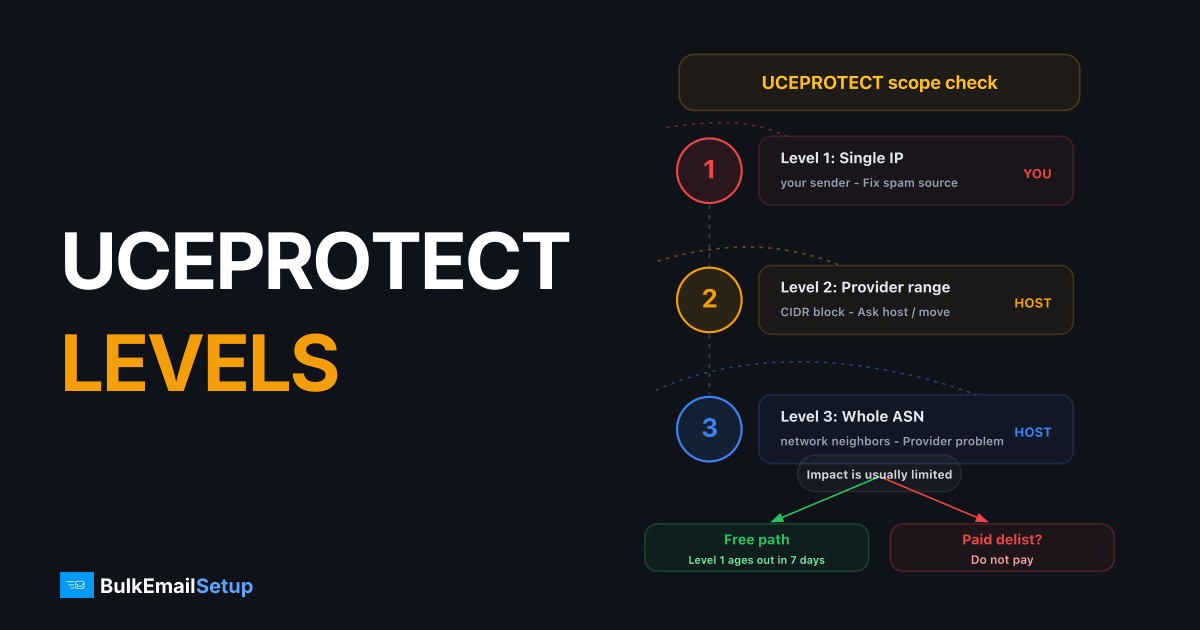
UCEPROTECT is a German DNSBL that lists single IPs (Level 1), provider allocations (Level 2), and entire ASNs (Level 3), and it is best known for charging a fee for "express delisting" while free removal means waiting out an automatic expiry. The short version of this guide: do not pay. Level 1 expires free in 7 days once the spam stops; Levels 2 and 3 are listings of your hosting provider's network, which your payment cannot fix; and few mailbox providers treat UCEPROTECT as a blocking signal in the first place.
The three levels
| Level | What is listed | Why | Your fault? |
|---|---|---|---|
| 1 | A single IP | That IP hit UCEPROTECT spam traps | Yes, investigate |
| 2 | The provider's allocation (CIDR range) | Too many Level-1 IPs in the range | No |
| 3 | The provider's entire ASN | Extreme Level-1 density across the ASN | No |
Check which level you are on:
# Level 1 (IP 203.0.113.10, octets reversed)
dig +short 10.113.0.203.dnsbl-1.uceprotect.net

# Level 2 and 3
dig +short 10.113.0.203.dnsbl-2.uceprotect.net
dig +short 10.113.0.203.dnsbl-3.uceprotect.net
# 127.0.0.2 = listed; NXDOMAIN = clean
Or use the web lookup at lookup.uceprotect.net. Large budget hosts and cloud providers spend much of their lives on Level 3, being there tells you about your host's abuse handling, not about your sending.
The paid "express delisting" controversy
UCEPROTECT's removal model is what sets it apart from Spamhaus and Barracuda, which delist for free:
- Free path: Level 1 entries expire automatically 7 days after the last trap hit. No form, no review.
- Paid path: whitelisted.org, affiliated with UCEPROTECT, sells immediate removal for a fee (historically ~25-90 CHF depending on scope).
Why paying is the wrong move:
- It fixes nothing. If your spam source is still active, you re-list immediately; if it isn't, you delist free in 7 days anyway. You are paying to skip a wait, repeatedly.
- Levels 2/3 are not yours to fix. Your fee does not change your provider's abuse statistics. The range stays dirty and the listing pattern continues.
- The model rewards itself. A blocklist that profits from delisting fees has an incentive structure the rest of the industry, and most postmasters, treat with skepticism. Pay-to-delist is the main reason many operators refuse to use UCEPROTECT as a blocking list at all.
- The impact rarely justifies it. Gmail, Microsoft, and Yahoo do not block on UCEPROTECT. The practical effect is limited to a minority of self-hosted mail servers, and even fewer apply Level 2/3 for hard rejection because the false-positive rate is enormous.
What to actually do, by level
Level 1: treat it as a real signal
Trap hits are trap hits, whoever runs the traps. Audit for the usual causes, an unverified list, a compromised form or account, a cold IP burst, the same checklist as in our Spamhaus delisting guide. Fix the cause, keep sending clean mail, and the entry ages out free in 7 days.
Level 2/3: it's your host, not you
- Confirm your own IP is not also Level-1 listed (if it is, see above).
- Email your host's abuse desk and ask about the listing; persistent Level 3 status means they tolerate spammers.
- If their ranges live on Level 3 permanently and you genuinely see B2B rejections citing UCEPROTECT, the durable fix is moving to a provider with clean IP space, not paying a recurring toll on someone else's mess.
If a recipient is blocking you on it
The rejection will name the list. For one-off B2B partners, ask their IT to whitelist your IP or relax Level 2/3 blocking, most admins do once they see the listing reason is "your host's neighbors."
Keep it in perspective
Prioritize the lists that move real volume: Spamhaus and Barracuda first, SpamCop next, UCEPROTECT last. Monitor it, understand it, but spend your effort on list hygiene, warm-up, and the architecture that survives any single listing, covered in how to send without getting blacklisted.
How BulkEmailSetup helps
Our servers run on IP space we vet against Level 2/3 problems before deployment, and we monitor all major blocklists so you know what is listed, what matters, and what to ignore. If you want infrastructure where blocklist drama is our problem, see pricing.
Frequently asked questions
Should I pay UCEPROTECT for express delisting?
No. Level 1 listings auto-expire free after 7 days of no spam, and Level 2/3 listings are about your provider's network, not you, paying doesn't fix the cause and the listing returns. Few major mailbox providers use UCEPROTECT for outright blocking anyway.
What does a UCEPROTECT Level 3 listing mean?
Your hosting provider's entire ASN (all their IP ranges) exceeded UCEPROTECT's spam thresholds. It says nothing about your IP specifically, you are listed because of your network neighbors.
How do I get off UCEPROTECT Level 1?
Stop the spam source and wait. Level 1 entries expire automatically 7 days after the last detected abuse, at no cost. Paying the express fee only skips the wait, and only until the next incident.
Does a UCEPROTECT listing actually hurt deliverability?
Usually less than people fear. Gmail, Microsoft, and Yahoo do not block on UCEPROTECT; impact is limited to the minority of mail servers that choose to use it, and very few use Level 3 for hard blocking because of its collateral damage.
Why is my brand-new clean IP on UCEPROTECT?
Almost certainly a Level 2 or Level 3 listing of your provider's range or ASN. Check the level at lookup.uceprotect.net, if it is 2 or 3, there is nothing wrong with your IP and nothing you can do except choose a cleaner host.


